HIPPOLYTUS OF ROME
Hippolytus of Rome (c. 170-236 AD). The Refutation of All Heresies, also know as: Elenchus or Elenchos or Refutatio Omnium Haeresium or Origen’s Philosoph(o)umena, Book 6, Chapters 1 & 14 (c. 230-235 AD)
“And they congratulate themselves on their intercourse with strange women, asserting that this is perfect Agape”:
http://books.google.com/books?id=d1qZhZz5RuEC&pg=PA232&lpg=PA232&dq=%22dreams+illusion+and+other+realities%22+perfect+agape&source=web&ots=xv-FQDo8xa&sig=Dqg8rEhmP2Fu_vF0BZSgYjMb414, Dreams, Illusion, and Other Realities – Google Books Result, by Wendy Doniger O'Flaherty, 1986, p. 232:
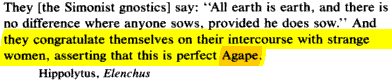
(This citing is also at my EPIPHANIUS, PANARION page):
Agape and Eros, Anders Nygren, Part II, 1938: Compete Authorized Translation by Philip S. Watson, 1953, p. 309 (entire page), “The Eros Type in Gnosticism | A Gnostic Love-Feast”:
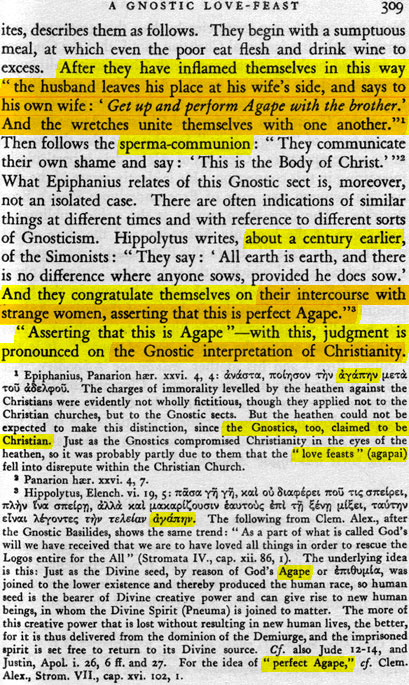
http://www.earlychristianwritings.com/text/hippolytus6.html, HIPPOLYTUS OF ROME: THE REFUTATION OF ALL HERESIES: BOOK VI., “CHAP. 1.”:
CHAP. 1. --THE OPHITES THE PROGENITORS OF SUBSEQUENT HERESIES.
Whatever opinions, then, were entertainedby those who derived the first principles (of their doctrine) from the serpent, and in process of time deliberately brought forward into public notice their tenets, we have explained in the book preceding this, (and) which is the fifth of the Refutation of Heresies. But now also I shall not be silent as regards the opinions of (heresiarchs) who follow these (Ophites in succession); nay, not one (speculation) will I leave unrefuted, if it is possible to remember all (their tenets), and the secret orgies of these (heretics) which one may fairly style orgies,--for they who propagate such audacious opinions are not far distant from the anger (of God),--that I may avail myself of the assistance of etymology.
“CHAP. XIV.(14)”:
CHAP. XIV.--SIMON INTERPRETS HIS SYSTEM BY THE MYTHOLOGICAL REPRESENTATION OF HELEN OF TROY; GIVES AN ACCOUNT OF HIMSELF IN CONNECTION WITH THE TROJAN HEROINE; IMMORALITY OF HIS FOLLOWERS; SIMON'S VIEW OF CHRIST; THE SIMONISTS' APOLOGY FOR THEIR VICE.
…
But, again, those who become followers of this impostor--I mean Simon the sorcerer--indulge in similar practices, and irrationally allege the necessity of promiscuous intercourse. They express themselves in the manner following: "All earth is earth, and there is no difference where any one sores, provided he does sow." But even they congratulate themselves on account of this indiscriminate intercourse, asserting that this is perfect love, and employing the expressions, "holy of holies," and "sanctify one another." For (they would have us believe) that they are not overcome by the supposed vice, for that they have been redeemed. "And (Jesus), by having redeemed Helen in this way," (Simon says,) "has afforded salvation to men through his own peculiar intelligence. For inasmuch as the angels, by reason of their lust for pre-eminence, improperly managed the world, (Jesus Christ) being transformed, and being assimilated to the rulers and powers and angels, came for the restoration (of things). And so (it was that Jesus) appeared as man, when in reality he was not a man. And (so it was) that likewise he suffered--though not actually undergoing suffering, but appearing to the Jews to do so --in Judea as 'Son,' and in Samaria as 'Father,' and among the rest of the Gentiles as 'Holy Spirit.' "And (Simon alleges) that Jesus tolerated being styled by whichever name (of the three just mentioned) men might wish to call him. "And that the prophets, deriving their inspiration from the world-making angels, uttered predictions (concerning him)." Wherefore, (Simon said,) that towards these (prophets) those felt no concern up to the present, who believe on Simon and Helen, and that they do whatsoever they please, as persons free; for they allege that they are saved by grace. For that there is no reason for punishment, even though one shall act wickedly; for such a one is not wicked by nature, but by enactment. "For the angels who created the world made," he says, "whatever enactments they pleased," thinking by such (legislative) words to enslave those who listened to them. But, again, they speak of a dissolution of the world, for the redemption of his own particular adherents.