FELLOWSHIP / COMMUNION / KOINONIA
Greek: κοιν… ; Latin: soci…
E.g., “And they continued stedfastly in the apostles’ doctrine and fellowship ….” –Acts 2:42
English:
The Oxford English Dictionary, 1933, “Fellowship”:
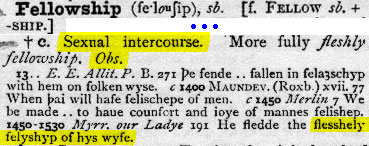
“Obs.” means obsolete. We all know why it’s obsolete today. (Note that words in the old days were arbitrarily spelled like they sounded.)
The Oxford English Dictionary, 1989, “fellowship”:
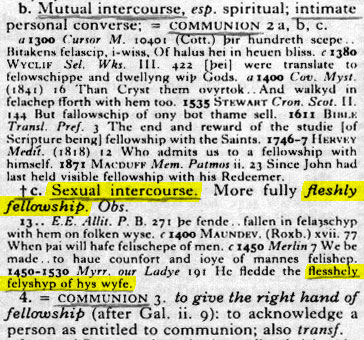
The International Dictionary of Religion, Richard Kennedy, 1984, p. 11:

The English Dictionarie: or, An Interpreter of hard English Words (The First Part of), H. C. Gent (Henry Cockeram), 1623:

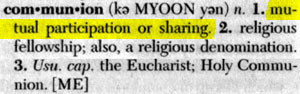
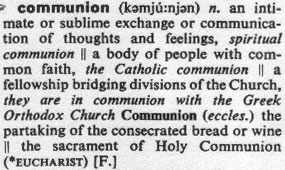
Webster’s New World Dictionary and Thesaurus, 1996, p. 119, “communion”:

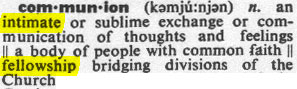
Funk & Wagnalls Standard Dictionary, 1993, pp. 142-143, “communion”:
The International Encyclopaedic Dictionary, 1901, p. 1005, “com-mun-i-on, com-mun-yone”:
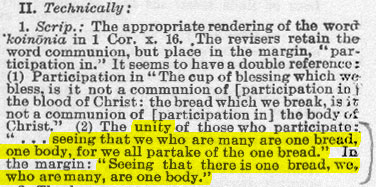
Now, this isn’t necessarily sexual, but I can definitely see how open / free sex could make those “who are many” into like “one body” more literally than today’s sacrament of marriage which pretty much mandates keeping bodies apart.
A Critical Pronouncing Dictionary and Expositor of the English Language, John Walker, 1791:
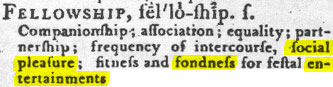
Translated: “Companionship; association; equality; partnership; frequency of intercourse, social pleasure; fitness and fondness for festal entertainments.”
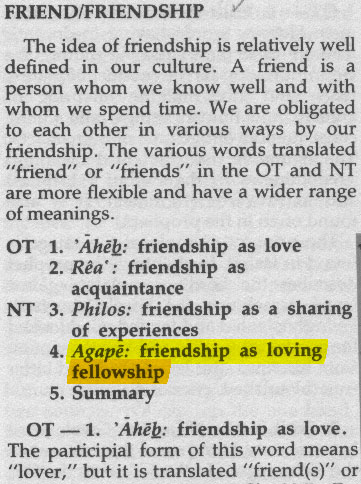
Expository Dictionary of Bible Words, Richards, Zondervan, 1991, p. 297:
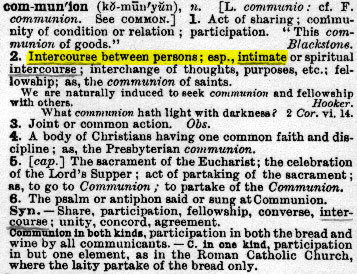
Webster’s New International Dictionary of the English Language, 1933, p. 452, “communion”:
P. 802, “fellowship”:
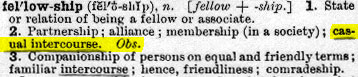
“Obs.” means “Obsolete.”
P. 1125, “intercourse”:
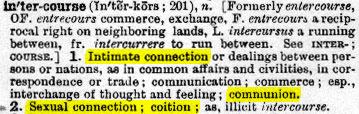
Webster’s New International Dictionary of the English Language, 1923, p. 452, “Communion”:
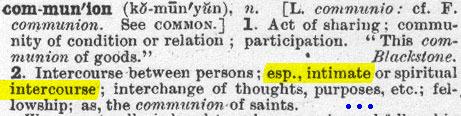
Webster’s New International Dictionary of the English Language, 1948, p. 1301, “intimate”:
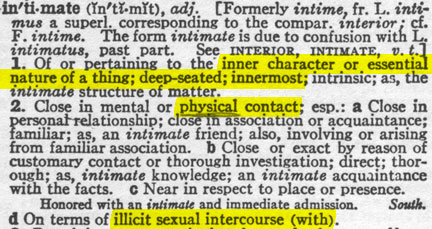
Merriam Webster’s Collegiate Dictionary, 1997, p. 233, “communion”:
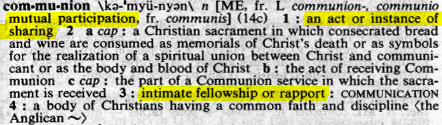
What would “mutual intimate sharing” being?
The Merriam-Webster Dictionary: Home & Office Edition, 1998, p. 106, “communion”:
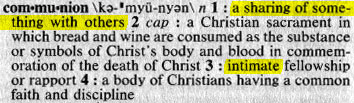
“Something” like the sex orgies they were vastly accused of.
Webster’s Universal Dictionary of the English Language (unabridged), 1909, p. 630, “fellowship”:

An American Dictionary of the English Language, Noah Webster, 1856, p. 445, “FELLOWSHIP”:
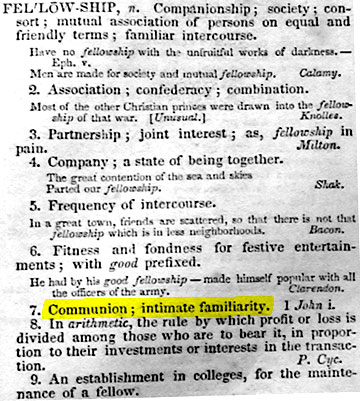
The New Home and Office Webster Dictionary, 1933, p. 339:

The New Roget’s Thesaurus in Dictionary Form, 1978, p. 76, “communion”:

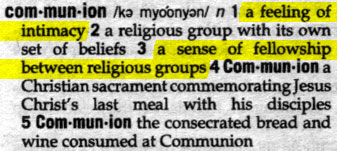
Microsoft Encarta Dictionary (paperback), 2002, p. 175, “communion”:
Larousse Illustrated International Encyclopedia and Dictionary, 1972, Part 2: Dictionary, p. 164:
Longmans English Larousse, 1968, p. 235:
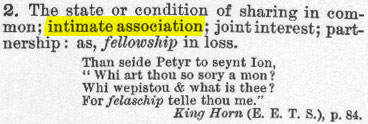
The Century Dictionary and Cyclopedia, 1897, p. 2175, “Fellowship”:
A Handbook of Theological Terms, Harvey, 1964, p. 13, “Agape and Eros”:

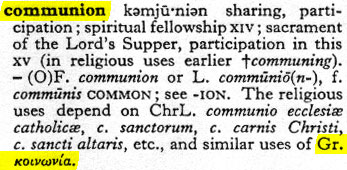
The Oxford Dictionary of English Etymology, Onions, 1966, p. 196, “communion”:
A Supplement to the Oxford English Dictionary, Vol. 2, 1976, p. 542:

http://books.google.com/books?id=sf5DeBh6Gz0C&pg=PP1&dq=%22Clement+of+Alexandria%22+By+Eric+Francis+Osborn&sig=ZxGTnt6WDPAzJRoPmD6pMSirZmc#PPA220,M1, Clement of Alexandria (c. 150-215 AD) – Google Books Result, by Eric Francis Osborn, 2005, p. 220, “Church and heresy | Heresy and morals”:

Greek (κοιν…):
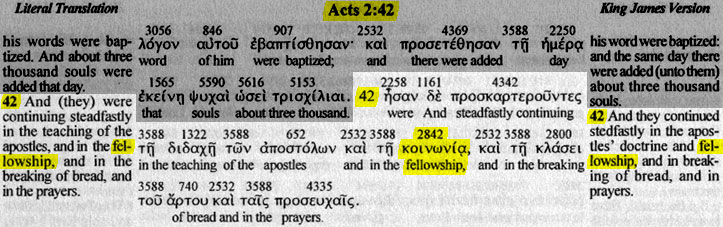
Interlinear Greek-English New Testament, Green, Baker Books, 1996, p. 371, Acts 2:42:
ΝΕΟΝ ΟΡΘΟΓΡΑΦΙΚΟΝ ΕΡΜΗΝΕΥΤΙΚΟΝ ΛΕΞΙΚΟΝ (NEW ORTHOGRAPHIC EXPLANATORY DICTIONARY) (this is a monolingual Greek dictionary where both the base word and its definition are in Greek, and is an abridgment of a large 9 volume dictionary), Δ. ΔΗΜΗΤΡΑΚΟΥ, 1969, pp.800-801, “κοινωνία”:
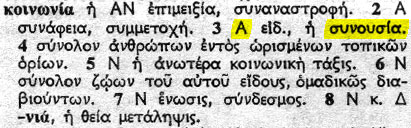
“Α” means it’s from ancient Greek only, not modern Greek, and before Byzantine / Medieval Greek (before 330 A.D.).
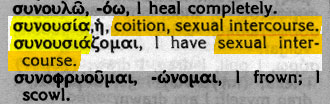
Divry’s English-Greek and Greek-English Desk Dictionary, 1996, p. 695 (Greek-English), “συνουσία (sunousia or synousia)”:
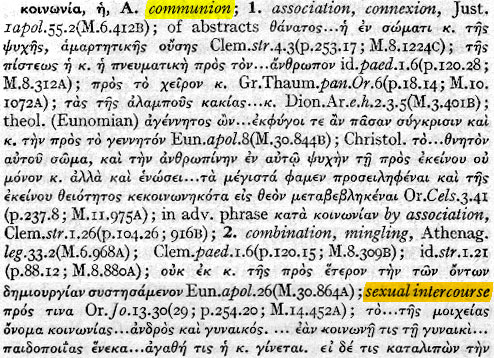
A Patristic Greek Lexicon, Lampe, Oxford, 1961, pp. 762-763, “κοινωνία”:
(“Patristic”: “Of or relating to the fathers of the early Christian church or their writings.”)
A Greek-English Lexicon (unabridged), Liddell & Scott, Oxford, 1871, p. 861, “κοινόω | κοίνωμα | κοινωνέω (Strong # 2841) | κοινωνία (Strong # 2842)”:
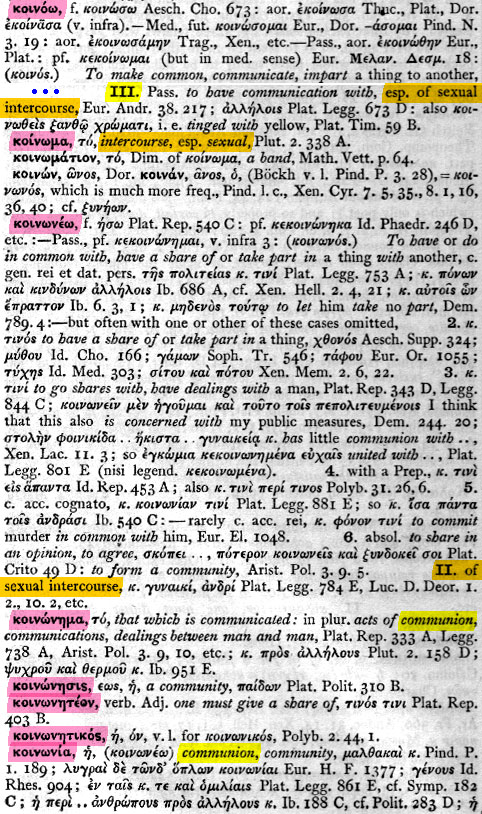
(Next column):
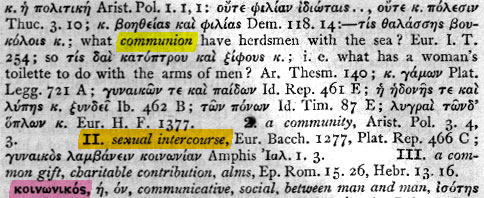
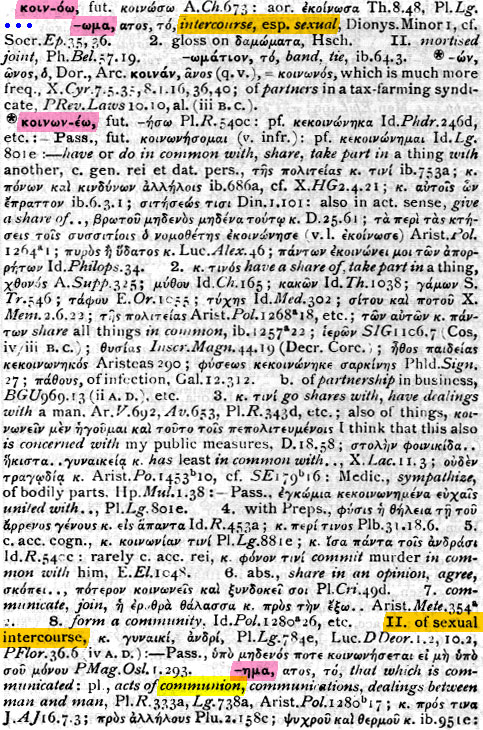
A Greek-English Lexicon with a Revised Supplement (unabridged), Liddell & Scott, Oxford, 1996 (first edition 1843), p. 969, “κοιν-όω -ωμα | κοινων-έω (Strong # 2841)”:
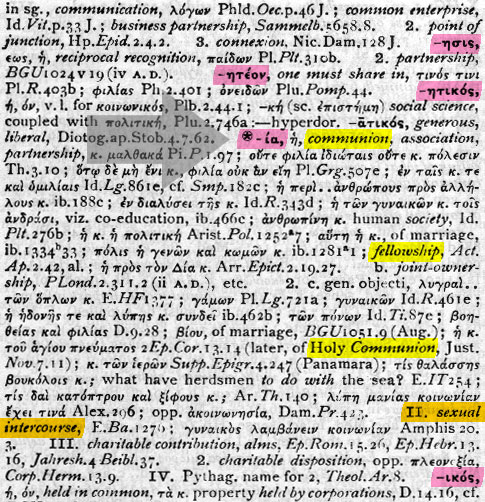
(Continued) p. 970, “κοινων-ία (Strong # 2842)”:
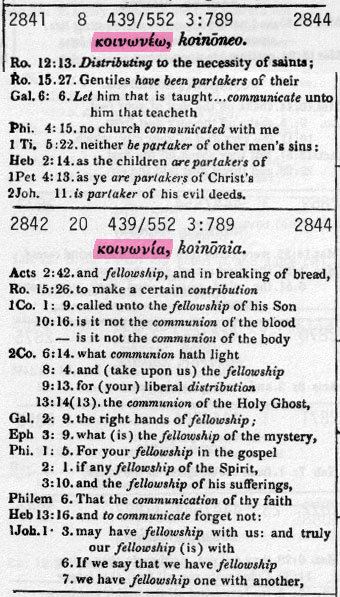
Here’s the occurrences in the New Testament for the King James Version:
The Word Study Concordance (KJV), Wigram / Winter, Tyndale House Publishers, 1978, pp. 426-427, “2841 | 2842”:
For example (KJV):
Romans 15:27 (for 2841):
“It hath pleased them verily; and their debtors they are. For if the Gentiles have been made partakers of their spiritual things, their duty is also to minister unto them in carnal (fleshly) things.”
Acts 2:42 (for 2842):
“And they continued stedfastly in the apostles’ doctrine and fellowship, and in breaking of bread, and in prayers.”
2 Corinthians 9:13 (“):
“Whiles by the experiment of this ministration they glorify God for your professed subjection unto the gospel of Christ, and for your liberal distribution unto them, and unto all men;”
Ephesians 3:9-12 (“):
“ 9And to make all men see what is the fellowship of the mystery, which from the beginning of the world hath been hid in God, who created all things by Jesus Christ 10to the intent that now unto the principalities and powers in heavenly places might be known by the church the manifold wisdom of God, 11according to the eternal purpose which he purposed in Christ Jesus our Lord 12in whom we have boldness and access with confidence by the faith of him.”
The Oxford Paperback Greek Dictionary, Watts, 1997, p. 253 (English-Greek), “communion”:

Expository Dictionary of Bible Words, Richards, Zondervan, 1991, p. 276, “FELLOWSHIP”:
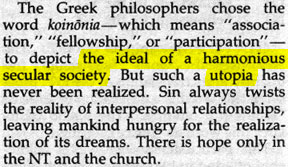
The Complete Word Study Dictionary of the New Testament, Zodhiates, 1993, p. 872:
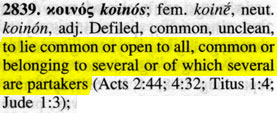
Composition of Scientific Words: A manual of methods and a lexicon of materials for the practice of logotechnics, Brown, 1956, p. 217, “coitus”:

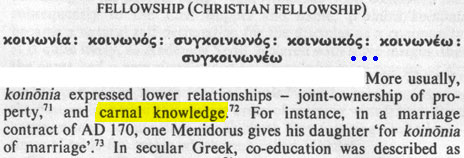
Christian Words, Nigel Turner, 1980, p. 163:
http://www.answers.com/carnal&r=67 (via Google Search: carnal [definition]):
1. Relating to the physical and especially sexual appetites: carnal desire.
http://www.perseus.tufts.edu/cgi-bin/ptext?doc=Perseus%3Atext%3A1999.04.0057%3Aentry%3D%2358451, (via http://www.perseus.tufts.edu/cgi-bin/ptext?doc=Perseus:text:1999.04.0057&query=id%3D%23170260&word=fellowship), Henry George Liddell, Robert Scott, A Greek-English Lexicon, “koinônia”:
|
Words With Similar Definitions |
|||||
|
Greek |
1: homilia |
2: himeroomai |
3: sunousia |
4: sunousiazô |
5: sumbiôsis |
|
Latin |
1: consortio |
2: sodalicius |
3: nuptiae |
4: societas |
5: sodalitas |
|
Click here to see more Greek and Latin results. |
Click on a word to see its definition |
Click here for help with this tool. |
|||
…
II. sexual intercourse, E.Ba.1276; gunaikos lambanein koinônian Amphis 20.3 .
http://www.perseus.tufts.edu/cgi-bin/ptext?doc=Perseus%3Atext%3A1999.04.0057%3Aentry%3D%23100907, Henry George Liddell, Robert Scott, A Greek-English Lexicon, “sunousia”:
|
Words With Similar Definitions |
|||||
|
Greek |
1: homilia |
2: koinônia |
3: anameignumi |
4: sunousiazô |
5: homilêtos |
|
Latin |
1: convictus |
2: sodalicius |
3: congressus |
4: nuptiae |
5: societas |
|
Click here to see more Greek and Latin results. |
Click on a word to see its definition |
Click here for help with this tool. |
|||
…
4. sexual intercourse, Democr.32, Pl.Lg.838a, X.Cyr.6.1.31 (v.l.), Epicur.Fr.62, etc.; hê andros kai gunaikos s. Pl.Smp.206c (interpol.); andrôn X.Oec.9.11 ; hê pros tous arrenas s. Arist.Pol.1269b27; hê tôn aphrodisiôn s. Pl.Smp.192c; hê tês paidogonias Id.Lg.838e ; of animals, copulation, Arist.HA630b35, al.; cf. suneimi (eimi sum) 11.2.
In monolingual Ancient Greek:
http://www.magenta.gr/en/en_demos.htm, Ancient-Modern & Modern-Ancient Greek dictionary, (free 15-minute demo download [anc_setup_en.exe 2-16-04]), “κοινωνια” (key-in “koinvnia”):
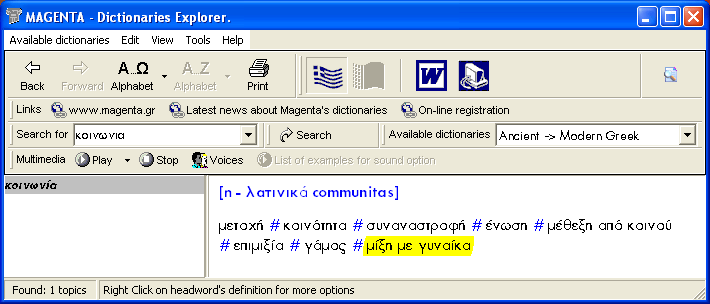
http://babelfish.altavista.com/ (phrase translations), Greek-English, (the above text, via copy-paste):
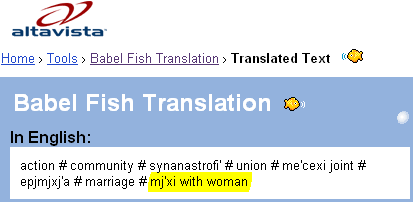
By the way, the following are some additional definitions, and the words altavista didn’t get:
action: sharing, participation
synanastrofi': complications, society, rotation, transaction; company, association, party
union: coupling, fitting; junction
me'cexi: communication, communion; participation
epjmjxj'a: marriages, complications; intercourse
http://www.magenta.gr/en/en_demos.htm, Ancient-Modern & Modern-Ancient Greek dictionary, (free 15-minute demo download [anc_setup_en.exe 2-16-04]), “mj'xi”: “μίξη (two citings above)” (form of μίξις: “mj'xi” citing above) (key-in “mijh”):
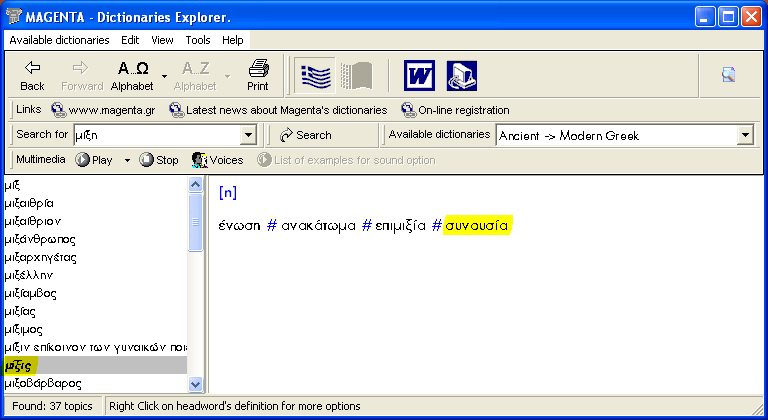
http://babelfish.altavista.com/ (phrase translations), Greek-English, (the above text via copy-paste):

By the way, the following are some additional definitions, and the words altavista didn’t get:
union: coupling, fitting; junction
anaka'twma: mixture, complex, confusion; mix-up
epjmjxj'a: marriages, complications; intercourse
Therefore, the ancient (New Testament) definition of κοινωνια (fellowship) is “Sexual intercourse with women.”
Another source:
Greek-English Lexicon, Liddell / Scott, 1996, p. 1136:
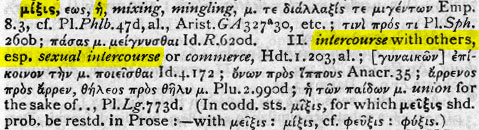
A more basic version:
An Intermediate Greek-English Lexicon, Liddell / Scott, 1997, p. 514:

The Vocabulary of the Greek Testament, Moulton / Milligan, 1930 (reprinted 1949), p. 351, “κοινωνία” (koinonia):
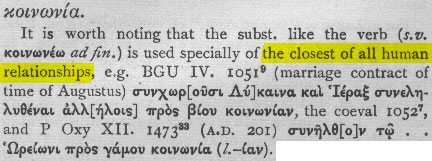
Theological Dictionary of the New Testament, Kittel, 1965, Vol. 3, p. 798:

Aristotle:
Here’s Aristotle putting fellowship / communion (society) into context with eros / erotic, agape, and phil….
Aristotle: Vol. 19: The Nicomachean Ethics (350 BC); H. Rackham, M.A., Fellow
of Christ’s College, Cambridge; Harvard University Press, London; 1926, revised
1934, reprinted 1975; pp. 572-573; Book IX, Chapter XII.1: 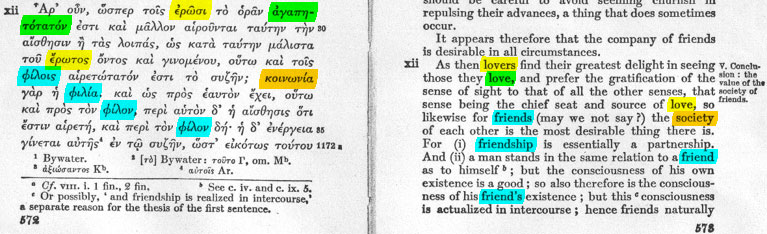
Another translation of the above:
http://classics.mit.edu/Aristotle/nicomachaen.9.ix.html (Massachusetts Institute of Technology), Nicomachean Ethics, by Aristotle, written 350 B.C.E, translated by W. D. Ross, Book IX, Chapter 12:
Does it not follow, then, that, as for lovers the sight of the beloved is the thing they love most [“greatest delight”], and they prefer this sense to the others because on it love depends most for its being and for its origin [“chief seat”], so for friends the most desirable thing is living together? For friendship is a partnership, and as a man is to himself, so is he to his friend; now in his own case the consciousness of his being is desirable, and so therefore is the consciousness of his friend's being, and the activity of this consciousness is produced when they live together, so that it is natural that they aim at this.
So, here fellowship / communion is translated as two lovers “living together.”
Latin (soci…):
Examples of Societas (or forms thereof):
http://www.biblegateway.com/passage/?book_id=54&chapter=6&version=4, Biblia Sacra Vulgata (Jerome’s Latin Vulgate, c. 405 AD), “II Corinthios 6” (2 Corinthians 6:14):
14nolite iugum ducere cum infidelibus quae enim participatio iustitiae cum iniquitate aut quae societas luci ad tenebras
2 Corinthians 6:14 (Douay-Rheims Version 1899):
Bear not the yoke with unbelievers. For what participation hath justice with injustice? Or what fellowship hath light with darkness?
(NKJV):
Do not be unequally yoked together with unbelievers. For what fellowship has righteousness with lawlessness? And what communion has light with darkness?
http://www.biblegateway.com/passage/?book_id=69&chapter=1&version=4, Biblia Sacra Vulgata (Jerome’s Latin Vulgate, c. 405 AD), “I Ioannis 1” (1 John 1:3,6,7):
3quod vidimus et audivimus adnuntiamus et vobis ut et vos societatem habeatis nobiscum et societas nostra sit cum Patre et cum Filio eius Iesu Christo 4et haec scribimus vobis ut gaudium nostrum sit plenum 5et haec est adnuntiatio quam audivimus ab eo et adnuntiamus vobis quoniam Deus lux est et tenebrae in eo non sunt ullae 6si dixerimus quoniam societatem habemus cum eo et in tenebris ambulamus mentimur et non facimus veritatem 7si autem in luce ambulemus sicut et ipse est in luce societatem habemus ad invicem et sanguis Iesu Filii eius mundat nos ab omni peccato
1 John 1:3,6,7 (Douay-Rheims Version 1899):
3That which we have seen and have heard, we declare unto you, that you also may have fellowship with us, and our fellowship may be with the Father, and with his Son Jesus Christ. 4And these things we write to you, that you may rejoice, and your joy may be full. 5And this is the declaration which we have heard from him, and declare unto you: That God is light, and in him there is no darkness. 6If we say that we have fellowship with him, and walk in darkness, we lie, and do not the truth. 7But if we walk in the light, as he also is in the light, we have fellowship one with another, and the blood of Jesus Christ his Son cleanseth us from all sin.
Examples of Socius (or forms thereof):
http://www.biblegateway.com/passage/?book_id=53&chapter=10&version=4, Biblia Sacra Vulgata (Jerome’s Latin Vulgate, c. 405 AD), “I Corinthios 10 (1 Corinthians 10:20)”:
20sed quae immolant gentes daemoniis immolant et non Deo nolo autem vos socios fieri daemoniorum non potestis calicem Domini bibere et calicem daemoniorum
1 Corinthians 10:20 (Douay-Rheims Version 1899):
But the things which the heathens sacrifice, they sacrifice to devils, and not to God. And I would not that you should be made partakers with devils.
http://www.biblegateway.com/passage/?book_id=54&chapter=8&version=4, Biblia Sacra Vulgata (Jerome’s Latin Vulgate, c. 405 AD), “II Corinthios 8 (2 Corinthians 8:23)”:
23sive pro Tito qui est socius meus et in vos adiutor sive fratres nostri apostoli ecclesiarum gloriae Christi
2 Corinthians 8:23 (Douay-Rheims Version 1899):
Either for Titus, who is my companion and fellow labourer towards you, or our brethren, the apostles of the churches, the glory of Christ.
http://www.biblegateway.com/passage/?book_id=57&chapter=1&version=4, Biblia Sacra Vulgata (Jerome’s Latin Vulgate, c. 405 AD), “Philippenses 1 (Philippians 1:7)”:
7sicut est mihi iustum hoc sentire pro omnibus vobis eo quod habeam in corde vos et in vinculis meis et in defensione et confirmatione evangelii socios gaudii mei omnes vos esse
Philippians 1:7 (Douay-Rheims Version 1899):
As it is meet for me to think this for you all, for that I have you in my heart; and that in my bands, and in the defence and confirmation of the gospel, you all are partakers of my joy.
Dictionarium Linguae Latinae et Anglicanae (Latin-English), Thomas Thomas, 1587, no page numbers, “Socia | Socius”:
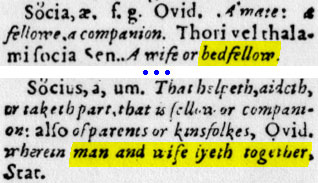
Translated from Elizabethan English:
Socia, æ. f. g. Ovid. A mate: a fellow, a companion. Thori vel thalamisocia Sen..A wife or bedfellow.
Socius, a, um. That helps, aids, or takes part, that is fellow or companion: also of parents or kinfolks, Ovid. wherein man and wife lying together, Stat.
http://www.perseus.tufts.edu/cgi-bin/ptext?doc=Perseus%3Atext%3A1999.04.0059%3Aentry%3D%2344554, Charlton T. Lewis, Charles Short, A Latin Dictionary, “sŏcĭālis”:
sŏcĭālis , e, adj. [socius] ,
I. of or belonging to companionship.
I. In gen., companionable, sociable, social (so not ante-Aug.): homo sociale animal, Sen. Ben. 7, 1, 8 : beneficium dare socialis res est, id. ib. 5, 11, 4 : amicitiae, App. M. 5, p. 171, 20 .--
II. In partic.
A. Of or belonging to allies or confederates, allied, confederate (the class. signif. of the word): lex, Cic. Div. in Caecil. 5, 18 : lex judiciumque, id. Verr. 2, 2, 6, § 15 : foedus, Liv. 34, 57 : exercitus, i. e. of the allies, id. 31, 21 : coetus, id. 7, 25
http://www.perseus.tufts.edu/cgi-bin/ptext?doc=Perseus%3Atext%3A1999.04.0059%3Aentry%3D%2344560, Charlton T. Lewis, Charles Short, A Latin Dictionary, “sŏcĭĕtas”:
|
Some Words that Regularly Appear with societas |
|||||
|
In Latin Prose (122 total): |
coeo |
renovo |
amicitia |
pactio |
Roscius |
|
In Latin Texts (122 total): |
coeo |
pactio |
amicitia |
renovo |
Roscius |
…
sŏcĭĕtas , ātis, f. [id.] ,
I. fellowship, association, union, community, society (implying union for a common purpose; cf.: conjunctio, consociatio; and not a mere assembly; cf.: circulus, coetus; conventus, sodalitas; freq. and class.). … societatem cum aliquo coire ... dirimere, id. Phil. 2, 10, 24 : societatem coire de municipis cognitique fortunis cum alienissimo, id. Rosc. Am. 31, 87 : quasi societatem coit [coitus] conparandi cibi, id. N. D. 2, 48, 123 … Dig. 17, 2, 5 ; 17, 2, 74: coire, ib. 17, 2, 1 sq. ; 17, 2, 5.
http://www.perseus.tufts.edu/cgi-bin/ptext?doc=Perseus%3Atext%3A1999.04.0059%3Aentry%3D%2344561, Charlton T. Lewis, Charles Short, A Latin Dictionary, “sŏcĭo”:
sŏcĭo , āvi, ātum, 1, v. a. [id.] ,
I. to join or unite together, to associate; to do or hold in common, to share a thing with another, etc. (freq. and class.; in Cic. mostly with inanimate objects; syn. jungo): coetus utilitatis communione sociatus, Cic. Rep. 1, 25, 39 : concilia coetusque hominum jure sociati, id. ib. 6, 13, 13
http://www.perseus.tufts.edu/cgi-bin/ptext?doc=Perseus%3Atext%3A1999.04.0059%3Aentry%3D%238902, Charlton T. Lewis, Charles Short, A Latin Dictionary, “coetus”:
coetus , us, v. 2. coitus.
http://www.perseus.tufts.edu/cgi-bin/morphindex?lookup=coetus&lang=la&corpus=Roman&author=&formentry=1, coetus:
|
coitus#2 |
sexual union |
http://www.perseus.tufts.edu/cgi-bin/ptext?doc=Perseus%3Atext%3A1999.04.0060%3Aentry%3D%232708, Charlton T. Lewis, Charles Short, A Latin Dictionary, “coitus”:
coitus ūs, m [com- + 1 I-] , sexual union, O.
http://lysy2.archives.nd.edu/cgi-bin/words.exe?coeo (Latin-English translator), “coeo”:
coeo, coire, coivi(ii), coitus V [XXXAO]
fit together; have sexual intercourse; collect/gather (fluid); meet; rally;enter agreement; unite/assemble/conspire; come/go together; mend/knit (wound);
http://lysy2.archives.nd.edu/cgi-bin/words.exe?concilia (Latin-English translator), “concilia”:
public gathering/meeting; popular assembly, council; hearing; debate/discussion
association, society, company; union/connection (of objects); league of states;
sexual union/coition; close conjunction; bond of union; plant iasione blossom;
Dictionary of Ecclesiastical Latin (Latin-English), Stelten, 1995, p. 44, “cóeo”:

P. 45, “coétus”:
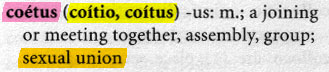
… “coít…”

http://www.perseus.tufts.edu/cgi-bin/ptext?doc=Perseus%3Atext%3A1999.04.0059%3Aentry%3D%238883, Charlton T. Lewis, Charles Short, A Latin Dictionary, “cŏ-ĕo”:
Of the coition of the sexes (both of men and animals), to copulate
http://catholic.archives.nd.edu/cgi-bin/lookup.pl?stem=coeo&ending= (University of Notre Dame), Latin Word Lookup, “coeo”:
coeo -ire -ii or -ivi -itum [to go or come together , assemble]; of enemies, [to engage]; of friends, etc., [to unite, combine]; transit. 'societatem coire', [to form an alliance]; of things, [to unite, come together]; of blood, [to curdle]; of water, [to freeze].
The New College Latin & English Dictionary, Traupman, 1966, p. 46 (Latin-English), “coĕō”:
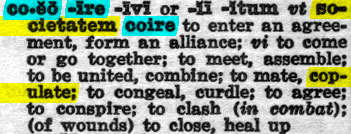
Collins Latin Gem Dictionary, Kidd, 1957, p. 58 (Latin-English), “co´/eō”:
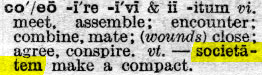
P. 417 (English-Latin), “communion”:

The Latin sexual Vocabulary, Adams, 1982, p. 179, “Coeo”:
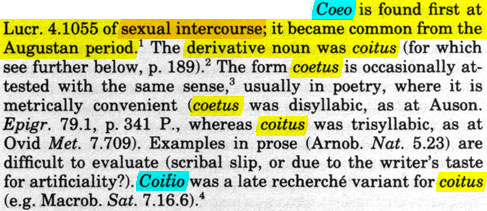
“Augustan period” is c. 1700-1740 AD.
Harpers’ Latin Dictionary, Lewis / Short, 1879, p. 364, “cŏĭtĭo”:
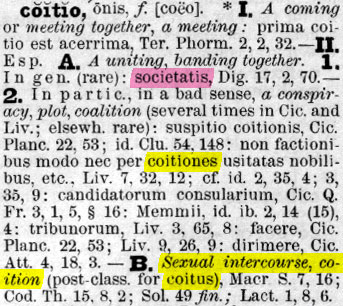
Examples of coeo / coite in the Latin Vulgate:
Genesis 26:10:
And Abimelech said, “What is this you have done to us? One of the people might soon have lain with your wife, and you would have brought guilt on us.”
Genesis 39:14:
that she called to the men of her house and spoke to them, saying, “See, he has brought in to us a Hebrew to mock us. He came in to me to lie with me, and I cried out with a loud voice.
Exodus 22:19:
“Whoever lies with an animal shall surely be put to death.”
Leviticus 15:18:
Also, when a woman lies with a man, and there is an emission of semen, they shall bathe in water, and be unclean until evening.
Etc.
Hebrew:
Gesenius’ Hebrew-Chaldee Lexicon to the Old Testament, 1847 (republished 1979, Baker Books), pp. 167-168 , “אהב” (the main Hebrew word for love):
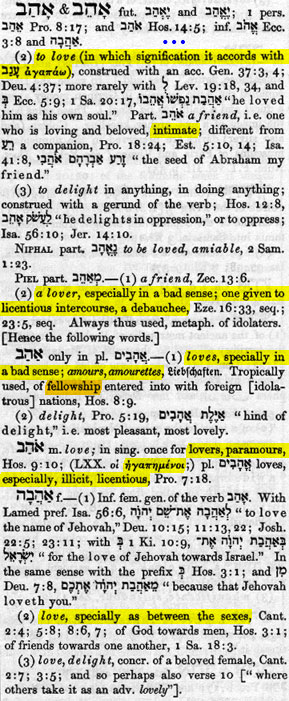
Well, we should know what they mean by a “bad sense.”