AKOLAS… (ακολασ…)
(The Greek word of Debauchery / Sex Orgy)
With: 4 Maccabees 13:7
EUSEBIUS: Ecclesiastical History, Book 9, Chapter 5:
(Eusebius: c. 260-341 AD)
http://people.vanderbilt.edu/~james.p.burns/chroma/saints/Persecution.html, Christians and the Roman State, “THE GREAT PERSECUTION”:
This threat of permanent exclusion of Christians from their home cities (where they would be well known) had the potential to affect more deeply Christians' lives than many of the previous measures (which their survival clearly shows could be successfully negotiated one way or another), cf. Euseb. H.E. 9.7.15. This process was accompanied by a positive encouragement of polytheistic cults and priesthoods (Lact. de mort. pers. 36.4f., Euseb. H.E. 9.4.2) along with a sustained propaganda warfare against Christianity (imperial distribution of copies of the scandalous Acts of Pilate and of the (false) accounts by prostitutes of Damascus of Christian orgies, Euseb. H.E. 9.5.1f.).
I.e.: Eusebius, Historia Ecclesiastica (Ecclesiastical History), Book ix: history to Constantine's victory over Maxentius in the West and over Maximinus in the East, c. 326. Eusebius of Caesarea (c. 260-341 AD). Date of event: 304-311 AD.
http://www.ucalgary.ca/~vandersp/Courses/texts/eusebius/eusehe9.html, Eusebius of Caesarea, Ecclesiastical History, Book IX, “CHAPTER V.: The Forged Acts”:
Having therefore forged Acts of Pilate and our Saviour full of every kind of blasphemy against Christ, they sent them with the emperor's approval to the whole of the empire subject to him, with written commands that they should be openly posted to the view of all in every place, both in country and city, and that the schoolmasters should give them to their scholars, instead of their customary lessons, to be studied and learned by heart. While these things were taking place, another military commander, whom the Romans call Dux, seized some infamous women in the market-place at Damascus in Phoenicia, and by threatening to inflict tortures upon them compelled them to make a written declaration that they had once been Christians and that they were acquainted with their impious deeds, — that in their very churches they committed licentious acts; and they uttered as many other slanders against our religion as he wished them to. Having taken down their words in writing, he communicated them to the emperor, who commanded that these documents also should be published in every place and city.
(The Loeb Classical Library): Eusebius: Ecclesiastical History, translated by Oulton, 1932, vol. 2: books VI-X, pp. 338-339, “IX. IV. 3—VI. 1 | V.”:
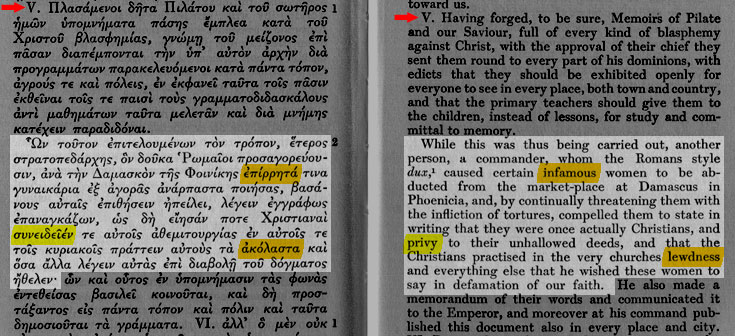
Each word translated from Greek:
Ών On τουτον this επιτελουμένων carried out τον the τρόπον way, έτερος other στρατοπεδάρχης military commander, ον being δουκα Duke Ρωμαιοι Romans προσαγορεύουσιν named, ανα per την the Δαμασκον Damascus της the Φοινίκης Phonenicia επίρρητά infamous τινα sort of γυναικάρια women εξ from αγορας market ανάρπαστα snatched away ποιήσας method of procedure, βασάνους inquiry by torture αυταις them επιθήσειν will place upon / assail ηπείλει threatenings, λέγειν speakings εγγράφως written/indicted επαναγκάζων to compel by force, ως as δη indeed/of-course είησάν be it so ποτε at some time Χριστιαναι Christian συνειδειέν being in secret knowledge / privy τε both/and/any αυτοις these αθεμιτουργίας doing lawless/godless deeds εν in αυτοις these τε both/and/any τοις per κυριακοις belonging to the Lord (Christ) πράττειν dealings αυτους them τα the ακόλαστα “debauchery” / “promiscuous” / “orgy” / “lecherous” / “licentiousness” / “unchastity” / “unbridled” και and όσα those who άλλα however λέγειν speaking αυτας they επι on διαβολη slander του of the δόγματος doctrine ήθελεν decree.
(The contiguous editable text):
Ών τουτον επιτελουμένων τον τρόπον, έτερος στρατοπεδάρχης, ον δουκα Ρωμαιοι προσαγορεύουσιν, ανα την Δαμασκον της Φοινίκης επίρρητά τινα γυναικάρια εξ αγορας ανάρπαστα ποιήσας, βασάνους αυταις επιθήσειν ηπείλει, λέγειν εγγράφως επαναγκάζων, ως δη είησάν ποτε Χριστιαναι συνειδειέν τε αυτοις αθεμιτουργίας εν αυτοις τε τοις κυριακοις πράττειν αυτους τα ακόλαστα και όσα άλλα λέγειν αυτας επι διαβολη του δόγματος ήθελεν.
An Internet source:
http://www.hs-augsburg.de/~harsch/graeca/Chronologia/S_post04/Eusebios/eus_hi09.html, Ἐκκλησιαστικὴ ἱστορία (Ecclesiastical History), “Θʹ: Τάδε καὶ ἡ ἐνάτη περιέχει βίβλος τῆς, Ἐκκλησιαστικῆς ἱστορίας (9: Such and the ninth book contains, of Church history)”:
[9.5.2] ὧν τοῦτον ἐπιτελουμένων τὸν τρόπον, ἕτερος στρατοπεδάρχης, ὃν δοῦκα Ῥωμαῖοι προσαγορεύουσιν, ἀνὰ τὴν Δαμασκὸν τῆς Φοινίκης ἐπίρρητά τινα γυναικάρια ἐξ ἀγορᾶς ἀνάρπαστα ποιήσας, βασάνους αὐταῖς ἐπιθήσειν ἠπείλει, λέγειν ἐγγράφως ἐπαναγκάζων, ὡς δὴ εἴησάν ποτε Χριστιαναὶ συνειδεῖέν τε αὐτοῖς ἀθεμιτουργίας ἐν αὐτοῖς τε τοῖς κυριακοῖς πράττειν αὐτοὺς τὰ ἀκόλαστα καὶ ὅσα ἄλλα λέγειν αὐτὰς ἐπὶ διαβολῆι τοῦ δόγματος ἤθελεν·
Another source for the Greek:
http://books.google.com/books?hl=en&id=weICAAAAQAAJ&dq=%22Eusebiou+tou+Pamphilou+Historias+ekkl%C4%93siastik%C4%93s+logoi+deka&printsec=frontcover&source=web&ots=i-Zll5uGq0&sig=WQT19ckDcQQ5QCb1X7-5T6SH7r8#PPA313,M1, Eusebiou tou Pamphilou Historias ekklēsiastikēs logoi deka =: Eusebius’ Ecclesiastical History, According to the Text of Burton –Google Books Result, Introduction by Willliam Bright, D.D., 1881, p. 313.
Dating the event (and more):
http://en.wikipedia.org/wiki/Diocletian, Diocletian:
In 303, Diocletian ordered a persecution of Christians that was to be the last and greatest in the Roman Empire.
Same text as earlier, but note footnote date of “forged Acts of Pilate”:
http://www.tparents.org/library/religion/christian/fathers/NPNF2-01/Npnf2-01-14.htm, Nicene and Post-Nicene Fathers, Series II, Vol. I, “[Eusebius: Ecclesiastical History] Book IX”:
Chapter V. The Forged Acts.
1 Having therefore forged Acts of Pilate22 and our Saviour full of every kind of blasphemy against Christ, they sent them with the emperor's approval to the whole of the empire subject to him, with written commands that they should be openly posted to the view of all in every place, both in country and city, and that the schoolmasters should give them to their scholars, instead of their customary lessons, to be studied and learned by heart.
2 While these things were taking place, another military commander, whom the Romans call Dux,23 seized some infamous women in the market-place at Damascus in Phoenicia,24 and by threatening to inflict tortures upon them compelled them to make a written declaration that they had once been Christians and that they were acquainted with their impious deeds,-that in their very churches they committed licentious acts; and they uttered as many other slanders against our religion as he wished them to. Having taken down their words in writing, he communicated them to the emperor, who commanded that these documents also should be published in every place and city.
http://www.tparents.org/library/religion/christian/fathers/NPNF2-01/footnote/fn54.htm#P5453_2474258, Footnotes:
22 This is the famous fourth edict of Diocletian, which was issued in the year 304.
http://books.google.com/books?id=XmkQAAAAIAAJ&pg=PA333&lpg=PA333&dq=%22forged+acts+of+pilate%22+eusebius+%22ecclesiastical+history%22&source=web&ots=3orGDUGi7A&sig=SRTY32P-wU2PahupDBSjqw1tT_U, The Trial of Jesus from a Lawyer's Standpoint – Google Book Result, by Walter Marion Chandler, 1908, part 2, p. 333, “Appendices | Acts of Pilate”:
(In plain text):
And in the time of the persecuting emperor Maximin, about the year of Christ 307, the heathen people forged Acts of Pilate, derogatory to the honor of our Savior, which were diligently spread abroad, to unsettle Christians, or discourage them in the profession of their faith. Of this we are informed by Eusebius in his Ecclesiastical History.
http://www.earlychristianwritings.com/actspilate.html (Early Christian Writings), Acts of Pilate:
When the influence of Christianity was increasing rapidly in the Empire, one of the last pagan emperors, Maximin II, two years before the Edict of Milan (313 - 2 = 311 AD), attempted to bring Christianity into disrepute by publishing what he alleged to be the true 'Acts of Pilate', representing the origins of Christianity in an unsavoury guise. These 'Acts', which were full of outrageous assertions about Jesus, had to be read and memorized by schoolchildren. They were manifestly forged, as Eusebius historian pointed out at the time;' among other things, their dating was quite wrong, as they placed the death of Jesus in the seventh year of Tiberius (AD 20), whereas the testimony of Josephus' is plain that Pilate not become procurator of Judaea till Tiberius' Twelfth year (not to mention the evidence of Luke iii. 1, according to which John the Baptist began to preach in fifteenth year of Tiberius). We do not know in detail these alleged 'Acts' contained, as they were naturally suppressed on Constantine's accession to power; but we may surmise that they had some affinity with Toledoth Yeshu, an anti-Christian compilation popular in some Jewish circles in mediaeval time.'
So the date of occurrence should be 304-311 AD.
Wantonness: ‘ύβρει (Hubrei / Hubris):
Two chapters just ahead of the earlier Chapter V:
http://www.ucalgary.ca/~vandersp/Courses/texts/eusebius/eusehe9.html, Eusebius of Caesarea, Ecclesiastical History, Book IX, “CHAPTER VII.: The Decree against us which was engraved on Pillars”:
The memorials against us and copies of the imperial edicts issued in reply to them were engraved and set up on brazen pillars in the midst of the cities, — a course which had never been followed elsewhere. The children in the schools had daily in their mouths the names of Jesus and Pilate, and the Acts which had been forged in wanton insolence. It appears to me necessary to insert here this document of Maximinus(Roman emperor from 308 to 313) which was posted on pillars, in order that there may be made manifest at the same time the boastful and haughty arrogance of the God-hating man, and the sleepless evil-hating divine vengeance upon the impious, which followed close upon him, and under whose pressure he not long afterward took the opposite course in respect to us and confirmed it by written laws.
Sounds like Maximinus is really sore about alleged free sex of the Christians.
(The Loeb Classical Library): Eusebius: Ecclesiastical History, translated by Oulton, 1932, vol. 2: books VI-X, pp. 342-343, “IX. VII. 1-4”:

(The contiguous editable text):
οί τε παιδες ανα τα διδασκαλεια Ιησουν κια Πιλάτον και τα εφ (επί) ‘ύβρει πλασθέντα ‘υπομνήματα δια στόματος κατα πασαν έφερον ‘ημέραν
Each word translated from Greek in consecutive order:
|
οί |
those |
|
τε |
both |
|
παιδες |
children |
|
ανα |
from bottom to top |
|
τα |
them |
|
διδασκαλεια |
teaching |
|
Ιησουν |
Jesus |
|
κια |
and |
|
Πιλάτον |
Pilate |
|
και |
and |
|
τα |
them |
|
εφ (επί) |
on |
|
‘ύβρει (noun fem dat sg of ‘ύβρ-ις) |
“wantonness,” “licentiousness,” “lewdness,” “lustful,” “shame,” “insult,” “violation,” “rape” |
|
πλασθέντα |
forges |
|
‘υπομνήματα |
memoranda |
|
δια |
by |
|
στόματος |
oral |
|
κατα |
down upon |
|
πασαν |
all |
|
έφερον |
bears / endures |
|
‘ημέραν |
daily |
It sounds like Christian wantonness was something taught to the children. I suppose the violence part refers to the eucharist, or a malicious kind of open sex, but that’s from the persecutor’s point of view.
Here’s where a Greek word has changed meaning:
|
Langenscheidt’s Standard [Modern] Greek Dictionary, 1990, p. 818, “‘ύβρ…”:
|
Langenscheidt’s Pocket Greek Dictionary: Classical Greek-English, p. 386, “‘ύβρ…”:
|
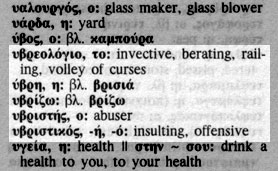
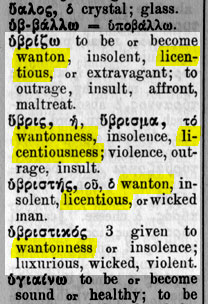
|
The Pocket Oxford [Modern] Greek Dictionary, 1995, p. 193, “‘ύβρ…”:
|
The Pocket Oxford Classical Greek Dictionary, 2002, p. 326, “‘ύβρ…”:
|
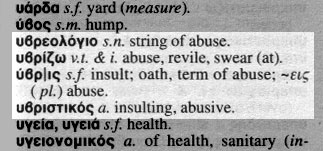
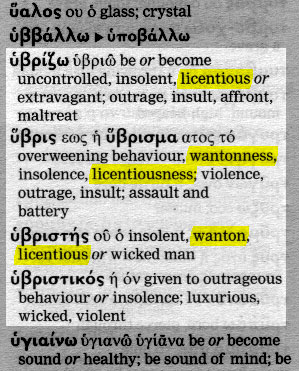
An Intermediate Greek-English Lexicon, Liddell and Scott, 1997 (first edition 1889), pp. 826-827, “‘ύβρ…”:
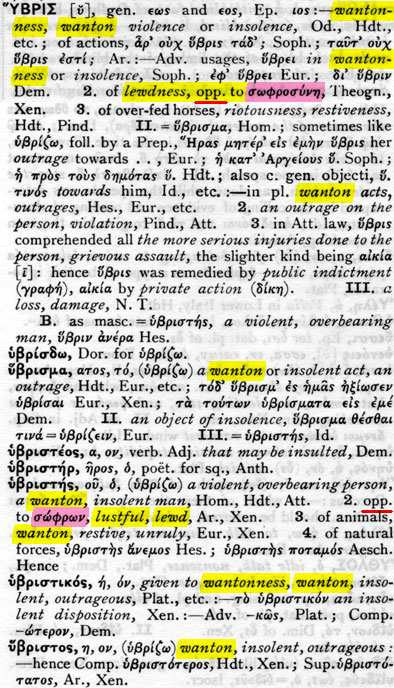
–“opp.” means “opposed to.”
P. 789 (the “opposed to” words):
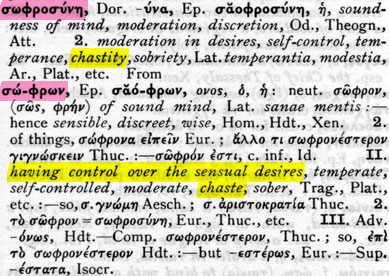
To add one from their large lexicon:
A Greek-English Lexicon, Liddell and Scott, 1996, p. 1841 (2nd column, 5th line down), “‘ύβρ…”:
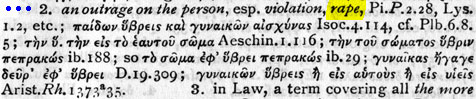
I’m not saying the Christian’s open sex was rape, I’m just trying to fully catch the sexual meaning of Maximinus.
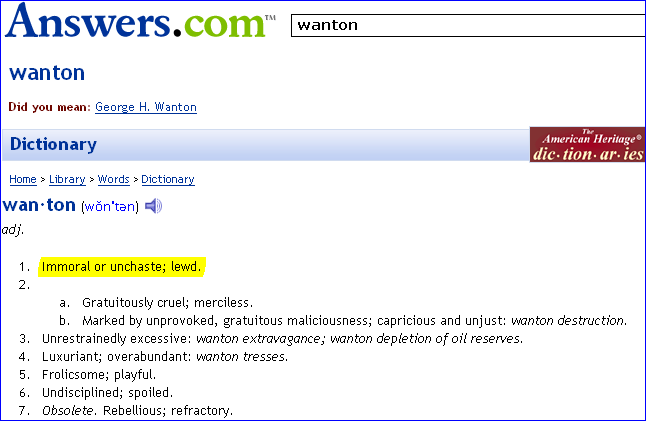
http://www.answers.com/wanton?cat=biz-fin, “wanton”:
4 Maccabees 13:7 (back to ακολασ…):
“ακολασ…”(debauchery / sex orgy) is nowhere to be found in the New Testament. Likely because it was the word to describe the sex orgy part of the “Mysteries,” which was part of the “secret” rites. This also shows that the writers of the New Testament purposely left out their alert for us to avoid the most horrible sin possible (as we’ve been taught). But it is in the Old Testament in Proverbs 19:29, 20:1, 21:11 as a bad thing. However, in 4 Maccabbees 13:7 it is written as a good thing, specifically in devotion to God. Hundreds of years of edits to Proverbs ended about 180 BC, to the finalized book we have now (ref. Eerdmans Handbook of the Bible, 1983, p. 354). 4 Maccabees, written about the time of Christ, was incorporated into the early Christians’ Greek Old Testament (the Septuagint), but later the Catholic Church removed it from their canon:
Today’s translations:
The Cambridge Annotated Study Apocrypha: New Revised Standard Version, 1994, p. 243, “4 Maccabees 13” (with side commentary, by Howard Clark Kee):
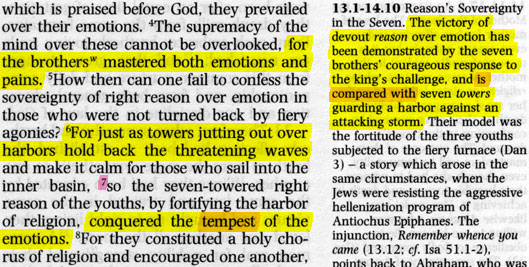
Here they use “emotions”: a euphemism for “passions”; and “tempest” for “debauchery,” and incorrectly used as an adjective.
The Septuagint with Apocrypha: Greek and English, Brenton, 1986 (orig. text 1851), p. 241 (of Apocrypha section), “IV. Maccabees XIII. | 7” (with original Greek):
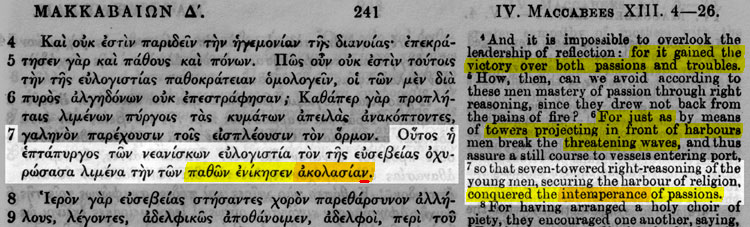
Here also they use “intemperance” for debauchery (incorrectly) as an adjective for “passions.”
Each word translated from Greek in consecutive order:
|
Ουτος |
This |
|
η |
truly |
|
επτάπυργος |
seven-towered |
|
των |
of the |
|
νεανίσκων |
young men |
|
ευλογιστία |
prudence / rightly reckoning |
|
τον |
the |
|
της |
of |
|
ευσεβείας |
faithful, devotion / piety, godliness, religion (always toward God) |
|
οχυρώσασα |
fortifying |
|
λιμένα |
port / harbor |
|
την |
that |
|
των |
of the |
|
παθων (noun neut gen plural of παθος) |
passions, troubles, lusts |
|
ενίκησεν (verb 1st aorist[past tense] action indicative 3rd pers sg of νικ-άω) |
won (in a battle or contest) |
|
ακολασίαν (noun fem accusative sg of ακολασία) |
debauchery / sex orgies
|
The “accusative” form (the “ν” on the end) “expresses the goal of an action or motion, as in English grammar: the objective case (that serves as the object), indicating the person or thing acted upon. “The accusative case is the case of the direct object, receiving the action of the verb,” or “the object of the verb.” And the verb is to have “won (in battle or contest).” Also in νικάω’s verb base definition: “to overcome,” “to prevail,” “to be superior,” “to carry away the victory,” “to win one’s cause (in a legal term),” “generally, overpower, esp. of passions [Liddell & Scott],” etc. for the “action” of debauchery / sex orgies.
The above verb:
A Greek-English Lexicon of the Septuagint, J. Lust, part 2: Κ-Ω, 1996, p. 316, “νικάω”:
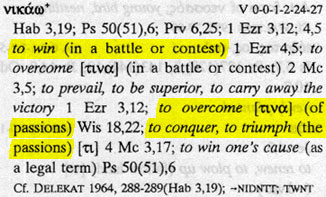
The context of the other parts of the chapter indicates that “passion” is the bad thing. “ακολασίαν” (sex orgies) here is not in the form of an adjective, like “tempest” or “intemperance” for the word “passion.” It is a noun in the “accusative” sense: “expressing the goal” or the “thing acted upon” that “won”: the good thing, and since the early verses tell that the seven brothers are now doing as the Lord wishes. From verse 6, the writer is making a deliberate comparison how the “threatening waves” (the bad thing) are overcome by the “towers” at harbors (the good thing), is like how that the “passions” (the bad thing) are overcome by the diversity of open sex (the good thing), something won “in a battle or contest” against “passion.” You see, what a lot of people don’t know, opposed to what the church tries to convey, (sexual) “passion” and “lust” do not mean sexual desire period. They both mean a “strong” kind of sexual desire. And, one lessens “strong” or “excessive” sexual desire when they have sex with everyone, because then sexual desire won’t be such a deprivation, as is what stabilizes the marriage system. It’s like if you go weeks without eating food, you will have a much “stronger” desire or “passion” to eat. If you are a male and have “troubles” getting sex because of all the women just play games to make you earn it, and the only way to get consistent sex is to basically do everything “one” wants or expects, then you have “passion” for her. So when she dies or divorces you, you will surely have even more “troubles.” Why would a guy like the Fonz ever get married if all he has to do is snap his fingers and the women come, unless of societal pressures for a job or image. Even if a guy can pick up a different beautiful woman in a bar on his way home from work every night, he still might be inconvenience by having to go to the bar every time, and get married to save time (especially if he’s a workaholic). But, it is easy to find that the early Christian societies were living in a communal kind of way, where work and sex could be easily shared. If one has “passion” for another, that doesn’t mean they just want sex. Today, that means they want to own and possess them. Paul says it best in 1 Corinthians 7:8-9: “8But I say to the unmarried and to the widows: It is good for them if they remain even as I am (unmarried); 9but if they cannot exercise self-control, let them marry. For it is better to marry than to burn with passion.” Obviously Paul is overruling an earlier authority, but covers himself by saying in verse 6: “But I say this as a concession, not as a commandment.” (There’s no word to indicate that Paul was celibate.) But, I say you really can’t give an inch or the later church will take a mile, by making marriage into a sacrament and “commanding” it as a prerequisite for sex. Today’s churches’ ludicrous commentary is that Jesus, Paul and the early Christians denounced marriage because it allows sex, then contradictorily says its allowed in marriage (only). But, that philosophy destroys mankind if everyone in the world did what Jesus, Paul, and the early Christians say is best: not getting married. The “troubles” of “passion” is what makes pornography such a lucrative business today: If open sex was the standard, then there wouldn’t be so many guys needing to just look at it elsewhere.
The debauchery / free love / sex orgy (ακολασ…) word:
Oxford Greek-English Learner’s Dictionary, Stavropoulos, 1988, p. 24, “ακολασ…”:
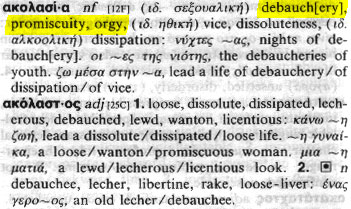
Realize, many modern day aspects will relate the word to the bad sense; and/or some will add the Bible corrupted replacements of the word:
A Greek-English Lexicon of the Septuagint, J. Lust, part 1: Α-Ι, 1992, p. 16, “ακολασ…”:
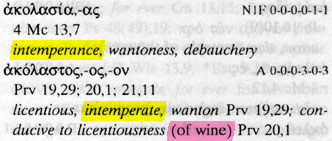
“Wine” references the sex orgies of Dionysus / Bacchus: the god of wine.
Langenscheidt’s Pocket Greek Dictionary: Classical Greek – English, p. 14:
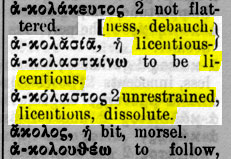
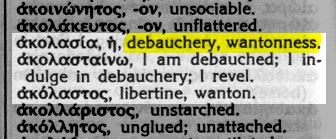
It amazes me how today’s church wants everyone to be sexual restrained.
Divry’s Modern English-Greek and Greek-English Desk Dictionary, 1996, p. 402:
(The contiguous editable text):
Ουτος η επτάπυργος των νεανίσκων ευλογιστία τον της ευσεβείας οχυρώσασα λιμένα την των παθων ενίκησεν ακολασίαν
Internet sources:
http://ocp.acadiau.ca/index.html?4Macc (The Online Critical Pseudepigrapha), 4 Maccabees:
13:7 οὕτως ἡ ἑπτάπυργος τῶν νεανίσκων εὐλογιστία τὸν τῆς εὐσεβείας ὀχυρώσασα λιμένα τὴν τῶν παθῶν ἐνίκησεν ἀκολασίαν.
http://quod.lib.umich.edu/cgi/r/rsv/rsv-idx?type=DIV1&byte=4496061, Bible, Revised Standard Version: 4 Maccabees, “4Mac.13”:
[7] so the seven-towered right reason of the youths, by fortifying the harbor of religion, conquered the tempest of the emotions.
http://ecmarsh.com/lxx/IV%20Maccabees/index.htm, IV Maccabees, “Chapter 7” (verses 4-7):
4 And it is impossible to overlook the leadership of reflection: for it gained the victory over both passions and troubles. 5 How, then, can we avoid according to these men mastery of passion through right reasoning, since they drew not back from the pains of fire? 6 For just as by means of towers projecting in front of harbours men break the threatening waves, and thus assure a still course to vessels entering port, 7 so that seven-towered right-reasoning of the young men, securing the harbour of religion, conquered the intermperance of passions.
Date info:
http://christianity.wikia.com/wiki/4_Maccabees (Christian Knowledge Base), 4 Maccabees, “Authorship and criticism”:
The book is generally dated between the first century BC and the first century AD, due to its reliance on 2 Maccabees and use by Christians. It was probably written before the persecution of the Jews under Caligula, and certainly before the fall of Jerusalem in AD 70.
http://bible.tmtm.com/wiki/4_Maccabees_(Jewish_Encyclopedia), 4 Maccabees (Jewish Encyclopedia), “Jewish Standpoint”:
Nothing can with definiteness be asserted as to the date of the book; it belongs probably to the period shortly before the fall of Jerusalem. In its present form it contains possibly some Christian interpolations (e.g., vii. 19, xiii. 17, xvi. 25), but they are certainly very few and insignificant. Later on, Christian homilists used the same topic, the martyrdoms, as the theme for sermons; the Church maintained a Maccabean feast (though not on the same date as the Jews) for at least four centuries.
The Oxford Bible Commentary, Barton / Muddiman, 2001, p. 791, “4 Maccabees | Date”:
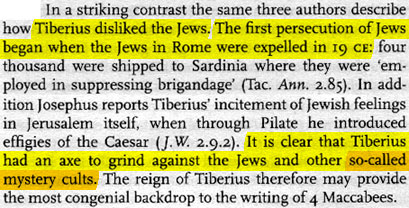
Well, I guess Rome did persecute some Jews: Jews that were part of the “so-called mystery cults.” Tiberius reigned from 14-37 AD.
“Passion” info:
http://www.answers.com/passion, “passion” (the bad thing):
A powerful emotion, such as love(today’s kind), joy, hatred, or anger. … Strong sexual desire; lust … SYNONYMS passion, fervor, fire, zeal, ardor. These nouns denote powerful, intense emotion (not just “emotion” period). Passion is a deep, overwhelming emotion: “There is not a passion so strongly rooted in the human heart as envy” (Richard Brinsley Sheridan). … Fire is burning passion (see 1 Corinthians 7:9): “In our youth our hearts were touched with fire” (Oliver Wendell Holmes, Jr.). … The passionate affection and desire felt by lovers for each other (like exclusively) … Sexual hunger
“Open/free sex” = Freedom from all that “trouble.”
http://reluctant-messenger.com/council-of-laodicea.htm, THE (Christian) COUNCIL OF LAODICEA IN PHRYGIA PACATIANA 364 A.D.:
Books banned by the (Christian) Council of Laodicea
|
Barnabas |
The First Book of Adam and Eve |
There’s a lot more sources that I don’t have the time to investigate.