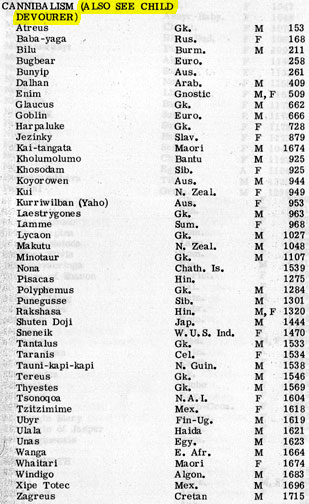
EUCHARIST-CANNIBAL
Encyclopædia of Religion and Ethics, Hastings, 1908-1927, vol. ?, p. 168, “AGAPE”:
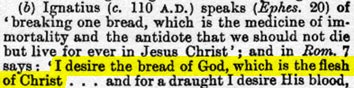
Sounds like “bread” is metaphorically of God, and “flesh” is literally Christ’s. (That’s Ignatius to the Romans 7:3 [c. 100 AD], not Paul’s Romans.)
The Encyclopedia Americana International Edition, 1995, p. 41, “The History of the Liturgy”:
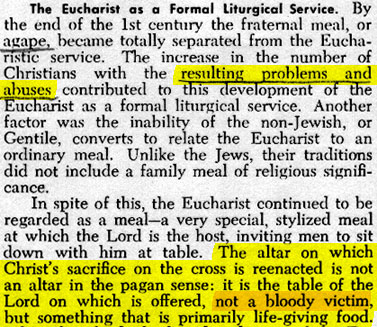
You see, the eucharist was to overrule pagan and Jewish blood sacrifices.
Sounds like Paul was the one who instituted the eucharist:
1 Corinthians 11:23-30:
Institution of the Lord’s Supper
23For I received from the Lord that which I also delivered to you: that the Lord Jesus on the same night in which He was betrayed took bread; 24and when He had given thanks, He broke it and said, “Take, eat; this is My body which is broken for you; do this in remembrance of Me.” 25In the same manner He also took the cup after supper, saying, “This cup is the new covenant in My blood. This do, as often as you drink it, in remembrance of Me.”(basically Luke 22:17-20) 26For as often as you eat this bread and drink this cup, you proclaim the Lord’s death till He comes. 27Therefore whoever eats this bread or drinks this cup of the Lord in an unworthy manner will be guilty of the body and blood of the Lord. 28But let a man examine himself, and so let him eat of the bread and drink of the cup. 29For he who eats and drinks in an unworthy manner eats and drinks judgment to himself, not discerning the Lord’s body. 30For this reason many are weak and sick among you, and many sleep.
That “as often as you drink it” or some translate “whenever you drink it” is inserted by Paul. Verse 26 is also added. “Unworthy” sounds like it may mean taking the eucharist in symbolic bread and wine instead of real human flesh and blood. Plus, “Jesus” said to do it remembrance of Him: in retrospect, not for anything in the future. And, a memory is pretty much set. I mean, if you do something later, no matter how many times you do it, the memory stays the same every time. It was done for a new covenant shed for you: a done deal. Jesus says to do it at that time, not to keep doing it in the future. If I told someone to drive my car around the block for my new covenant (to overrule the old covenant’s animal sacrifice), that’s asking to do it once at that time: it’s not saying to do it every day.
In those days, people mistakenly believed that you are what you eat. But today, we have found that our memory, reckoning abilities, even the DNA doesn’t inherit to the person consuming the flesh (or we’d all be animals): Generic protein, cholesterol, saturated fat, etc. are the only things that our systems extract from flesh.
Luke 22:14-16 (TEV), The Last Supper:
14When the hour came, Jesus took his place at the table with the apostles. 15He said to them, "I have wanted so much to eat this Passover meal with you before I suffer! 16For I tell you, I will never eat it until it is given its full meaning in the Kingdom of God."
Which is saying that they will not understand “its full meaning” until the future (the Kingdom of God), not until Paul.
Luke 22:19:
And He took bread, gave thanks and broke it, and gave it to them, saying, “This is My body which is given for you; do this in remembrance of Me.”
In the original Greek Scripture, the verb “do” (ποιειτε) is definitely in the “present” tense, not the “future” tense. Meaning “do” it at that time only, then remember it.
A World History of Art, Pischel, 1968, p. 144, “Early Christian Art | Catacomb Painting”:
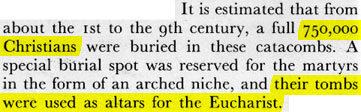
Sounds like some pretty easy access to their bodies.
The Catacombs of St. Callixtus; Baruffa; Published by L.E.V., Vatican City; 1993; p. 46; “6. The Tombs of Children and Adults”:
Hopefully.
The eucharist was done to overrule the Jewish and Pagan animal sacrifice salvations. It was intended to be done only once at the Last Supper. It was not to be continued, because it constituted a one faith in Christ’s teachings only, which would cover all false cop-outs. Early Christians’ continuance of the eucharist is only telling the Jews and Pagans that Christ’s sacrifice alone did not cover that necessity / hole, therefore needs to be repeated each time. Today, just “reenacting” Christ’s one sacrifice is not necessary since hardly any religion today has animal sacrifices.
Early Christians still lived in a large pagan human-sacrifice era, where outside pressures could have been the cause for the infanticide.
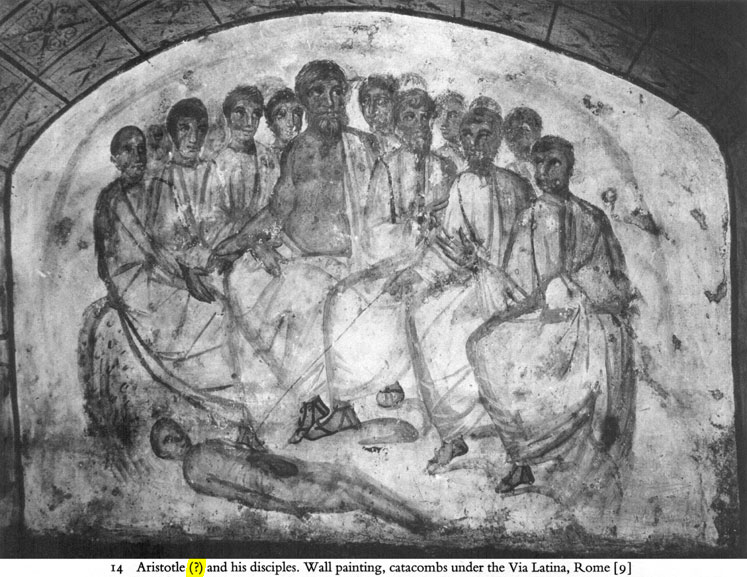
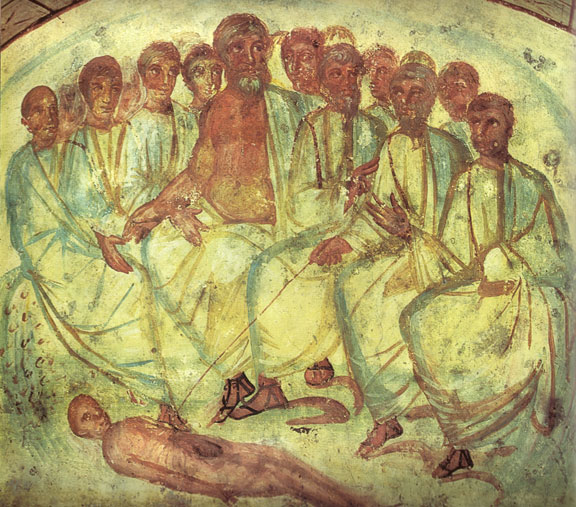
Looks like they’ve purposely opened up a dead body for some reason:
Early Christian Art: AD 200-395: From the Rise of Christianity to the Death of Theodosius, André Grabar, 1968, p. 226, “3. The Art of the Fourth Century | The Via Latina Paintings | 249. Rome. Catacomb of the Via Latina: Aristotle (?) with his Disciples” Eucharist (?):
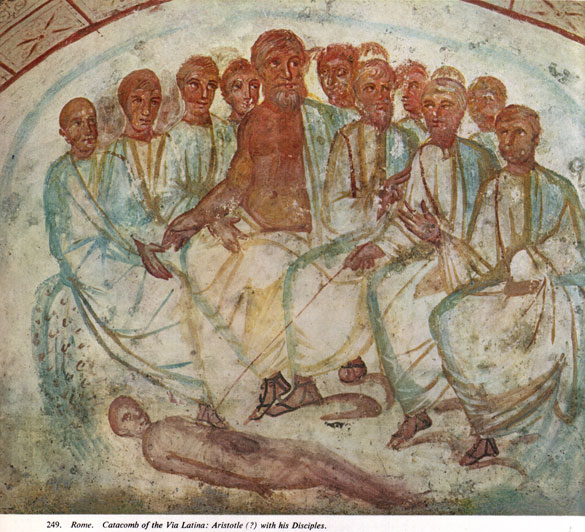
Early Christian Art: AD 200-395: From the Rise of Christianity to the Death of Theodosius, André Grabar, 1968, pp. 227-228, “3. The Art of the Fourth Century | The Via Latina Paintings”:
Christian Iconography: A Study of Its Origins, André Grabar, 1968, p. 9:
Illustration 14:
The Crucible of Christianity, Toynbee, 1969, p. 208, illustration 9:
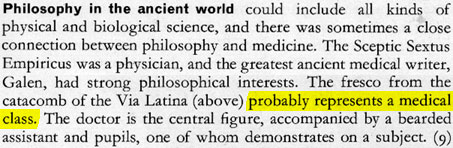
“Probably” means they don’t really know.
It was a religious thing:
Dictionary of Mythology Folklore and Symbols, Jobes, 1962, Vol. 3 (topical) Index, pp. 44-45: