COUNCIL OF CARTHAGE
Canons 41 & 42, 393 AD
(aka: Synod of Hippo, Canons 28 & 29; duplicated in more popularity at the Third Council of Carthage, 397 AD)
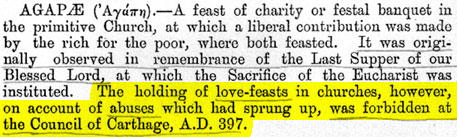
A Glossary of Liturgical and Ecclesiastical Terms, 1877, p. 7, “AGAPÆ”:
http://www.ccel.org/fathers/NPNF2-14/6sardica/afcns2.htm, Council of Carthage, (the agape canons):
CANON XLI. (Greek xliv.)
That by men who are fasting sacrifices are to be offered to God.
THAT the Sacraments of the Altar are not to be celebrated except by those who are fasting, except on the one anniversary of the celebration of the Lord's Supper; for if the commemoration of some of the dead, whether bishops or others, is to be made in the afternoon, let it be only with prayers, if those who officiate have already breakfasted.
…
CANON XLII. (Greek xiv.)
Concerning the not having feasts under any circumstances in churches.
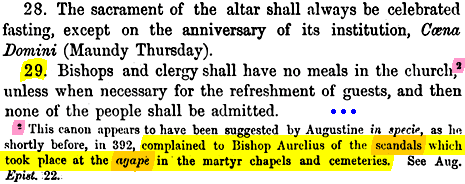
THAT no bishops or clerics are to hold feasts in churches, unless perchance they are forced thereto by the necessity of hospitality as they pass by.The people, too, as far as possible, are to be prohibited from attending such feasts.
http://www.ccel.org/ccel/schaff/npnf214.xv.iv.iv.xlii.html, The Canons of the 217 Blessed Fathers who assembled at Carthage, “Canon XLI”:
Canon XLI. (Greek xliv.)
That by men who are fasting sacrifices are to be offered to God.
THAT the Sacraments of the Altar are not to be celebrated except by those who are fasting, except on the one anniversary of the celebration of the Lord’s Supper; for if the commemoration of some of the dead, whether bishops or others, is to be made in the afternoon, let it be only with prayers, if those who officiate have already breakfasted.
Notes.
ANCIENT EPITOME OF CANON XLI.
The holy mysteries are not offered except by those who are fasting.
This canon is Canon xxviij. of the Synod of Hippo, a.d. 393.
JOHNSON.
From this canon and the 29th of Trullo, it is evident that by the Lord’s Supper, the ancients understood the supper going before the Eucharist, and not the Eucharist itself, and that on Maunday-Thursday yearly, before the Eucharist, they had such a public entertainment in imitation of our Saviour’s last Paschal Supper. I refer it to the consideration of the learned reader, whether St. Paul, by the Δεῖπνον κυριακὸν, 1 Cor. xi. 20, does not mean this entertainment. For the obvious translation of that verse is, “It is not your [duty or business] when you meet together [in the church] to eat the Lord’s Supper.” He would not have them to eat this supper in the public assembly: “For” (says he) “have ye not houses to eat and drink in, or despise ye the Church of God?” From the 4th age forward, the Eucharist was sometimes called the Lord’s Supper; but from the beginning it was not so. And even after it did sometimes pass by this name, yet at other times this name was strictly used for the previous entertainment, as may be seen by this canon, which was made in the 4th century. Further it seems probable, that the Lord’s Supper and the Love-feast was the same, though it was not usually called the Lord’s Supper; but only (perhaps) that love-feast, which was made on the day of the institution of the Eucharist, which we now call Maundy-Thursday.
http://www.ccel.org/ccel/schaff/npnf214.xv.iv.iv.xlii.html, The Canons of the 217 Blessed Fathers who assembled at Carthage, “Canon XLII”:
Canon XLII. (Greek xiv. [sic: xlv.])
Concerning the not having feasts under any circumstances in churches.
THAT no bishops or clerics are to hold feasts in churches, unless perchance they are forced thereto by the necessity of hospitality as they pass by. The people, too, as far as possible, are to be prohibited from attending such feasts.
Notes.
ANCIENT EPITOME OF CANON XLII.
A cleric is not to feast in a church, unless perchance he is driven thereto by the necessity of hospitality. This also is forbidden to the laity.
This canon is Canon xxix. of the Synod of Hippo, a.d. 393.
I think the reason this council canceling of the agape love-feast is cited most in books is because it doesn’t mention “beds.”
A History of the Councils of the Church, by Charles Joseph Hefele, 1896, vol. 2, p. 399, “BOOK VIII | SYNOD AT HIPPO IN 393” (Canons 41 & 42 are canons 28 & 29 in Synod of Hippo):
http://kt70.com/~jamesjpn/articles/ChristianityAndSei.htm, The Christian Digest, Presents: CHRISTIANITY AND SEX--PART 1, “SMOLDERING SEXUAL SUPPRESSION”:
The "Agapae," or "love feasts" of Early Christians, had for the first three centuries been a time when liberal contributions were made by the rich to the poor at a special gathering held for fun, feasting and fellowship. The Council of Carthage, in the year 397, repressed and solemnly condemned these "love feasts." Rev. Charles Buck described the demise of this quaint Christian custom:
The kind of charity, with which the ceremony used to end, was no longer given between different sexes; and it was expressly forbidden to have any beds or couches for the conveniency of those who should be disposed to eat more at ease. Notwithstanding these precautions, the abuses committed in them became so notorious, that the holding of them (at least in churches) was solemnly condemned at the Council of Carthage, in the year 397 (Buck, 1838: 16).