CATHARS
Let’s first back up to 325 AD:
Catholics rather accepting of Cathars:
http://www.piar.hu/councils/ecum01.htm, FIRST (Christian) COUNCIL OF NICAEA - 325 AD, “CANONS”:
- Concerning those who have given themselves the name of Cathars, and who from time to time come over publicly to the catholic and apostolic church, this holy and great synod decrees that they may remain among the clergy after receiving an imposition of hands. But before all this it is fitting that they give a written undertaking that they will accept and follow the decrees of the catholic church, namely that they will be in communion with those who have entered into a second marriage and with those who have lapsed in time of persecution and for whom a period [of penance] has been fixed and an occasion [for reconciliation] allotted, so as in all things to follow the decrees of the catholic and apostolic church. Accordingly, where all the ordained in villages or cities have been found to be men of this kind alone, those who are so found will remain in the clergy in the same rank; but when some come over in places where there is a bishop or presbyter belonging to the catholic church, it is evident that the bishop of the church will hold the bishop's dignity, and that the one given the title and name of bishop among the so-called Cathars will have the rank of presbyter, unless the bishop thinks fit to let him share in the honour of the title. But if this does not meet with his approval, the bishop will provide for him a place as chorepiscopus or presbyter, so as to make his ordinary clerical status evident and so prevent there being two bishops in the city.
They sound like a pretty large sect to be mentioned at the first major council after Rome accepted the Church.
Later, (after agape feast fully suppressed) not so nice:
http://fixedreference.org/en/20040424/wikipedia/Albigensian_Crusade, Albigensian Crusade:
The Albigensian Crusade (1209-1229) was part of the Roman Catholic Church's efforts to crush the Cathars. It is linked to the movement now known as the Medieval Inquisition. The Cathars were especially numerous in southern France, in the region of Languedoc, then part of the Catalan-Aragonese Confederation or Kingdom of Aragon.
http://www.davidcox.com.mx/library/38_heresies_and_sects.htm, 38 Heresies and Sects, “Catharism”:
Cathars were considered such a threat in the Middle Ages that both a Crusade and a Papal Inquisition were launched against them. The Albigensian Crusade (named for the French city of Albi, a Cathar stronghold), lasted 20 years and saw astonishing violence, the most famous being in July 22, 1209 when the city Beziers was sacked and 20,000 men, women, and children killed by the crusaders. The Cathars that survived were wiped out by the Papal Inquisition of 1227, finished off by the burning of 215 Cathar leaders at the Castle of Montsegur in 1244. By the beginning of the 14th century the Cathars were extinct.
How come?:
http://www.ipt-forensics.com/journal/volume5/j5_2_4.htm, Sexual Attitudes in the Contemporary Legend About Satanic Cults, by Jeffrey S. Victor, “Devil Worship Accusations Against the Cathars”:
The Cathars were accused of engaging in sexual orgies, sometimes involving incest, and of practicing secret rituals in worship of the Devil, involving the sacrifice of children and eating their flesh in cannibalistic rites (Cohn, 1975).
Where have we heard all this before?
http://www.davidcox.com.mx/library/38_heresies_and_sects.htm, 38 Heresies and Sects, “Catharism”:
Logically, marriage was forbidden, though fornication was permitted.
http://www.atlan.org/articles/sacraments/, The Atlantean Origin of the Seven Sacraments, “3) Matrimony”:
In the New Testament, marriages are usually celebrated at night and are often attended by agapes which somewhat evoke the strange marriage rituals described in the Song of Songs. The practice also evokes the puzzling orgies of the Gnostic Cathars of Medieval Europe. These love feasts are reenactments of the Cosmogonic Nuptials, the orgiastic mingling of Fire and Water that takes place at Doom.
The stereotype for groups strongly against marriage was either no sex at all or open sex.
http://www.geocities.com/mcnaughtonofdunderave/religion_of_the_comet.htm (2-6-04), The Religion of the Comet by Thomas R Holme:
Suffice it to say that although Cathar perfects became vegetarians and gave up all sexual life, the exact opposite was true for regular Cathar members who were known for their sacred orgies. …
So it was about 1209 with their brethren massacred behind them, that Cathar survivors began to straggle into England. The pope’s crusade against them continued until 1229 so one may expect that Cathars continued to escape to England all during that time period. …
The Cathars were a Christian religion that did not believe in the pope. …
In 1150 Geoffrey of Auxerre wrote about the free love of the Cathars. They evangelized their love to the extent that word of it spread like wildfire across the land and in 1157 the Catholic Council of Reims condemned as heretics all who participated in sexual orgies. Around 1182 the historian Walter Map wrote that the orgies happened in this fashion: the participants put out the lights and in the dark and made obscene rites, and afterwards made love with any other person handy, indiscriminately. They believed the sacrament of free sexual love-making transported them into eternal beings. Another historian of the day, Alan of Lille, explained their thinking thus: A person must use every means at his disposal to cleanse himself of everything earthly or diabolical clinging to him. In order to rid themselves of concern for the body they engaged in random sexual intercourse. They “Abuse” the body to show their contempt for it, and the Catharist had contempt for marriage believing that marriage imprisons the souls in bodies by keeping each person from loving all the others. The scriptures say that in heaven there shall be no marriage. Therefore eternal beings will love every other eternal being indiscriminately. Earthly bonds must be regarded contemptuously to free oneself to be eternal.
Many thousands of Cathars lived in the mountains of southern France. During the centuries of their existence their communities grew and grew. They had libraries and universities and great scholars and saints. Their great adversary was the Catholic religion which was commited to eradicating them, finally sending armies of soldiers returning from the Crusades to war against the mountain Cathars. Entire villages were massacred. The Cathars were burnt for their beliefs. What is amazing is the many historian’s accounts of Cathar men and women singing psalms together as they burned in the flames until the very last moment!
So, in spite of their complicated and somewhat scarey theosophy many people today are inclined to think of the Cathars as noble hearts made tragically to suffer, oppressed as they were by evil tyrannical powers. The Catholic crusaders that burned the valiant Cathar men, women and children, who tortured them in dungeons, seem much like the Nazis of the 19th century. … For basically all the Cathars were saying was that the torture chambers of the Catholic church dungeons were not of Christ, but were evil, and the pope who commanded crusaders to burn men and women and children to death was a servant of Satan, not of Jesus Christ, truly and clearly. …
At any rate those Cathars who found their way to England surely did not remain. England was a Catholic land where the pope could easily get his hands on them. The only safe place on the British Island where they might go would be the mountainous Celtic areas of Scotland. There they would safely blend into the land among the Normans already claiming their futures there. The Cathars would be wise enough not to make the same mistake they had made in France. Their free love masses would end or become very secret. (you see, the “mistake” or reason for persecution was “their free love masses.”) They would modify their religion and their habits in such a way they would not again be crusaded against in their new home. …
This ability to do great evil without qualm is the path by which Cathars became known as witches. …
Whether or not you believe that surviving French Cathars crossed to England and made their way to the Scottish Highlands there is still the fact of the rise of Dianist Witchcraft in Scotland in the fifteen hundreds. …
In this way Cathars could have lived in the Highlands of Scotland undetected for centuries.
The Cathars were exterminated in France between 1209 and 1229. Any who escaped to other lands did so during those years.
I think that’s pretty cleaver how the Catholic Church tried to kill off an entire Christian sect (Cathars) so their practices don’t get disseminated into the future. As you can see, it worked rather well, don’t you think? I am amazed, though, how the Catholic Church was so powerful of an influence that it fooled the entire world, even the Protestants, with full instillment, concerning marriage, when the actual Bible says it’s serves Christ better to not marry (1 Cor. 7). Well, they had me believing it too, at one time.
http://www.newadvent.org/cathen/01267e.htm, Albigenses:
They were also called Catharists (katharos, pure), though in reality they were only a branch of the Catharistic movement. …
The dualism of the Albigenses was also the basis of their moral teaching.… As generation propagates the slavery of the soul to the body, perpetual chastity should be practiced. Matrimonial intercourse is unlawful; concubinage, being of a less permanent nature, is preferable to marriage. Abandonment of his wife by the husband, or vice versa, is desirable. Generation was abhorred by the Albigenses even in the animal kingdom. Consequently, abstention from all animal food, except fish, was enjoined. … War and capital punishment were absolutely condemned.
http://home.wanadoo.nl/serendipity/index-c.html, "Catharism" (12-27-01):
The main westeuropean gnostic movement, centering in the south of france in the 12-13th century AD. Cathars believed that gnosis, or divine knowledge (possibly requiring aid from above) was a necessary requirement for enlightenment and salvation. Catharism was initially a very peacefull and grassroots affair
The Dark Side of Christian History, Ellerbe, pp. 72-75, “The Church Fights Change”:
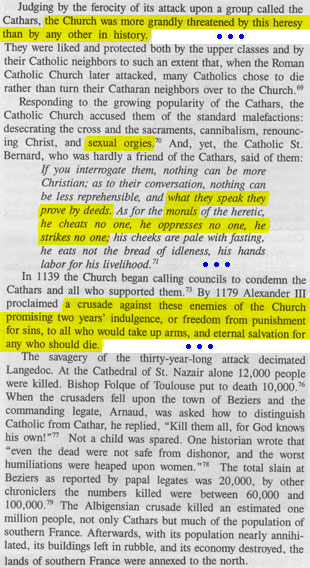
“The worst humiliations were heaped upon women,” today the word is “slut.” You need to try to understand the power behind the Catholic’s influence against sex out of marriage for today, and why you can’t think of God and morality in any other way.
http://www.locksley.com/6696/satan.htm, Satan: Prince of the World, by: Gene Taylor, Anderson County Sheriff's Office, “The Fall of Satanism”:
In 1022, in Orleans, France a group of about 14 heretics were burned at stake. Over the next few centuries hundreds of thousands of accused witches, accused heretics, and Jews were executed. The allegations in Orleans were that the heretics engaged in secret rituals in which they worshipped the Devil, held sex orgies, and sacrificed infants. The legend was born then and is the one we hear repeated today (Victor, 1993).
The Cathars were a significant movement against the Church. Around the 1160's the Cathars had thousands of followers in southern France and northern Italy. They had their own churches and clergy organization. In 1208 a Catholic army was sent by the Pope to exterminate the Cathars. They had been accused of engaging in sexual orgies and practicing secret rituals in worship of the Devil, involving sacrificing children and eating their flesh (Victor, 1993).
Actually the Cathars were a rather puritanical group. Many of their leaders practiced life-long chastity, frequent fasting, and vegetarianism (Victor, 1993).
The Dead Sea Scrolls and the Christian Myth, John M. Allegro, 1992, pp. 129-131, “The Love Feast” (Re: Manichaean Elect):
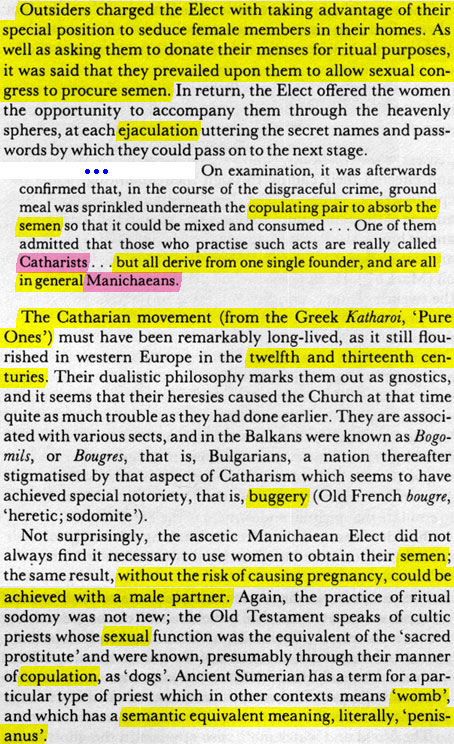
John M. Allegro was one of the original scholars who worked on the Dead Sea Scrolls.
http://en.wikipedia.org/wiki/Free_love, Free love, “History of free love movements”:
Karl Kautsky, writing in 1895, noted that a number of "communistic" movements throughout the Middle Ages also rejected marriage.[6] Typical of such movements, the Cathars of 10th to 14th century Western Europe freed followers from all moral prohibition and religious obligation, but respected those who lived simply, avoided the taking of human or animal life, and were celibate. Women had an uncommon equality and autonomy, even as religious leaders. The Cathars and similar groups (the Waldenses, Apostle brothers, Beghards and Beguines, Lollards, and Hussites) were branded as heretics by the Roman Catholic Church and were brutally suppressed. Other movements shared their critique of marriage but advocated free sexual relations rather than celibacy, such as the Brothers and Sisters of the Free Spirit, Taborites, and Picards.
Again, it appears that marriage is the only sin.
http://www.innervision.com/mysteries/cathars.html, Cathars and Reincarnation, “Why Were the Teachings of the Original Christians Brutally Suppressed by the Roman Church?”:
At Beziers, when asked how to tell who was a Cathar and who was not, the commanding legate, Arnaud, replied, 'Kill them all, for God will know his own.' Not a child was spared. … By 1215, the Council of Lateran established the dread Inquisition. During the next 50 years the toll of those killed by this infamous arm of the Church climbed to one million, more than in all of the other crusades against heresies combined.
This shows that the most evil of all Christian sects, would be the ones who will win militarily, which would be the ones who later teach society their views. If the Cathars would have attacked and killed all the Catholics, then today were would all be thinking like the Cathars.
http://www.dobl-oc.com/Engles/Cathars/:
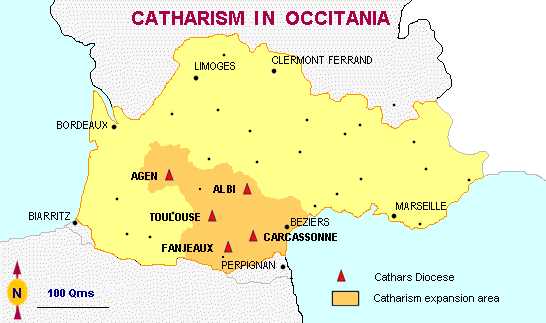
http://www.innervision.com/mysteries/cathars.html:
…
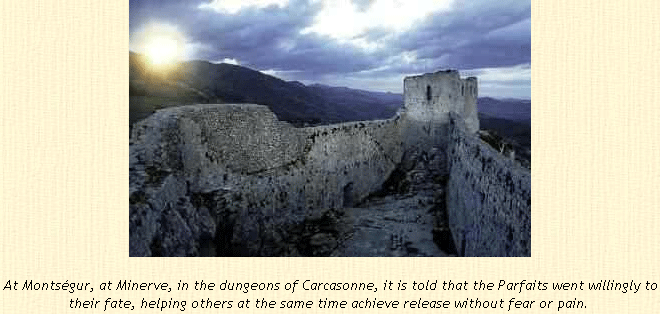
http://www.mysticmissal.org/cathars.htm:

http://www.cathars.org/html/catharisme.html (2-5-04), Catharism, the religion of the Cathars, “4- Cathar Symbolism”:
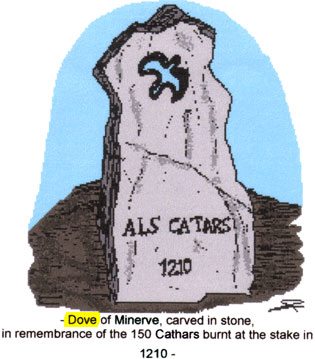
http://www.computours.net/cathar/

Just what
were the cathars? The answer is revealed in a study of life centuries ago; a
Christian religion, eventually to founder on the rock of catholic bigotry.
Cathars were a gentle people who, whilst
existing all over southern Europe,
were particularly active in the wealthy southern part of France around Toulouse, Carcassonne and Béziers. Its followers had a simple code of living to
become pure - “parfaits”. Only later did scholars ascribe the Greek word
for pure - kathari - to this religion.
Essenes:
http://www.chaosmagic.com/discussion/archivedmessages/baphomet-and-choronzon.shtml, Baphomet and Choronzon:
You will find the name of the Gnostic Goddess of Wisdom, Sophia, written in Hebrew. Thus we can see the secret cypher passed from Essene to Gnostics, to Cathars to Knights Templar.
The Encyclopedia of Religion, Eliade, 1987, vol. ?, p. 566, “GNOSTICISM”:
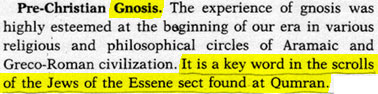
P. 573, “GNOSTICISM | The Middle Ages”:
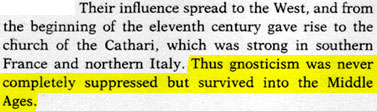
Bulgars, Bulgaria, buggery, etc.:
http://encyclopedia.laborlawtalk.com/Cathars, Cathars - definition of Cathars in Encyclopedia, “Beliefs”:
They did not perform any rite of marriage, as procreation (bringing more souls into the world) was frowned upon. It was as a result of this particular belief that the term "buggery" was coined (after the 'Bulgars', or 'Bougres') since sex (using a loose definition) was perfectly all right as long as as no children resulted.
http://www.fictionwise.com/knight/boschfortytwo.html, Was Bosch a Sodomite?:
Lynda Harris writes, rather charmingly, "In medieval Europe, the Cathars were often referred to as 'Bougres.' This was an acknowledgement of the fact that their religion had originally come from Bulgaria." Yes, and also that the Cathars, like many other heretic groups, were accused of unconventional sexual acts, hence our word "buggery."
http://www.askwhy.co.uk/christianity/0811Inquisition.html, Christianity Revealed, Heresy and the Inquisition II: Persecution of Heretics, “The Albigensian Crusade”:
The orthodox Catholics of France called them “bougres”, for Bulgars, implied that their sexually chaste leaders indulged in anal sex, and so the name of innocent people became one of the worst swear words used.
http://www.askwhy.co.uk/christianity/0810Inquisition.html, Christianity Revealed, Heresy and the Inquisition I: Cathar Beliefs, “Albigensian Beliefs”:
The name of Bulgarians (“Bougres”) was often applied to the Albigenses, who communicated with the Bogomil sectaries of Thrace.
http://www.davidcox.com.mx/library/38_heresies_and_sects.htm, 38 Heresies and Sects, “Euchites”:
The Euchites were a sect that separated from the Christian Eastern (Orthodox) Church in Mesopotamia, and then extended by Asia Minor and Thrace. By the 12th century it had reached Bohemia and Germany. The doctrine of this sect was declared a heresy by both Western and Eastern Christian authorities, and according with a resolution of the Council of Trier (1231) they were persecuted.
The doctrine of the Euchites was very similar to that of the Bogomils and Luciferians. They did not recognise the sacraments of the Christian church, considered Lucifer as the elder son of God, and, based on the idea that the direct descendants of Adam and Eve had to practice it to procreate, admitted incest among their members. Homosexuality was also considered a natural practice among them, and virginity in women had no value to the members of this cult. They were mentioned for the first time in one of Michael Psellus' works, in the 11th century.
Cats:
http://www.thefreeencyclopedia.com/definition/word.aspx?w=Cathar, Cathar:
Catharism was a movement with Gnostic elements that originated[sic] around the middle of the 10th century, branded by the contemporary Roman Catholic Church as heretical. It existed throughout much of Western Europe, but its home was in Languedoc, in southern France. The name Cathar most likely originated from Greek catharos, "the pure ones". Another suggested origin was from Latin cattus, for "cat", which were usually associated with witches and heretics, who were claimed to kiss cats' anuses.
http://www.maknap.com/MysteryTV/history/templars/articles/mhte_15a_charges.htm, The Knights Templar, “The Initiations”:
The consensus among historians is that these charges were derived from those levelled at the Cathar heretics of the Languedoc a little under a century before. The Cathars, too, had been said to renounce the Christian sacraments, worship a cat, kiss the Devil on the buttocks, and take part in orgies.
http://www.askwhy.co.uk/christianity/0818Inquisition.html, Christianity Revealed: Witchcraft I:
The name Cathar derives from cat, because they kiss the ass of the cat,
http://www.shanmonster.com/witch/familiar/cat.html, Cats, Magic, and Witchcraft, “The Devil as a Cat”:
The testimony in many trials portrayed witches or heretics like the Waldensians and Cathari as gathering together to kiss the posterior of a black cat.
Well, like I’ve always said, I’ve never found a perfect religious group to follow.
Dictionary of Mythology Folklore and Symbols, Jobes, 1961, Vol. 1, p. 297, “Cat”:

Witches:
http://www.fortunecity.com/meltingpot/ukraine/231/dionysian/orphism.html, From Orphism to Gnosticism:
surviving all the anti-Gnostic 'witchhunts' which destroyed other sects. … Christian Gnosticism would eventually be eradicated (as an open religion) by the Catholic Church, the last defiance being from the medieval Cathars.
http://omega.cohums.ohio-state.edu/medrel/sij_lectures/wk2wed.htm (2-5-04), Heresy and the Pact:
•Cathars (Gazari) = “pure”
—Neoplatonic world view; procreation avoided…incest, abortion, infanticide? …
—impede marital sex
—typical orgy …
The idea of the foreign, threatening cult. At first, accusations are made by pagans against each other (Bacchanalia, etc.) then they are made against Christians by Greeks and Romans, and then Christians begin to make them against each other (against “heretics”). Often, the specific accusations include orgies, infanticide and cannibalism (thus borrowing from the Nightwitch). Also comes to include worship of demons and practice of magic.
http://www.geocities.com/Heartland/Pines/7224/Rick/chronindex.htm, Church History Timeline, “The Twelfth Century”:
1157 The archbishop of Reims, Samson, noted that Manicheanism was being popularized in his diocese by itinerant weavers. These Manicheans reportedly criticized marriage and promoted licentious behavior. Samson referred to the heretics as Poblicani.
“The Fourteenth Century”:
1350 A Bulgarian council meeting at Tirnovo condemned two former monks of Mount Athos, Cyril the Barefooted and Lazarus, on charges of heresy. Bogomil doctrines had spread to Mount Athos by way of a certain Irene, who ran a hostel in Thessalonica where monks would sometimes stay. The two monks had been banished from Athos and moved to Tirnovo. Lazarus urged nudism and universal male castration. Cyril taught that married couples should live apart. A third preacher, Theodosius, also promoted nudism, but he also encouraged men to sin that grace may abound. His movement was noted for its sexual excess.
“The Fifteenth Century”:
1484 Pope Innocent VIII (1484-92) condemned witchcraft in the bull Summis desiderantes affectibus. The bull blamed witches for plague and storms, stated that apostate Christians had entered into sexual relations with witches, and claimed that witches’ spells had harmed men, women, children and beasts. Innocent sent inquisitors to Germany to conduct witch trials there.
“The Sixteenth Century”:
1595 Martin Del Rio, a Spanish Jesuit, published a book on witchcraft. According to Del Rio, witchcraft flourishes as the intial enthusiasm for heresy dies out. In his view, this phenomenon was then taking place in the Low Countries. Del Rio also popularized the notion that witches hold sabbats and engage in sexual intercourse with Satan.
http://www.paganlibrary.com/witch_hunting/persecution-modern_ancient.php, Persecution: Ancient And Modern:
We mentioned earlier that in Continental Europe, the heresy trials appeared to arise from the persecution of the Christian sects of the Bogomils, Cathars, Albigensians, and others such as the Jews, Waldensians, and even the Knights Templars. The stereotype of the witch was compounded from many different sources, and gradually became the composite figure of the shape-shifting hag, who flew through the air on a broom, and flung her curses at all and sundry.
The concept of the pact with the devil existed as early as the 8th century, and as we have seen, sexual license, buggery and ritual sacrifice have long been seen as activities supposed to be practiced by those outside of society's norm, whether they be Christian or Pagan.
…
In 1022, the first burning occurred: at Orleans, the victims were accused of, "holding sex orgies at night in a secret place, either underground or in an abandoned building. The members of the group appeared bearing torches. Holding the torches, they chanted the names of demons until an evil spirit appeared. Now the lights were extinguished, and everyone seized the person closest to him in a sexual embrace, whether mother, sister or nun.
http://books.google.com/books?id=LsjagvvkveEC&printsec=frontcover&dq=%22Witchcraft+in+the+Middle+Ages%22&sig=_7aPn9aR9O1Hc7bYOFQIImKvUuw#PPA88,M1, Witchcraft in the Middle Ages –Google Books Result, by Jeffrey Burton Russell, 1984, p. 88:

http://mikhalia.drak.net/inquisition.html (2-6-04), Witchcraft, “The Inquisition”:
In 1022 the Church held the very first mass heresy trial, the defendants were reformed Christians who preached that the Church was unnecessary because God was in the heart. They were accused of incestuous orgies, nocturnal flying, and the summoning of demons and spirits. They confessed to speaking with the Holy Ghost who was a spirit of sort, for this they were sentenced to death. They were burned at the stake, singing and laughing, convinced that they were not wrong and that God would save their souls. During the 12th century organized heresy was seen by the Church as a threat and vigorous efforts were put forth to stamp out the sects of heretics, especially the Cathars.
http://www.answers.com/witchcraft, “witchcraft”:
European diabolical witchcraft was a form of sorcery that appealed to pre-Christian symbolism and was associated by Church leaders with heresy. The origins of witchcraft in Europe are found in the pre-Christian, pagan cults such as the Teutonic nature cults; Roman religion; and the speculations of the Gnostics (see Gnosticism), the Zoroastrians, and the Manicheans. These religions and philosophies believed in a power of evil and a power of good within the universe. Later, among certain sects, the worship of good was repudiated as false and misleading. … Accusations of witchcraft were frequently combined with other charges of heresy against such groups as the Cathars and Waldensians.
http://www.askwhy.co.uk/christianity/0818Inquisition.html, Christianity Revealed: Witchcraft I, “Witchcraft in the Inquisition”:
If witches met in secret nocturnal assemblies to carry out what the judges considered inversions of Christian worship, and orgiastic sex, then they were indeed still practising the heresy that had earlier been categorized by the same behaviour. …
“Witchcraft and Heresy”:
At Douai, a woman was brought before the Inquisition on the ground that she was a Waldensian. In France, at this period, the crime of witchcraft was frequently designated as “Vauderie” showing that it was associated with the Vaudois, the Waldenses. She was forced to name names, and they in turn denounced others, until a large number of victims confronted the inquisitor. Under a promise of light sentences if they confessed, they all glibly agreed that they had gone to witch meetings on oiled broomsticks, had met the Devil in the form of a goat or ape, and had concluded with a general orgy.
“The Devil” is likely the Catholic definition.
http://www.loyno.edu/~history/journal/1986-7/horton.htm, Devil Worship in the Middle Ages:
In 1179, another group of heretics gained the attention of the Church. The Waldensians, or Vaudois, were accused of cannibalism, holding orgies, worship of the Devil in the form of a dog, and sorcery. This group originated as a sect of aesthetes founded by a rich young man who disposed of all his worldly goods in imitation of the apostles. Their problems began when, unlike the Franciscans who originated in a similar way, they were denied papal approval to preach. When they continued to do so, they were excommunicated in 1181, and condemned as heretics in 1184. <16>
Man, Myth & Magic: The Illustrated Encyclopedia of Mythology, Religion and the Universe, Cavendish, 1995, p. 2344, “Sex | Overwhelming Eros”:
http://www.askwhy.co.uk/christianity/0820Inquisition.html, Christianity Revealed, “Witchcraft III”:
Again it is a likely link between Catharism and witchcraft. … The Cathars characterized the Catholic Church as the synagogue of Satan, matching their refusal to use the word “Church” except for the body of true believers, and their use of “synagogue” otherwise. … The Therapeutae, of which the Essenes were a branch, at the beginning of the Christian era, had an all night religious service like that of the witches:
After the feast they celebrate the sacred festival during the whole night. They sing hymns in honour of God, at one time all singing together, and at another moving their hands and dancing in corresponding harmony. Then when each chorus of the men and each chorus of the women has feasted by itself separately, like persons in the Bacchanalian revels, they join together.
Murray observes that this is so like the singing dances of the witches that both might come from the same source. It shows how close to the truth she was. The Essenes had to praise God continuously and sang hymns to the rising sun, as the early Christians did. If the Cathars were a survival of Essenism and primitive Christainity, then they might have done the same, and thereafter, when they were scattered by persecution, their scattered remnants will have tried to preserve the same traditions.
http://www.answers.com/topic/sabbath-witchcraft, “Witches’ Sabbath”:
A meeting of witches, supposed by medieval Christians to be a demonic orgy. … midnight meeting of witches to practice witchcraft and sorcery; in the Middle Ages it was supposed to be a demonic orgy … It was believed that the Sabbath commenced at midnight and ended at dawn, beginning with a procession, continuing with a banquet, then a Black Mass, and culminating with an orgy in which non-marital or sexual intercourse with demons in male or female form was practised. Hallucinogens were cited as means to favour sexual climax and sometimes alcohol was mentioned.
Dictionary of Symbols and Imagery, Ad de Vries, 1976, p. 417, “sex | IV. sexual orgies”:
Sexualia: From Prehistory to Cyberspace, Bishop / Osthelder, 2001, pp. 260-262, “Witches and Witch-hunters”:
http://www.infidels.org/library/historical/joseph_mccabe/religious_controversy/chapter_22.html, The Story Of Religious Controversy, “The Real Witch“:
In point of fact, the Paulicians and Bogomiles and their kin had quaintly mixed the old Persian belief with some of the speculations of the Gnostics. The ancient Persians had believed that the evil principle had created matter which was evil. To Christians the evil principle was Lucifer, and the new heretics contended that Lucifer was one of the two sons of God, unjustly cast off by an overbearing father. He became their "prince" and "lord," and (unlike the Persians) they believed that he would ultimately triumph. This belief either led to or was due to -- the details are necessarily obscure, as we know the tenets only from bitter enemies -- another departure from Manichaeism. The Manichaeans had been very ascetic, deeming the flesh (as part of the creation of the evil principle) an evil thing; and it is clear that the Albigensians and other European heretics also led strict lives. But the glorification of Lucifer meant that matter and the flesh could scarcely be regarded as evil, and a reaction into orgies was inevitable. The witches, at least, had such orgies.
“The Secret Cult”:
It is now time that we formally considered the question, what witchcraft really was. The prevailing, almost universal, opinion of those who at length rose against the persecution, and of the nineteenth-century writers on witchcraft, was that the cult or organization and all the details alleged about it were a creation of popular credulity and monkish imagination. The secret meetings or Sabbaths were thought to have been as fictitious as the ride through the air on a greased broomstick. The "devil" who is put as the central object of the cult was declared a fiction. The witches' mark, the orgies, the homage, and all the rest were regarded as wholly imaginary. Inquisitors wrote their manuals of these things, and the unfortunate men and women confessed whatever they willed in order to put an end to the diabolical tortures. Death for witchcraft was preferable to a life thus prolonged; indeed very few in any case were ever acquitted by the Inquisition. Bernard Shaw's dramatic version of its procedure looks rather like a meeting of a committee of the Fabian Society to judge a member for, say, reading H.G. Wells. The Inquisitors had bowels of brass.
http://books.google.com/books?id=JPjXqjphQ-4C&pg=PA86&dq=%22Occultism,+Witchcraft,+and+Cultural+Fashions%22+%22promiscuous+embrace%22&sig=hXcFy1qlFrkzfzkom4gSzdZPWvk#PPA86,M1, Occultism, Witchcraft, and Cultural Fashions: Essays in Comparative Religions –Google Books Result, by Mircea Eliade, 1978, p. 86, “Some Observations on European Witchcraft”:
P. 87:
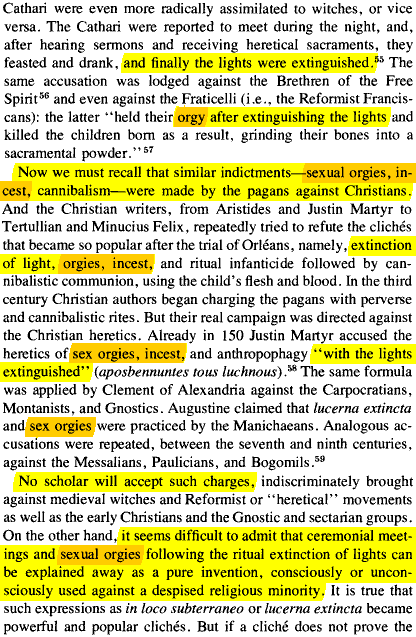
P. 88:
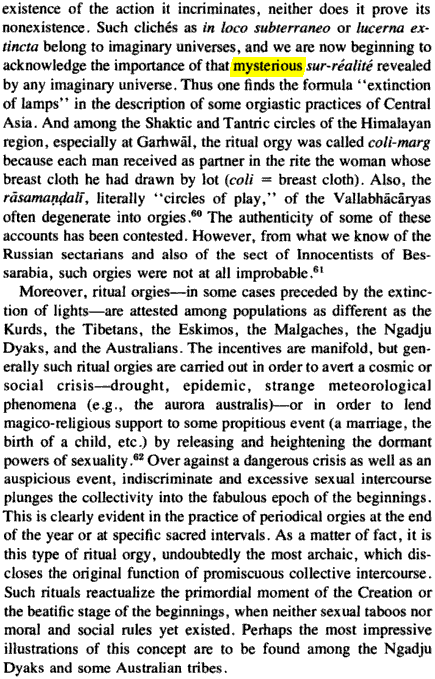
http://www.rotten.com/library/sex/group-sex/orgies/, Orgies:
The Christian attitude toward sex was extremely repressive, especially as it related to the unwashed masses (as opposed to priests, who pretty much did what they wanted for the first 2,000 years). Things deteriorated further during the Middle Ages, when group sex was explicitly linked to Satanism and witchcraft, and those in power sublimated their sexual impulses into violence.
The Oxford English Dictionary, 1933, “Orgy” “2”:

Dictionary of Mysticism and the Occult, Drury, 1985, pp. 201-202:
http://www.eioba.com/a70752/orgies_a_brief_history, Orgies, a brief history, “Witchcraft”:
A manual for witch hunters, Malleus Maleficarum29 (Hammer of Witches), published in 1486 by the Church, concluded that witchcraft was based upon women’s insatiable sexual lust. That is why women are more likely to become witches than men. It says: "...But the natural reason is that she is more carnal than a man, as is clear from her many carnal abominations" adding that "... All witchcraft comes from carnal lust, which is in women insatiable.
…
Witches also were adulterous, practiced cunnilingus, anal sex and fellatio. They corrupted young girls into the pleasures of lesbianism.39.
…
The connection between sex and sin and promiscuity, women and whore, was established. Hundreds of thousands (some even put the figure at between two and four million people33) were burnt at the stake.
Now I see why Catholics persecuted witches.
Rasputin / Khlysty (Russia’s Gnostic Underground):
The Woman’s Encyclopedia of Myths and Secrets, Barbara G. Walker, 1983, pp. 743-744, “Orgy”:
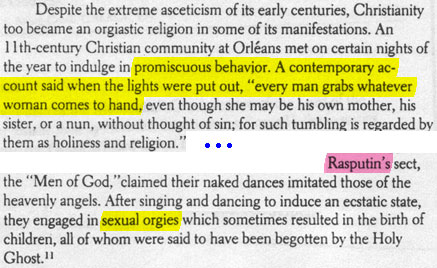
http://www.smol.ro/loveme/variety.html, “Largest Orgy”:
One other lecherous religion is Khlysty, a 19th century Russian flagellant order whose perverted doctrines where advocated by Rasputin. I don't know of any modern day counterparts that still use mass fornication, but there are bound to be a few open to new members.
http://www.gnosticliberationfront.com/Russia's%20Gnostic%20Underground.htm, Love & Ecstasy: Russia’s Gnostic Underground, “People of God”:
The Italian metaphysician Julius Evola offers the following, slightly different, description of a Khlyst ceremony:
The dogmatic premise of the sect is that man is potentially God. By developing awareness of this, he can be God in fact, taking to himself the nature of Christ (whence comes the name of the sect) if he is a man, or that of the Virgin if a woman, through the transfiguring descent of the Holy Ghost, provoked by celebration of a secret midnight rite. The participants, both men and women, wear only a white garment over complete ritual nakedness. While pronouncing invocations, they begin dancing in a circle. The men form a circle in the middle that moves quickly in the direction of the path of the sun, while the women form an outer circle at first and move in the opposite direction to the path of the sun (a ritual reference to the cosmic polarity observed by the sexes). The motion becomes more and more wild and giddy until some of the participants leave the circles and begin dancing alone, like the ancient vertiginatores and Arab dervishes, so fast, it is said, that sometimes their figures can no longer be picked out as they fall and rise again (the dance as a technique of ecstasy). Their frenzy becomes contagious. To increase their exaltation, the men and women, whip each other (pain being an erotic and ecstatic factor). At the peak of this exaltation, the inner transformation, the immanent, invoked descent of the Holy Spirit begins to be foreshadowed. At this point, both men and women strip off their while ritual garments and copulate promiscuously; the drive of the sexual experience and the trauma of coitus bring the rite to its most extreme intensity.4
Evola recounts the oft repeated charge, made by their Orthodox enemies, that these secret ceremonies always ended in an unrestrained sexual orgy. Or as one author put it, the Khlysty engaged in “a kind of lucerna extincta [lights-out] rite, in which men and women…had intercourse [including] homosexual intercourse”, to attain an altered state of consciousness. … We know the Khlysty repudiated marriage, openly distaining conventional family life.
…
So also does he who, lifting his spirit to God, has enjoyment with a person of the same sex or alone….In doing that which we erroneously call impure is real purity ordained by God, without which man cannot arrive at a knowledge of Him.7
…
Filled with the Holy Spirit, their bodies of flesh transformed, they can commit no bodily sins. Sexual repression is out of the question as it only serves to fuel a dangerous imbalance and neurosis. Thus strictly controlled non-reproductive sex may be sanctified by ritual, purified and transformed into an intense embracing of God. The medieval Brethren of the Free Spirit in Western Europe demonstrated the transcendent virtues of such sacred sex, nakedness, and scorn of all man-made conventions.
Miscellaneous:
http://www.xenohistorian.faithweb.com/church/xr01.html, A History of Christianity: Chapter 1: THE DEVELOPMENT OF THE EARLY CHURCH: 1 to 300 A.D., “The First Heresies”:
Remarkably, there is a surviving community of Gnostics today, the Mandaeans in Iraq and Iran.
You don’t say.