ARISTIDES (& Porphyry)
Aristides The Philosopher, The Apology Of Aristides, Chapter 17, c. 125 AD
And, Porphyry (Porphyrios) (c. 233-305 AD)
And, the Christian burning of the huge library in Alexandria (391 AD)
http://www.pinn.net/~sunshine/book-sum/porphyry.html, Porphyry's Against the Christians: The Literary Remains:
8) "According to the early critics Tacitus, Pliny, and Aristides, Christianity was to be judged according to the unwillingness of its adherents to compromise. They were superstitious fanatics given to outpourings of enthusiasm, or they occasionally indulged in sexual orgies in association with their eucharistic banquets.
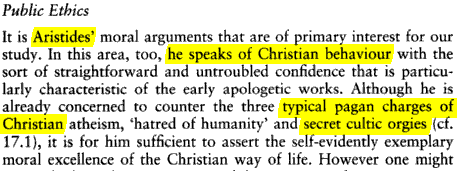
http://books.google.com/books?id=iWiEut-zdW4C&pg=PP3&lpg=PP3&dq=%22jewish+law+in+gentile+churches+halakhah+and+the+beginning%22&source=web&ots=_wI_OtmYIr&sig=nUU28H7qdpX0vdIy4HsIokXCylI#PPA204,M1, Jewish Law in Gentile Churches: Halakhah and the Beginning of Christian Public Ethics – Google Book Result, by Markus Bockmuehl, 2000, p. 204, “The Beginning of Christian Public Ethics | Aristides of Athens”:
http://en.wikipedia.org/wiki/Apology_of_Aristides, Apology of Aristides, “Content of the Apology”:
Now the Greeks, O King, as they follow base practises in intercourse with males, and a mother and a sister and a daughter, impute their monstrous impurity in turn to the Christians." This is an allusion the charges of Thyestean banquets and other immoralities, which the early apologists constantly rebut.
http://www.tertullian.org/fathers/aristides_02_trans.htm, THE APOLOGY OF ARISTIDES THE PHILOSOPHER: Translated from the Syriac, “XVII”:
Now the Greeks, O King, as they follow base practises in intercourse with males, and a mother and a sister and a daughter, impute their monstrous impurity in turn to the Christians. …
Henceforth let the tongues of those who utter vanity and harass the Christians be silent
http://www.tertullian.org/fathers/aristides_07_appendix.htm, THE ORIGINAL GREEK OF THE APOLOGY OF ARISTIDES, “The Apology and the Preaching of Peter”:
With regard to the second passage, there is a still more striking parallel in c. xvii., preserved to us only in the Syriac Version. ' The Greeks then, O king, because they practise foul things in sleeping with males, and with mother and sister and daughter, turn the ridicule of their foulness upon the Christians; but the Christians are honest and pious,' etc.
http://books.google.com/books?hl=en&id=0mxAAAAAIAAJ&dq=%22the+apology+of+aristides%22&printsec=frontcover&source=web&ots=LvYYlCqQoQ&sig=01dlVKohjWueQtf4SRc8PbWG6y0#PPA51,M1, The Apology of Aristides on Behalf of the Christians: From a Syriac Ms. Preserved on Mount Sinai – Google Book Result, by J. Rendel Harris, 1893, p. 51, “XVII”:

By the way, concerning Porphyry (above):
Porphyry (Porphyrios) (c. 233-305 AD)
http://www.irishoriginsofcivilization.com/irishoriginsexcerpts/irishorigins1.html, The Irish Origins of Civilization: Akhenaton, the Cult of Aton, and the Dark Side of the Sun:
The Church burned enormous amounts of literature. In 391 Christians burned down one of the world's greatest libraries in Alexandria, said to have housed 700,000 rolls. All the books of the Gnostic Basilides, Porphyry's 36 volumes, papyrus rolls of 27 schools of the Mysteries, and 270,000 ancient documents gathered by Ptolemy Philadelphus were burned. Ancient academies of learning were closed. Education for anyone outside of the Church came to an end - Helen Ellerbe (The Dark Side of Christian History)
Sounds like they wanted to hide some facts. If that library had survived, we today would have a great deal more information about past history then we do today.
http://mwillett.org/atheism/christian-civilization.htm, Christianity and the Death of Civilization, “The Burning of the Library at Alexandria”:
Theophilus, God love him, is the Christian most often associated with the definitive act of destruction of ancient wisdom, the Burning of The Library at Alexandria. … The great library at Alexandria was a collection of the knowledge and written culture of the entire known world.
http://www.bede.org.uk/library.htm, The Mysterious Fate of the Great Library of Alexandria, “Theophilus”:
Theophilus, Patriarch of Alexandria, is also the patron saint of arsonists. As Christianity slowly strangled the life out of classical culture in the fourth century it became more and more difficult to be a pagan. There stood in Alexandria the great temple of Serapis called the Serapeum and attached to it was the Great Library of Alexandria where all the wisdom of the ancients was preserved. Now Theophilus knew that as long as this knowledge existed people would be less inclined to believe the bible so he set about destroying the pagan temples. But the Serapeum was a huge structure, high on a mound and beyond the abilities of the raging Christian fanatics to assault. Faced with this edifice, the Patriarch sent word to Rome. There the Emperor Theodosius the Great, who had ordered that paganism be annihilated, gave his permission for the destruction of the Serapeum. Realising they had no chance, the priests and priestesses fled their temple and the mob moved in. The vast structure was razed to it foundations and the scrolls from the library were burnt in huge pyres in the streets of Alexandria.
Wow, what we could have had today if it would have survived.