EARLY CHURCH AGAINST MARRIAGE
Tatian, apologist (“marriage is prostitution”):
http://www.ccel.org/fathers2/NPNF2-01/Npnf2-01-09.htm#P2227_1055358 (Christian Classics Ethereal Library: Early Church Fathers), Eusebius Pamphilus: The Church History of Eusebius (Ecclesiastical History, by Eusebius of Caesarea [260-339 AD]), Book IV, Chapter XXIX.3, written 325 AD:
… Tatian (said about 172 AD) … he pronounced marriage to be corruption and fornication.
First of all, how can this connection be possible if “fornication” means sex between single people, and be “marriage” at the same time? That would be saying “marriage is sex outside of marriage.” So I bought a book to see the Greek:
Eusebius Ecclesiastical History, Books I – V, Loeb Classical Library, Translated by Kirsopp Lake, Harvard University Press, 1926, reprinted 2001, pp. 396-397, Book IV, Chapter XXIX.3 (criticizing Tatian):

Well, there’s pornia (πορνείαν). So now it not only makes possible sense, but it explains that in about 172 AD the earlier Christians (the apologist Tatian, Valentinus, Marcion and Saturninus) considered marriage as a form of sex for gain or hire. That is, since all of God’s free food has been eliminated, a woman “needs” that financial support for herself and her children, and the man “needs” sex from the woman. So it’s a workable deal; but, it’s not the optimal arrangement, as dictated by higher logic, and God / Jesus, as the Bible denounces prostitution and states it’s better to not marry (Matt. 19:10-12; 22:30; 24:37-39; Mark 12:24-27; Luke 17:26-30; 20:34-36; 1Cor. 7:all; 15:42-43,49-53; 1Tim. 5:11,12; 1John 3:1-3). However, Paul, not Jesus, adamantly supports the allowance of marriage (8-10 years after he changed / “allowed” marriage in 1Cor. 7) in 1Tim. 4:1-3, where he also allows the eating of “meats” (Strong # 1033). So it makes sense that the Early Christians where mixed-up on what to do. I think most Early Christians believed that it was best to not become married; but, believed that if they did, they did not sin, as Paul overruled in 1Cor. 7:28 & Heb. 13:3-4. Paul talks along with Jesus in 1Tim. 5:11,13, then overrules Him it in verse 14. Jesus and His Disciples directly stated in Matt. 19:10-12 that “it is not good to marry.”
The following (of above Greek) is the more correct translations (the writer was the opposing Eusebius of Caesarea in the fourth century.):
|
μυθολογήσας |
γάμον |
τε |
φθοραν |
και |
πορνείαν |
|
fully telling myths / legends / lore |
marriage |
both |
corruption / decay / destruction / death / transitoriness / ruin / perdition / deterioration |
and |
prostitution (sex for gain or hire) |
Ref: Oxford Classical Greek Dict., 2002; Langenscheidt Classical Greek-English Dict., no date; Greek-English Lexicon, Liddell & Scott, 1871; http://dictionary.reference.com/translate/text.html (Dictionary.com), Greek to English.
http://www.ccel.org/fathers/ANF-01/iren/iren1.html#Section28, Irenaeus Against Heresies – Book I, “Chap. XXVIII.—Doctrines of Tatian, The Encratites, and Others” (criticizing Tatian):
Springing from Saturninus and Marcion, those who are called Encratites (self-controlled) preached against marriage … Some of those reckoned among them have also introduced abstinence from animal food, thus proving themselves ungrateful to God, who formed all things … like the followers of Valentinus; while, like Marcion and Saturninus, he declared that marriage was nothing else than corruption and fornication.(3) But his denial of Adam's salvation was an opinion due entirely to himself.
2. Others, again, following upon Basilides and Carpocrates, have introduced promiscuous intercourse and a plurality of wives, and are indifferent about eating meats sacrificed to idols, maintaining that God does not greatly regard such matters. … But why continue? For it is an impracticable attempt to mention all those who, in one way or another, have fallen away from the truth.
http://www.ccel.org/ccel/schaff/anf02.iii.iii.html, Fathers of the Second Century: Fragments, “IX”:
Tatian condemns and rejects not only marriage, but also meats which God has created for use.—Hieron.: Adv. Jovin., i. 3.
http://www.earlychristianwritings.com/info/tatian-wace.html, Tatian, “3) The Theological Opinions of Tatian”:
makes possible a transition to the severer views of denouncing marriage as defilement and fornication as did Marclon and Saturninus (Iren. c. xv.; Hieron. Comm. l.c. in Ep. ad Gal. vi.), and also the use of meats (Hieron. adv. Jovin. i. 3).
http://www.lyricstime.com/otis-redding-tramp-lyrics.html, Otis Redding Lyrics, “Tramp”:
You can't buy me all those minks and sables and all that stuff I want. … You a tramp, Otis. You just a tramp.
http://www.earlychurch.org.uk/tatian.html#n19, Tatian (110 - 180 AD):
2. "Like Marcion and Saturninus, he declared that marriage was nothing else than corruption and fornication..."19 … 19 Tatian rejected marriage on the basis of 1 Cor. 7:5 & Gal. 6:8; Tatian, Address, 8 (ANF, Vol. 2, 68); Irenaeus, Heresies 1.28.1 (ANF, Vol. 1, 353). See further R.M. Grant, "Tatian and the Bible," Kurt Aland & F.L. Cross eds. Studia Patristica, Vol. 1. (Berlin: Akademie-Verlag, 1957), 300-301.
http://www.dinneratyourplace.com/historysite/2a.html (Christian History Time Machine), Christians, “The Apostolic Fathers”:
Tatian: 110-172. Ministered in Assyria, Syria and Rome. Wrote Diatessaron and to the Greeks. Produced first harmony of Gospels.
http://www.ccel.org/ccel/schaff/hcc2.v.xiii.xx.html, History of the Christian Church, Volume II: Ante-Nicene, § 131. Tatian and the Encratites:
Tatian, a rhetorician of Syria, was converted to Catholic Christianity by Justin Martyr in Rome, but afterwards strayed into Gnosticism and died a.d. 172.91010 He resembles Marcion in his anti-Jewish turn and dismal austerity. Falsely interpreting 1 Cor. 7:5 (and how about the rest of the chapter), he declared marriage to be a kind of licentiousness and a service of the devil. Irenaeus says, that Tatian, after the martyrdom of Justin, apostatised from the church, and elated with the conceit of a teacher, and vainly puffed up as if he surpassed all others, invented certain invisible aeons similar to those of Valentine, and asserted with Marcion and Saturninus that marriage was only corruption and fornication. … His followers, who kept the system alive till the fifth century, were called, from their ascetic life, Encratites, or Abstainers, and from their use of water for wine in the Lord’s Supper, Hydroparastatae or Aquarians.91111 They abstained from flesh, wine, and marriage, not temporarily (as the ancient catholic ascetics) for purposes of devotion, nor (as many modern total abstainers from intoxicating drink) for the sake of expediency or setting a good example, but permanently and from principle on account of the supposed intrinsic impurity of the things renounced. The title "Encratites," however, was applied indiscriminately to all ascetic sects of the Gnostics, especially the followers of Saturninus, Marcion, and Severus (Severians, of uncertain origin).
Bishop Marcion:
http://www.earlychristianwritings.com/info/marcion-wace.html, Marcion, a noted and permanently influential heretic of the 2nd cent.:
Discipline and Worship.--In rites Marcion followed the church model. … Marriage he condemned. A married man was received as a catechumen, but not admitted to baptism until he had agreed to separate from his wife (ib. i. 29 and iv. 10). This probably explains the statement of Epiphanius that the Marcionites celebrated the mysteries in the presence of unbaptized persons. The sect could not have flourished if it discouraged married persons from joining it; and if it admitted them only as catechumens, that class would naturally be granted larger privileges than in the Catholic church.
http://www.earlychristianwritings.com/info/marcion-layman.html, Marcion, the Canon, the Law, and the Historical Jesus, “Marcion’s Teachings: Marriage and Sex”:
Despite sounding almost antinomian, Marcion and his followers were actually very strict. "Curiously, Marcion also preached strict ascetism, denied the right of marriage, and formulated stern regulations concerning fasting." Hinson, The Early Church, at 92. This was not unusual in an of itself. "During the second and third centuries, many heretical groups taught that marriage was Satanic and akin to fornication; some connected it with the work of an inferior creator.
So mainstream Churches today are going to say that these “many heretical groups,” close to the actual time of Jesus, were so screwed up that they strongly and purposely deviated from Christ’s adamant, absolute and clear teachings (maybe even His “commandment”) of not only marriage, but marriage before sex; instead of Christ preaching against marriage, than one (or many) extant group(s) serving the needs of the strong Roman secular family and prostitution standard (in reality, family and prostitution fits correctly), and hoping to evade actual Roman persecution, only kept (did not burn) documentation supporting the rebuking of the many earlier Christian groups who denounced marriage. It’s like the only reason 1Cor. 7 became canonized was because it did say it’s “better” to not marry, but mainly it ALLOWED it for those individuals who just can’t be without one another (who “burn” with continual lust). You see, marriage is a “continual” thing. As we today should all know by now, corruption for the majority of thinkers, usually always wins; and, so much so that when effective birth control comes out, it takes (probably well) over 45 years for reality to sink in. Even thought the government’s real objective (to lower the need for welfare taxes), with their allowing abortions, creation of STDs and suppression of STD cures and preventives, all they really need to do is destroy the marriage standard, because the marriage standard includes wanting children, and make effective birth control freely and easily (maybe home delivered) available to everyone; then, the population will not increase as fast with unwanted pregnancies. You see, it’s “effective birth control” that has slowed the population numbers since the baby boomers, not the fact that sex is getting more promiscuous (mainly the 70s) (look at me… I’m a disco duck . . . Oh mama shake your tail feather, ha ha ha ha ha. . . . . Everybody’s doin’ the disco, disco duck …Try your luck, don’t be a cluck!).
Saturninus:
http://www.catholicfirst.com/thefaith/churchfathers/volume01/irenaeus02.cfm (Catholic First), Irenaeus Against Heresies, Book I, “Chap. XXIV. – Doctrines of Saturninus and Basilides”:
1. Arising among these men, Saturninus (who was of that Antioch which is near Daphne) and Basilides …
2. … This heretic was the first to affirm that two kinds of men were formed by the angels,--the one wicked, and the other good. And since the demons assist the most wicked, the Saviour came for the destruction of evil men and of the demons, but for the salvation of the good. They declare also, that marriage and generation are from Satan.(2) Many of those, too, who belong to his school, abstain from animal food (which tells me they were really the good hearted people), and draw away multitudes by a reigned temperance of this kind. --That’s because the multitudes then are just like the multitudes today: fake good hearted, self-centered, etc. The vast majority of so called good people I’ve ever met are so dumb that they actually believe that they are good. If you’re not a vegetarian by your own choice, not by learning how eating meat is equally unhealthy as smoking (but in different ways), then you are NOT a true Christian. I assure you, Heaven is not waiting for you. You will be waiting (in suffering) for Heaven.
http://biblicalexaminer.org/w199505.htm (The Biblical Examiner), Abounding Heresies, “Meat”:
[T]o abstain from meats: Though one of the more obvious modern applications of abstain from meats is the Roman practice of "abstaining from meats" during Lent or on special days, e.g. Fridays, the understanding of the phrase is clearly "abstain from animal food," i.e. vegetarianism. Irenaeus [A.D. 120-202] gives us an idea of the background of "abstain from animal food:" Under CHAP. XXIV. - DOCTRINES OF SATURNINUS AND BASILIDES, Irenaeus says,
...This heretic [Saturninus, ed] was the first to affirm that two kinds of men were formed by the angels,-- the one wicked, and the other good. And since the demons assist the most wicked, the Saviour came for the destruction of evil men and of the demons, but for the salvation of the good. They declare also, that marriage and generation are from Satan. Many of those, too, who belong to his school, abstain from animal food, and draw away multitudes by feigned temperance of this kind. They hold, moreover, that some of the prophecies were uttered by those angles who made the world, and some by Satan; whom Saturninus represents as being himself an angel, the enemy of the creators of the world, but especially of the God of the Jews. [Ibid, v. I, p 349, Irenaeus Against Heresies.]
Hence, abstention "from animal food," i.e. vegetarianism, strongly implies, knowingly or unknowingly, service to another god, demonism. Thus when one abstains from meat for better health, he says that God did not give in His Word all the details needed for a healthy diet; he, therefore, attacks God, saying that He did not tell man all he needs to know in His Word for good health, 2 Tim 3:16. Vegetarianism, by establishing a "higher" standard than does God, thus serves another god. Please note, though, that we do not include in this statement those who forgo "animal food" for specific medical reasons, e.g. partially removed stomach.
All I can say is that happiness and pleasure is what God put into us to tell us of what to pursue. Pain and suffering is what God put into us to tell us what not to pursue and that something is wrong and needs to be changed. The problems are when one person’s happiness / pleasure causes another one’s pain / suffering. When you choose the side that is unfair to any living animal, you have chosen it based on your selfishness, not God. The ones who chooses / interprets the side of selfish evil, will make it easy for God to show others in the afterlife who is not His. It’s not for God to understand, it’s for other people to understand. The Bible says that very few are worthy of God; therefore, evil will quickly outnumber them. But, again, “I” still have yet to find anyone who was then, or is today, factually perfect, even regarding Christ. I have fully analyzed, without bias, exactly what true right and wrong is, and it all fits perfectly together, but yes, it definitely needs to be explained. Everyone I’ve ever met or known, except Christ, has two ways of determining right from wrong: mostly, by far, they know it by what their “majority influence” has taught it to be (church, government, media, rock star, family / friends, etc.), then whenever they deviate from that (becoming “self thinkers”), they decide right from wrong by what is personally to their self-centered advantage. Now this is concerning the more major issues. I am the only one that I know who principally endeavors to fully go that extra step and avoid my own bias. Otherwise, all my writing and effort would definitely be in vain. Now, some of my stuff is, or could be, to my personal advantage, and some is not, or would not be, to my personal, self-centered advantage. But, I can’t only write about the things which are not foreseeably to my personal advantage, just to gain credibility, or it wouldn’t be complete. But, by default, I realize, and now have to base my writings on, that everyone will still believe that all this is somehow to my self-centered advantage, and they believe that there is no way I could be doing all this just for God without me supporting all the mainstream ideas that people have been instilled about God. – They “are certain” that I write only toward my personal wants simply because they know, again, whenever they deviate from major mainstream teachings, they only do it toward their self-centered advantage.
You see, in addition to paying / suffering for your earthly sins (against “innocent” people), they’ll be other (afterlife) right-from-wrong things that you will not be instructed to do, but will have to figure out for yourself, before you can “be worthy” to enter the Kingdom of Heaven. No, you will not automatically know that’s the case. It’ll be just like this life, where you will think you are still in the status quo, and you will think you won’t have to do it. You see, God will need to be satisfied that your “self-will” will make the correct choices, once you are made free. (I’ve always wondered if I’m there right now.) You see, apparently, the Kingdom of Heaven is destructible, and only self-willed people who make the right kind of choices will be allowed to enter, or else, it would not stay a Kingdom of Heaven: it would end up being corrupted like this world is. Apparently, the Spirit World and/or future humans will be the ones who will be making that determination. I’ve got it figured out now, but again, my reasoning is not part of today’s majority. But I can tell you that you will want to live in the Kingdom of Heaven then, as much as how now you don’t wish to die, and even significantly more, because your physical body will (basically) not suffer, and there will be like a many times more things to do and experience. That is, logically, the ultimate goal of the human race and future generations. But, again, like our repeated past, favoritism, power, saving face, dishonesty, unfairness, corruption, violence, etc. can destroy it (the Kingdom of Heaven); because, then it would require laws, punishments, trusting people (today’s types of people), which causes many, many limitations for happiness. And the whole place is gone once someone starts creating those weapons of mass destruction. Since the real universe is fallible, then a perfect paradise within it would have to require that only resurrected people, who will always pick the fair choice, could be allowed to enter. Proof that it could be fallible is the basic fact that we all want it now, but don’t have it. “Ev'rybody's looking for a Perfect World” –Huey Lewis, 1988. If someone like you, who thinks “when the time comes, I’ll be good natured: I’ll just do whatever is required to get in” won’t work; because, if you go into the Kingdom of Heaven thinking “good natured” but just for the obvious selfish reason, then, once in, you will revert back to taking control, being unfair, family bias, etc., God could not just remove you at that time, any more than He could have stopped Hitler from starting WWII. Therefore, your real / entire nature has to be fully righteous. The only way God can guarantee utopia for past lives, is to know the true good nature of the soul that He lets in.
http://4forums.com/political/showpost.php?p=58588&postcount=85, View Single Post - Purgatory:
St. Augustine flatly stated that marriage is a sin. Tatian said marriage is corruption, “a polluted and foul way of life.” Influenced by him, Syrian churches ruled that no person could become Christian except celibate men, and no man who had ever been married could be baptized. Saturninus said God made only two kinds of people, good men and evil women. Marriage perpetuated the deviltry of women, who dominated men through the magic of sex.4 Centuries later, St. Bernard still proclaimed that it was easier for a man to bring the dead back to life than to live with a woman without endangering his soul. Prostitution is something men allowed whenever they made laws against rape. Which I agree, forcing sex is wrong, especially in the days of no birth control; but, humans (women and men) will practically always take advantage of a situation. Saturninus was probably thinking about the more attractive women who can get lots of money, things, and conditions from men – and definitely men’s souls (lust), especially when they’re married to him. Not today’s laws, but today’s judges (male or female judges) definitely have favoritism for the woman; unless of course, she’s what I call an “honest prostitute”: a hooker. Well, even those get more favoritism than men. The best known example is how the Bobbitt lady got off – if a man cut off a piece of a woman’s anatomy, he would (rightfully) go to prison for a long time. Since that case, I’ve personally even heard about women who have done (partially) the same, because they now know the secular penalty will be light. Because men are so co-dependent, I’d guess half the men wouldn’t even turn them in. I think the only time a judge will judge a woman equally is when she gets angry at the judge or any system person. Animallike emotions still overrules favoritism. With today’s multitude of “bitching” women (who think it’s a sign of independence), some judge might not ever get the chance to enjoy some favoritism. Martha Stewart had to have angered somebody.
Later Church overrules Tatian, et al.:
Canons of St. Basil, c. 375 AD:
http://www.ccel.org/ccel/schaff/npnf214.xvii.xii.html, The First Canonical Epistle of Our Holy Father Basil, Archbishop of Cæsarea in Cappadocia to Amphilochius, Bishop of Iconium. The First Canonical Epistle of Our Holy Father Basil, Archbishop of Cæsarea in Cappadocia to Amphilochius, Bishop of Iconium.: The Second Canonical Epistle of the Same, “Canon XXVI.”:
Fornication is neither marriage, nor the beginning of marriage. If it may be, it is better that they who have committed fornication together be parted; but if they be passionate lovers, let them not separate, for fear of what is worse.
The issue is whether fornication (likely “porneia”: prostitution: sex for money / conditions) is marriage or the beginning of marriage. Obviously this canon represents the side that is of today’s mainstream. But, it’s also allowing fornication / prostitution only if it is the true definition of “lust”: passionate / strong / heartbreak kind of relationship, as Paul did in 1 Corinthians 7:9.
General:
http://www.newadvent.org/cathen/05412c.htm (Catholic Encyclopedia), Encratites:
Literally, "abstainers" or "persons who practised continency", because they refrained from the use of wine, animal food, and marriage. The name was given to an early Christian sect … Although St. Paul refers to people, even in his days, "forbidding to marry and abstaining from meats" (I Tim., iv, 1-5), the first mention of a Christian sect of this name occurs in Irenæus (I, xxviii). He connects their origin with Saturninus and Marcion. Rejecting marriage … Refraining from all ’émpsucha (animal food and intoxicants) … He fabled about some invisible æons, as the Valentinians do; and proclaimed marriage to be corruption and fornication, as Marcion and Saturninus do … In their hatred of marriage they declared woman the work of Satan … The Gospel according to the Egyptians, referred to by Clement (Strom., III, ix, 13), Origen (Hom. in i Luc.), Hippolytus (Philos., V, vii), which contained a dialogue between Jesus and Salome specially appealed to by the Encratites in condemnation of marriage (to this Gospel the recently discovered "Logia" probably belong); the Gospel of Philip, of Thomas, the Acts of Peter, of Andrew, of Thomas, and other Apocrypha, furthering Gnostic-Encratite views.
So I’m finding much “between the lines” “Christian” support for my theory that God / Jesus is within the scope of “logic” and “reality.”
http://www.mikeroweforums.com/forums/showpost.php?p=20893&postcount=39, Mike Rowe Forums – View Single Post – Gay and Lesbian marriages:
Tatian 120 - 173 AD (Syrian rhetorician.) Marriage is a polluted and foul way of life.
Tertullian 155 - 220 AD. (An important early Christian theologian, polemicist
and moralist.) Marriage was a mortal crime,
"more dreadful than any punishment or death"
(Origen) Origenes Adamantius
185 - 254 AD. (One of the most important theologians and biblical scholars of
the early greek church) Matrimony is impure and
unholy, a means of sexual passion
…
St. Ambrose 339 - 397 AD Marriage was a crime
against God; because it changed the state of virginity that God gave
every man and woman at birth. That marriage was
prostitution of the members of Christ and married
people ought to blush at the state in which they are living.
St Jerome 347 - 419 AD The
primary purpose of a man of God was to cut down
with an axe of virginity, the wood of marriage.
Technically, I cannot support gay or lesbian marriages simply because it’s marriage, which begets favoritism.
http://www.pinn.net/~sunshine/book-sum/serpent.html, Adam, Eve, and the Serpent, Elaine Pagels, Vintage Books, 1988:
"Clement rejects, above all, the claim that Adam and Eve's sin was to engage in sexual intercourse - a view common among such Christian teachers as Tatian the Syrian, who taught that the fruit of the tree of knowledge conveyed carnal knowledge. . . . Sexual intercourse, he declares, was not sinful, but part of God's original - and "good" – creation –Just to show that Early Christian didn’t believe sex alone was wrong; but, as much as I’d like it to refer to sex, “the tree of the knowledge of good and evil” refers to eating meat. Allegorically, “tree” even refers more to food than it does to sex. See my 1-27-98 writing on “The Garden of Eden.”
http://northernway.org/pagandna.html, Christianity Has Pagan DNA:
Roman Catholic Church heroes say the following about marriage:
Marriage is a sin. (St. Augustine)
Matrimony is impure and unholy, a means of sexual passion.
(Origen)
Marriage is a moral crime, more dreadful than any punishment or any death...spurcitiae,
obscenity, filth. (Tertullian)
Marriage is corruption, a polluted and foul way of life. (Tatian)
Marriage is a crime against God. Marriage is prostitution of the members of
Christ. Married people ought to blush at the state in which they are living.
(St. Ambrose)
The primary purpose of a man of God is to cut down the wood of marriage with
the axe of virginity. (St. Jerome)
http://www.astradome.com/marriage.htm, Marriage, The Woman’s Encyclopedia of Myths and Secrets, by Barbara G. Walker:
The following are quotes from past Saints & Scholars:
Origen declared: "Matrimony is impure and unholy, a means of sexual passion."
St. Jerome: "The primary purpose of a man of God was to "cut down with an ax of Virginity the wood of Marriage."
St. Ambrose: "Marriage was a crime against God, because it changed the state of virginity that God gave every man and woman at birth. Marriage was prostitution of the members of Christ."
Tertullian: "Marriage was a moral crime, more dreadful than any punishment or any death." It was "obscenity," or "filth."
St. Augustine: "Marriage is a sin." Augustine also expressed disgust at feminine sexual and maternal functions. He coined the saying that birth is demonstrably accursed because every child emerges "between feces and urine."
St. Paul: Dammed marriage with faint praise, remarking that to marry was only better than to burn.
St. Jerome: "Every man who loves his wife passionately was guilty of adultery."
 Church customs reflected many of the above views. There wasn't a Christian sacrament of marriage until
the 16th century. Catholic
scholars said the wedding ceremony was
"imposed on" a reluctant church.
…
Church customs reflected many of the above views. There wasn't a Christian sacrament of marriage until
the 16th century. Catholic
scholars said the wedding ceremony was
"imposed on" a reluctant church.
…
The
Council of Trent (1545-1563) decreed that a person who even hinted that the state matrimony
might be more blessed than celibacy would be declared anathema - accursed and
excommunicated. The earliest form of Christian marriage was a
simple blessing of the newly wedded pair, in facie ecclesiae - outside the church's closed doors - to keep the
pollution of lust out of God's house.
Common-law
marriages were often informal. Mere cohabitation could constitute a valid
marriage. Temporary trial marriages were legal up to the early 17th
century. The church displayed remarkable
reluctance to deal with the matter of marriage at all. During the Middle Ages there was no ecclesiastical
definition of a valid marriage nor of any contract to validate one.
In 1753 Lord Harwidke's Act made clerical blessing a requirement for legal
marriage in England but the Act didn't apply to Scotland. …
… the "job" of a wife is the last
relic of slavery in that it earns
nothing. …
Only
recently, and grudgingly, did the clergy of some denominations remove the word
"obey" from the bride's responses in the marriage service. Many
clergymen still believe a wife should bow to her husband's wishes more than he
bows to hers - not the best attitude in men who think themselves qualified to
act as marriage counselors. Yeah, we’re
going through a transition, thanks to effective birth control, where marriage
will eventually be eliminated altogether. This transition will accelerate once
all dangerous STDs are eliminated—once the “need” for marriage is gone, nobody
will want it. And if religion still doesn’t support it, there is going to be less
and less people practicing the Goldenrule, causing more “real” problems. …
It
is evident that a condescending attitude towards a woman still prevails in many
marriages and also in the business environment. This is changing however,
as more and more women are becoming educated and competing on many levels in
business and government very successfully. Education and the ability to
earn a decent living certainly gives a woman an edge. She is
equipped to enter into a relationship - and even a marriage - for the
right reasons - to be treated as an equal, cherished, loved, and
respected. Yes, independent women is another
reason why the marriage standard is on its way out.
http://www.moondance.org/1997/summer97/nonfiction/religion.htm, Intrigues, Scandals and Christianity, By Loretta Kemsley:
Early Catholics opposed marriage … Origen declared, 'Matrimony is impure and unholy, a means of sexual passion.' St. Jerome said the primary purpose of a man of God was to 'cut down with an ax of Virginity the wood of Marriage.' St. Ambrose said marriage was a crime against God, because it changed the state of virginity that God gave every man and woman at birth. Marriage was prostitution of the members of Christ, and 'married people ought to blush at the state in which they are living.' Tertullian said, 'Marriage was a moral crime, more dreadful than any punishment or any death.' It was spurcitiae, 'obscenity,' or 'filth.' St. Augustine flatly stated that marriage is a sin. … Syrian churches ruled that no person could become Christian except celibate men, and no man who had ever been married could be baptized.
http://www.fortunecity.com/roswell/prophecy/23/News/Dec97.htm, The Annwn Magazine & Newsletter, Dec. 1997, Newletter # 16, Malanda, QLD, Australia, from the book “Death of an Evil God” by Dr. J Chiappalone: “On Marriage”:
Christian Fathers and Doctors of the Church in the early years were opposed to this institution of marriage. … Jesus renounced His family declaring He had no relatives except the faithful. … Jerome, in writing the Latin Vulgate, used this as a reason for destroying marriage and the family, and he stated that every man who loves his wife passionately was guilty of adultery, and this was repeated by the present pope in this decade (really?). Inspite of what the church said, there was no Christian sacrament of marriage until the 16th century. Marriage was imposed, in a way, by monetary consideration and political expediency on a reluctant church, and the liturgical forms were borrowed from "pagan" canon law. The Anglicans actually borrowed the marriage ceremony from the Anglo-Saxon deeds. In contrast, in Asia the Gods were married; the Brahman priests were married and the early Israelites banned unmarried men from the priesthood. Marriage was a greatly venerated ceremony under the so-called pagan religious doctrines. The Council of Trent declared anathema for anyone who said that marriage was more blessed than celibacy. And so it was that in early times the Christian marriage was a simple blessing of the newly-wedded in Facie Ecclesiae - outside the church's closed doors. This blessing, it is reported, was a technical violation of canon law but it became popular and gradually won acceptance. In 1215 the Fourth Lateran Council granted it legal status. However, the church maintained that there was no marriage in Heaven and Christ's statement in the scriptures was quoted. Thomas Aquinas (a demonic consciousness) assigned a goodness value of 30 to marriage as compared to 60 for widowhood and 100 for virginity. During the Middle Ages there was no ecclesiastical definition of a valid marriage nor of any contract to validate one. Marriage was ignored by the church, leaving it largely in the realm of the Common Law. Temporary trial marriages were legal until the 17th century and under Roman and so-called pagan law, marriage could be entered into and dissolved fairly easily. It was not until 1563 that the church declared that priestly blessing was essential. And it was not until 1753 that Lord Harwicke's Act made clerical blessing a requirement for legal marriage in England. But even then the Act did not apply to Scotland. When laws were changed and men were permitted to bequeath their property directly to their children, celibacy was strictly enforced among the clergy. In other words, priests were forbidden to enter into valid marriages so that they would not have heirs. Hence, all property they owned or gained would revert back to the church when they died. These changes were not considered until well into the Middle Ages. During the 5th and 6th centuries, priests did take wives and this continued until the 11th century. These new laws brought much wealth to the church. In 1074 Excommunication of married priests was established and yet in 1123 the First Lateran Council had to again suppress simony and marriage of priests. Throughout these cruel ages, the church fostered chastisement of wives by husbands, their theological view being that the woman had sinned more than the man and should therefore be unhappier. Men were only doing God's will when they made women suffer. Of course this contrasted to the Gnostics who saw women as equals at all times and also it contrasted with the Orientals who cherished their women. … Thomas Aquinas said a wife is lower than a slave because a slave may be freed; "Woman is in subjection according to the law of nature, but a slave is not." … Finally, to demonstrate that the church had no official policy on marriage, consider the case of Charlemagne. He had eight official wives and countless concubines. But having rendered the church invaluable service, by slaughtering all those in opposition to it, he was made emperor of the Holy Roman Empire by the Pope and later declared a Saint. Under the doctrines of today's church he would, no doubt, be excommunicated and sent to Hell! … Up until the 16th century, the church and its clergy demonstrated an obvious rejection of marriage for anybody
I’m gathering too much supportive stuff on this subject. But my main point is, if Christ wished marriage and the family to be the standard, then it would have been that way from the beginnings of early Christianity; and, it would say that in the New Testament.
http://members.tripod.com/~immortaltreasure/sex.html, SEXSEXSEX:
In 1721 Beaumont (theologian, counselor) ordered the pious to reject any and all sensual pleasures, even the most subtle or involuntary ones: If ye perceive a sudden sweet taste in your mouths or feel any warmth in your breasts, like fire, or any form ofpleasure in any part ofyour body, or... ifye become aware by occasion ofpleasure or satisfaction derived from such perception, thatyour hearts are drawn away from the contemplation ofjesus Christ and from spiritual exercises ... then this sensation is very much to be suspected of coming from the Enemy; and therefore were it ever so wonderful and striking, still renounce it and do not consent to accept it. Inhibition of sensual impulses was the keynote of western morality up to and including the 19th century, when Dr. Alcott authoritatively stated that even marital sex should never be indulged more than once a month. Any greater frequency was "prostitution of the matrimonial life." II For many centuries the church insisted that marital sex should be as barren of sensual pleasure as possible, and that orgasms in women were unseemly or even devilish. The "missionary position" was the only permitted sexual position, because it afforded the least pleasure, especially to the wife. In consequence of such socialization, "good" women were frequently sex-haters. Bertrand Russell said of his first wife that "she had been brought up, as American women always were in those days, to think that sex was beastly, that all women hated it, and that men's brutal lusts were the chief obstacle to happiness in marriage." … Patriarchal religion was devoted to destruction of the sensual female nature that elicited and responded to such emotional commitments. Women's sexual desire or pleasure was generally considered detrimental to the marital relationships A standard Christian work on sex dedicated to Cardinal d'Este, Sinibaidi's 17th-century Geneanthropeia, said no woman could conceive if she enjoyed sex.41 Before the turn of the last century (1899), it was expected that "good" women would know nothing of sexual pleasure. If they showed an inclination to learn, they might be cruelly teased. Thomas Branagan's advice to young men was to test the virtue of a fianc6e by trying to seduce her, to make sure she would react with "becoming abhorrence." If she seemed too compliant, she must be jilted (broken up with). The name of John Bowdler became a byword for his pious labors in removing all risqu6 words from the Bible, Shakespeare, etc. … women were permitted no such pride in their sexual nature. "As a general rule," said Acton, "a modest woman seldom desires any sexual gratification for herself. She submits to her husband, but only to please him; and, but for the desire of maternity, would far rather be relieved of his attentions." Acton admitted however that there were a few sad exceptions to his rule, who might be found either in the divorce courts or in lunatic asylums, suffering from "the form of insanity called nymphomania. … As recently as 1966, an anthropological study of the Irish islanders of Inis Beag revealed a mini-culture of 19th-century Christian. patriarchal patterns in sexual life. Female orgasm was unknown. Women were trained to endure rather than enjoy sex. Men habitually ejaculated within seconds. Modesty was the overwhelming preoccupation of both sexes; husbands and wives didn't see each other naked (What do you mean: that’s 1966 in mainstream America also – ask Edith Bunker). Sexual foreplay consisted of rough fondling outside the sleeping garments. No coital position other than Venus obserm was used. Premarital sex was virtually unknown, since young couples were never alone together. Not even "walking out," the old-fashioned version of dating, was allowed. Young people received no instruction in sexual matters. The islanders said after marriage "nature would take its course" without the embarrassment of discussion. … Even the dogs of Inis Beag were whipped for licking their genitals or other "obscene" behavior. (I don’t see humans as really being wiser than dogs, just higher communication / brainwash skills) … The symbols of "sexiness" are created and instilled by the society, however odd it may seem to realize that human physiological responses can actually be keyed to abstract images. "It is now quite clear that how a person behaves sexually is largely determined not by inborn factors but by learning." The prevailing conventional wisdom and its influence on the growing child determine whether most people will enjoy sex or hate it, perceiving their own bodies as heaven or hell. Western anti-sexuality has created many individuals tending toward the "hate" or "hell" end of the spectrum, epitomized by a psychiatric patient who said, "Somehow I always think that sexual intercourse is a great disgrace for humans." A female patient called her body an "abhorrent envelope," and said, "I wish I could tear this skin off. If I didn't have this stupid body, I would be as pure outside as I feel inside." … Like men, most women prefer to do what their society values and rewards. … Sexual development is further hampered by conventional religions which still attach fear and guilt to almost every stage of the process. Ignoring recent proofs that masturbation is necessary for development of normal orgasmic capacity in both sexes, Pope Paul VI's 1976 declaration on sexual ethics pronounced masturbation "a grave moral disorder." … A report of the Commission on Obscenity and Pornography concluded: "Failure to talk openly and directly about sex ... overemphasizes sex, gives it a magical nonnatural quality.... Such failure makes teaching children and adolescents to become fully and adequately functioning sexual adults a more difficult task.... The very foundation of our society rests upon healthy sexual attitudes grounded in appropriate and accurate sexual information." 70 In other words, the foundations of society rest on dissemination of precisely the kind of information that Christian morality insisted on withholding from one and all-men, women, and children. Churches today have largely renounced all their responsibility to establish guidelines for sexual development or sexual behavior
http://dictionary.reference.com/search?q=wise&r=67 (Dictionary.com), “wise”:
Having the ability to discern or judge what is true, right, or lasting
http://www.pridesource.com/article.shtml?article=6675, Parting Glances: I do! (Oh, no you don't.), By Charles Alexander:
As related in an earlier column, Martin Luther forbade sermons on marriage to be preached in church. He said marriage was the business of the state and not a sacrament.
http://www.amazon.com/exec/obidos/tg/detail/-/0785262199/002-4584638-1528856?v=glance, Uncle Sam's Plantation: How Big Government Enslaves America's Poor and What We Can Do About It (book):
The author shows in surgical detail how buying into the radical feminist party line (i.e. that men are "the enemy," marriage is "prostitution and slavery in a different form," and "money is power") has not only contributed to high rates of illegitimacy and abortion in the black community, but has also rendered many black women "unpaid whores and old maids."
http://www.bmcg.com/clubstroke/archive/1201991.htm:
I have no prob with prostitution. Some guys need it. There are guys who fought for our country in the wars of the 20th century who have had their faces blown off and nobody will have sex with them but a prostitute. In a way marriage is prostitution anyway. Man goes to work to earn money for the woman's basic needs, she opens her legs as a way of earning that money. Sexual needs are fulfilled.
http://septuagint-interlinear-greek-bible.com/pdf/ezekiel.pdf (http://septuagint-interlinear-greek-bible.com/downbook.htm), The Septuagint, Ezekiel 16:31-32:
(The Septuagint is the Greek [not Hebrew] Old Testament used predominantly by the Early Christians)
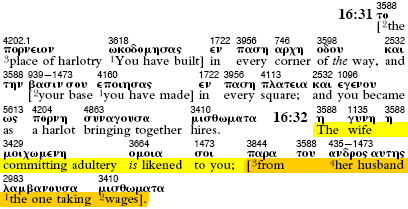
“The wife committing adultery is likened to you [a harlot for hire]; the one taking wages from her husband” is not only saying that marriage is a wife taking wages from her husband (harlotry), but it is also “adultery.” Another source:
http://ecmarsh.com/lxx/Jezekiel/Jezekiel%20LXX.htm, The Septuagint Bible Online, Jezekiel (Ezekiel) 16:31-32:
31 Thou hast built a house of harlotry in every top of a way, and hast set up thine high place in every street; and thou didst become as a harlot gathering hires. 32 An adulteress resembles thee, taking rewards of her husband.
http://ecmarsh.com/lxx/IV%20Maccabees/IV%20Maccabees%20LXX.htm, The Septuagint Bible Online, IV Maccabees 2:10-11, 21:
10 For the law conquers even affection toward parents, not surrendering virtue on their account. 11 And it prevails over marriage love, condemning it when transgressing law. … 21 For at the time when God created man, He implanted within him his passions and moral nature.
By the way, “love” here is rendered philias (φιλίας), not agape love.
Dishonest prostitution:
http://www.coyotela.org/history.html (or http://veronicafrancoescort.blogspot.com/2005/05/prehistoric-origins-of-prostitution.html), The Authentic Herstory [sic] of Prostitution: A Brief Chronicle of Sacred Whoredom:
To put it another way: the very nature of all intimate relationships between women and men is inherently prostitutional. Like their prehistoric ancestors, contemporary women provide men with sex in exchange for material goods; contemporary men provide women with material goods in exchange for sex. So strong is this genetic program that it has even been made the foundation of modern monogamous marriage: in all 50 states, by law, husbands are required to financially support their wives and children, while wives are legally required to provide sexual services to their husbands. This is why it is so difficult to convict a husband of raping his wife: until recently, the idea of "marital rape" was unthinkable. This also explains the curious fact that many men prefer that their wives not work outside the home. … And so we see that the monogamous bond began as a sexual contract based on mundane economic considerations rooted in prostitution. Not surprisingly, many contemporary feminists see little difference between the role a wife plays and that of a sex worker paid for hire. Dr. Dale Spender, for example, defines marriage as a form of legalized prostitution; that is, "the exchange of sexual services for material support." Now, let’s try to get the Church to be honest about that fact. No way, right? They’ve all sold their souls to the Devil, and pray heavily for their artificial salvation cop-outs.
…
MARRIAGE IS SANCTIONED PROSTITUTION
However, by institutionalizing prostitution under the word "marriage," our Judeo-Christian-based society itself continues to keep the whore's trade alive. As was noted earlier, all states have laws that require married men to financially support their wives, while at the same time requiring wives to provide sexual services for their husbands. This relationship form is defined by Webster, as it is by most contemporary sexologists and feminists, as "prostitution." Even in countries where polygyny (a man having multiple wives simultaneously) is practiced, we find the same established custom of "marriage-as-institutionalized prostitution," revealing that the oldest profession in the world has not been exterminated. It has merely been renamed and sanctioned under the catch-phrase "monogamous marriage."
John 13:34-35 (NKJV):
34A new commandment I give to you, that you love one another; as I have loved you, that you also love one another. 35By this all will know that you are My disciples, if you have love for one another."
The opposite of Jesus’ “commandment” is, of course, the marriage vows:
http://www.weddingsweddings.com/examples.html, Wedding Ceremony Examples Personalized Ceremonies:
VOWS
Minister: (Grooms Name) will you take (Brides Name) to be your lawful wife, will you love her, honor and keep her in sickness and in health and forsaking all others keep only unto her so long as you both shall live.
Response: I will.
Minister: (Brides Name) will you take (Grooms Name) to be your lawful husband, will you love him, honor and keep him in sickness and in health and forsaking all others keep only unto him so long as you both shall live.
Response: I will.
I realize that all humans are merely dumb animals with high communication skills, but come on people, try to “think” a little harder: “Forsaking all others” is the opposite of John 13:34-35.
Historical Dictionary of Catholicism, Collinge, 1997, p. 383:

What about the sexual ethics in the centuries close to Christ?
Human Sexuality, Masters / Johnson / Kolodny, 1992, p. 403, “Figure 16-2”:
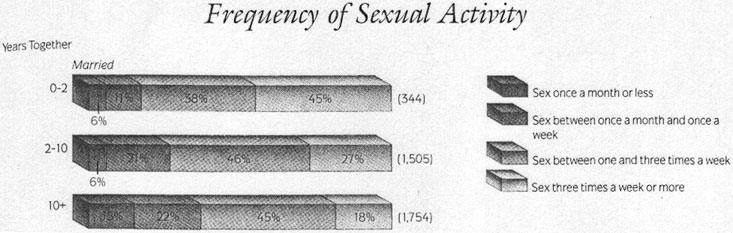
This chart shows that married people desire sex less as the years progress. It is likely that in a free / open sex society, people will still desire sex as often as when they first marry, or probably even more often.
Human Sexuality, Luria / Friedman / Rose, 1987, p. 567, “Sex As Property”:

My opposition:
http://www.newadvent.org/cathen/09699a.htm (Catholic Encyclopedia), Moral and Canonical Aspect of Marriage:
I. MARRIAGE INSTITUTED BY GOD
Marriage is a contract and is by its very nature above human law. It was instituted by God, is subject to the Divine law, and cannot for that reason be rescinded by human law.
They have no basis for this theory. In fact, conversely, Jesus and St. Paul both speak strongly against marriage (Matt. 19:12 [last sentence]; 1 Cor. 7), so how can it be “Divine law”? However, the above is overwhelmingly embedded into the minds of today’s Christians; which shows that no one relies on the actual Bible for instruction, they all “just believe” what religious leaders tell them. Even the ones who reject this teaching still believe that Jesus said it. Therefore, the power of “trust” actual overrules text. What the world needs (really bad) is someone they “trust” that is “trustworthy” (and knowledgeable).
… "If any one should say, matrimony is not truly and properly one of the seven sacraments of the Gospel law, instituted by Christ, but an invention of man, not conferring grace, let him be anathema (damned)" (Council of Trent (1545-1563), Sess. XXI, can. 1)
You see, a Church council said this, not the Bible. Both Jesus and St. Paul said that when married to obey the rules of marriage (which complies with the Goldenrule), but stated for those reasons it is better to not marry.
http://www.ccel.org/fathers2/ANF-02/anf02-62.htm, Ante-Nicene Fathers, Vol II, “Elucidations | III” (Clement of Alexandria):
Next, he treats of the Marcionites(early Christians), who rejected marriage on the ground that the material creation is in itself evil. … Then he gives his attention to another class of heretics boasting that they followed the example of Christ, and presuming to teach that marriage is of the devil.
Matthew 9:14-15:
14Then the disciples of John came to Him, saying, “Why do we and the Pharisees fast often, but Your disciples do not fast?” 15And Jesus said to them, “Can the friends of the bridegroom mourn as long as the bridegroom is with them? But the days will come when the bridegroom will be taken away from them, and then they will fast.”
The conditions and obligations of marriage tend to cause a man to spend more time with his wife, and less or no time with his old friends. We all kind of experience that feeling when we get married and then attend our high school reunions. Marriage takes a bridegroom away from his friends, therefore the friends morn because they lose that fellowship. I guess when you morn, you don’t feel like eating.
SparkCharts (informational inserts for college notebook binders): Anthropology, 2005, “The Study of Human Culture | Marriage”:
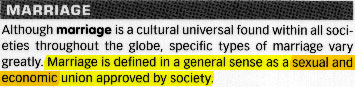
In other words, marriage is an organized (“approved by society”) form of prostitution: sex for “economics.” There is absolutely no logic to how Jesus, the true Son of God, could denounce prostitution but support and actually require marriage.
Understanding the evils of our current methods of war is something like one in ten people can understand, the evils of eating meat is like one in a hundred, the evils of society’s taking of free food is maybe like one in a thousand, but the evils of marriage / monogamy is something only one in a million people might understand:
http://christianity.about.com/?once=true&, The Lord of the Rings: A Christian Classic?:
The journey is through a fantasy world in which good and evil, light and darkness, powers natural and supernatural are at war. … The suggestion that the "Ring" can be the key to whether good or evil prevails speaks of a universe founded upon certain principles, or as Christians would put it, "created" by a certain God.
http://graal.co.uk/lordoftherings.html, Who Was The Lord Of The Rings?:
Although generally perceived to be a male device, the Ring was also presented to the Great Ladies as a marriage token of the Ring Lords.
(1-31-04) After watching The Lord of the Rings: The Return of the King, and noticing how all war and hostilities ended instantly after the ring was destroyed, I couldn’t help but surmise the obvious correlation when I know that a ring is marriage’s most popular symbol. There certainly could have been a genius who wrote this story years ago – surely I’m not the only one. Therefore, I see this as an obvious supportive message that when marriage is eliminated as the standard for sex, then wars, hostilities, animosities, unfairnesses, bias, etc. will surely lessen or end, toward the Christ guaranteed world as promised.
http://www.imdb.com/gallery/hh/1019674/527SalaPortrait5.jpg?path=gallery&path_key=0167260&seq=3, Image from The Lord of the Rings: The Return of the King (2003), (The “mind dominating” Dark Lord Sauron of Mordor, where Frodo and Samwise went to destroy the “Great Ring of Power”):

So, is this what a picture of marriage would look like? It looks right to me.
http://www.telegraph.co.uk/news/main.jhtml?xml=/news/2006/02/21/ntrend21.xml (or http://www.telegraph.co.uk/news/uknews/1511038/Majority-of-births-will-soon-be-out-of-wedlock.html), NEWS.telegraph, “Majority of births will soon be out of wedlock” (2-21-06):
Half of all babies will be born to unmarried mothers by 2012 if present trends continue, says new research that suggests the rapid erosion of moral and religious taboos. Moreover, fewer than half of families will consist of married couples and up to a third could be lone parents, said Dr Peter Brierley, a former Government statistician now specialising in religious trends. Dr Brierley's projections followed the publication of official figures yesterday showing that the number of births outside marriage has almost quadrupled in recent decades. The Office for National Statistics' Social Trends report, an annual snapshot of Britain, said that the figure rose to 42.3 per cent last year. In 1994, the figure was 32 per cent and in the early 1970s it was less than 10 per cent. The number of births outside wedlock exceeds 50 per cent in some parts, including Wales. In the North East, it was 54.1 per cent last year. In London, where a higher proportion of young mothers are Muslims who adhere to more conservative family values, a third of children were born outside marriage. The report said Britain now had the fourth highest level of births outside marriage in Europe, after Sweden, Denmark and France. Much of the rise comes from a sharp increase in people living together. But the number of one-parent families is also increasing. The figures have alarmed family campaigners, who say the collapse of marriage could have a serious impact on social structures. They say that most of the statistical evidence suggests that children brought up by married parents do better than those raised by cohabiting couples or lone parents. Dr Brierley, the executive director of Christian Research, an independent organisation that analyses Church statistics, said he had tracked birth patterns for his latest publication, Religious Trends 5. "If we get to the stage where more than half of children are born outside marriage, we are fundamentally changing the basis on which society has worked for centuries. "A whole range of traditional thought about 'home', 'marriage' and 'living together' will have to be re-examined. Psychologists say the children from single-parent families do not achieve so much or behave so well as those raised by married families (thanks to today’s Christians)." Dr Brierley said his extrapolations show the number of married families will decline from 62 per cent in 2001 to 49 per cent in six years. In contrast, the proportion of cohabiting couples will rise to about 18 per cent (from 13 per cent in 2001) and one-parent families could represent up to 33 per cent of the population (compared to 25 per cent in 2001). "There is much more at stake here than statistics," he said. "The implications are quite frightening." Although much concern has focused on single parents, cohabiting couples also provide less stable backgrounds for children, said the Economic and Research Council, a Government-funded social research body. John Ermisch, a professor of economics at Essex University, said in a paper for the council: "Only 35 per cent of children born into a cohabiting union will live with both parents throughout childhood, compared with 70 per cent born within marriage." Campaigners and Church leaders have accused politicians of marginalising marriage by undermining its legal and financial privileges and shying away from promoting it above other types of family. Labour abolished the last tax break for married couples, the Married Couples' Allowance, while its tax credit system is said to favour single-parent families. Ann Widdecombe, a former Tory Home Office minister, said: "After the death of the extended family, we are now seeing the death of the nuclear family. "The long-term consequences are bad for everyone. A well-ordered society is based on the bedrock of marriage, otherwise we will have increasing social disruption."
In a world that is quickly moving away from the marriage standard, but with a Church that still condemns sex outside of marriage, other ethical problems will just get worse, until the Church rescinds its condemnation against the innocent. It will still take some time since those who condemn-the-innocent do it just to support their own sexual moral cop-outs: their unjust, self-centered “ticket into Heaven” overruling the Goldenrule. Plus, those kinds of judgmental people will continue to destroy the lives of the many future children born out of wedlock, leading them into more drugs, crime, suicide, etc. But, every day more Paul Harveys are dying, so eventually things will get better for the world. Paul Harvey very much supported some recent legislation against cruelty to animals (which is good), but he is likely not a vegetarian. Therefore, his heart is in the right place, but his brain can’t seem to correlate very well. Again, we all need to admit that we’re all just dumb animals who “just trusts” the majority of our influences way too much. My writings truly involve a lot of people.
There are three entire chapters (17-19) of the Book of Revelation devoted to the coming destruction of the Mysterious Babylonian Mother of Prostitutions, which is logically “marriage”:
Sexualia: From Prehistory to Cyberspace, Bishop / Osthelder, 2001, p. 83, “Matrimony and Partnership | Types of Marriage”:
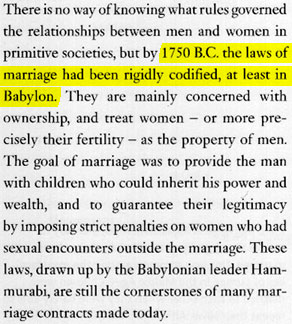
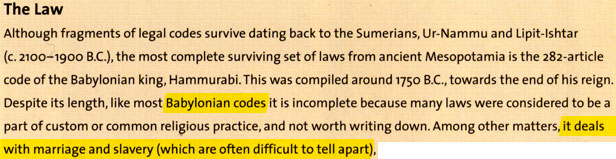
Now, some form of marriage or possessiveness has been around to some extent for about a million years. But this text from ancient Babylon is the earliest extant documentation of its bias conditions, restrictions and obligations. Therefore, very noteworthy per today’s deciphering of the Book of Revelation.
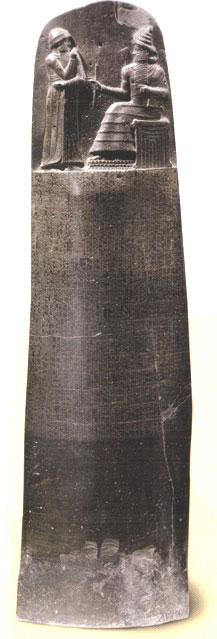
P. 139, “Sexuality in Mesopotamian Myth | The Law”:
 :
:
Sexualia: From Prehistory to Cyberspace, Bishop / Osthelder, 2001, p. 155, “Sex and Marriage in Judaism”:
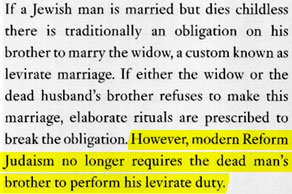
Not only did Jesus overrule Jewish laws but Jews even overruled Jewish law.
Sexualia: From Prehistory to Cyberspace, Bishop / Osthelder, 2001, p. 302, “Courtesans” (high dollar prostitutes):
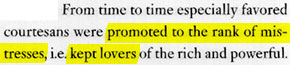
Therefore, “marriage” must be the highest form of prostitution.
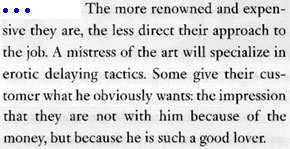
(It looks like just having a prostitute could be better for a man.)
Sexualia: From Prehistory to Cyberspace, Bishop / Osthelder, 2001, p. 204, “The Classical World | Prostitutes, Concubines, and Courtesans”:
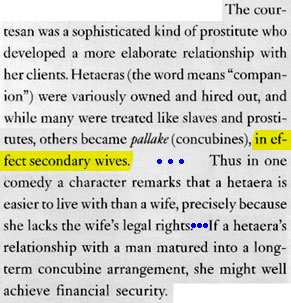
Sexualia: From Prehistory to Cyberspace, Bishop / Osthelder, 2001, p. 205, “The Classical World | Prostitutes, Concubines, and Courtesans | Famous Courtesans”:
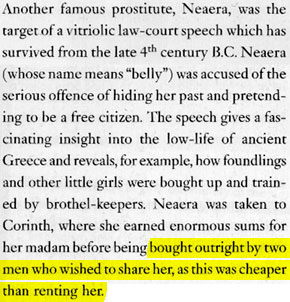
And it’s even cheaper to just marry her.
Sexualia: From Prehistory to Cyberspace, Bishop / Osthelder, 2001, p. 246, “When Desire Turns to Sin | Sin and Shame”:
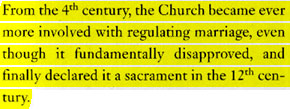
Interesting:
Sexualia: From Prehistory to Cyberspace, Bishop / Osthelder, 2001, p. 246, “When Desire Turns to Sin | Sin and Shame”:
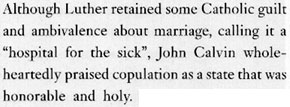
Some say marriage is a “civilized” form of sex, not open / free sex like animals do; but, slavery was also once a “civilized” from of labor: something the dumb animals don’t do either.
The Eerdmans Bible Dictionary, 1987, p. 693, “Marriage”:

http://www.personal.kent.edu/~jlarson/christianity/persecution.htm (Jennifer Larson, Professor of Classics, Kent State University), Ancient Christianities: Persecution and Polemic, “Charges against the Christians” (12-14-01):
Even more disturbing, Christianity was disruptive of family and social norms. Take the issue of virginity. Paul recommended a life of chastity for those who had the strength to practice it. This seems harmless enough. But what did this mean in practical terms? It meant that young women like Thecla would refuse to obey their parents, would reject the marriages arranged for them, and would become estranged from their families. Whereas Roman traditional values dictated that young men must marry, produce heirs and pass on a patrimony greater than the inheritance they themselves had received, Christianity encouraged young men to refuse their duty to reproduce and to give away the family possessions. Just as Jesus predicts in the gospels, fathers became divided against sons and mothers against daughters. Christianity was not respectable, but radically subversive.
“Disruptive of family”:
Since marriage is prostitution, a pagan man who can get it free from Christian women, will tend to give less and less support to his own wife; thereby causing his wife and her children financial problems. How in the world could Christians disrupt the family and social norms if Christianity was how Focus on the Family says?
http://frterry.org/History/Chapter_2/Chap.2%20Christians%20in%20a%20Hostile%20World.htm (Father Terry's Verbal Conscience), Chapter Two: I. Christians in a Hostile World First to Third Centuries, "B. Objections from philosophers and politicians":
Celsus, in the second century and Porphyry in the third, launched their attacks in three directions. …
a. Ignorant and Pretentious Poor--they recruited from the socially inferior classes of people. They concentrated on women, children and slaves. Christians sapped (“To undermine the foundations of”; “To deplete or weaken gradually”) both marital and parental authority.
http://kt70.com/~jamesjpn/articles/ChristianityAndSei.htm, The Christian Digest, Presents: CHRISTIANITY AND SEX--PART 1, “CELIBATES SEIZE CONTROL OF CHRISTENDOM”:
The Spanish provincial Synod of Eliberis (the Council of Elvira), in 305, enjoined bishops, priests, and deacons to separate from their wives. This ruling was disallowed by the Council of Nicaea, in 325. The counsel did not agree with the total banning of priests from marrying, deeming that honorable marriage was as truly chaste as the life of a celibate. However, in 385, Pope Siricius again commanded complete celibacy for bishops, priests, and deacons, and called for the separation of those who were married.
In A Handbook of Church History by Samuel G. Greene, we learn that:
False notions of Christian purity led in many instances to the voluntary separation of husband and wife. . . . Justinian was the first in the Eastern Empire to forbid married persons to be elected bishops. [Subdeacons could still have wives.] In the West, endeavours to enforce celibacy on all the clergy were made with indifferent success, until the days of Hildebrand (Gregory VII), in the Eleventh Century, by whom the law was made absolute. The East, on the contrary, while eventually (after the Synod of Trulla, A.D. 692) requiring celibacy in the bishop, not only permits, but encourages the marriage of the rest of the clergy (Greene, 1907: 229).
http://www.1911encyclopedia.org/Sacrament (Classic Encyclopedia: Based on the 11th Edition of the Encyclopaedia Britannica [pub. 1911]), Sacrament:
In many regions baptism involved renunciation of married life, and for at least the first two hundred years marriage was a civil rite preceding baptism, which was deferred until the age of thirty or even later. Liturgical forms for consecrating marriage are of late development, and the Church took the institution under its protection through outside social pressure rather than of its own will and wish.
http://www.newadvent.org/fathers/3804.htm (Catholic Encyclopedia), Synod of Gangra (4th Century), “Canon 1”:
If any one shall condemn marriage, or abominate and condemn a woman who is a believer and devout, and sleeps with her own husband, as though she could not enter the Kingdom [of heaven] let him be anathema (excommunicated).
–Shows many condemned marriage and even sex in marriage (with her own husband).
“Canon 9”:
If any one shall remain virgin, or observe continence, abstaining from marriage because he abhors it, and not on account of the beauty and holiness of virginity itself, let him be anathema.
“Canon 10”:
If any one of those who are living a virgin life for the Lord's sake shall treat arrogantly the married, let him be anathema.
“Canon 14”:
If any woman shall forsake her husband, and resolve to depart from him because she abhors marriage, let her be anathema.
You can see that it wasn’t an issue if marriage was the prerequisite for sex, but rather that if marriage was a sin.
http://www.futurechurch.org/fpm/history.htm,
A Brief History of Celibacy in the Catholic Church, “Second
and Third Century”:
Age of
Gnosticism: light and spirit are good, darkness and material things are evil. A person cannot be married and be perfect. However,
most priests were married.
“Popes who were married”:
St. Peter, Apostle
(There seems to be a big gap here)
St. Felix
III 483-492 (2 children)
St. Hormidas 514-523 (1 son)
St. Silverus (Antonia) 536-537
…
By the way:
“Sixth Century”:
590-604-Pope Gregory “the Great” said that all sexual desire is sinful in itself (meaning that sexual desire is intrinsically evil?).
That sounds like a new kind of ruling, that people didn’t know / realize before. Therefore, apparently Christ didn’t seem to make it clear enough until… 590-604 AD.
The HarperCollins Dictionary of Religion, 1995, p. 685, “marriage | Christianity”:
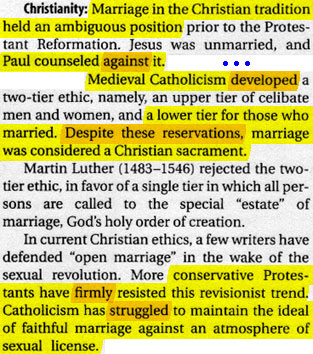
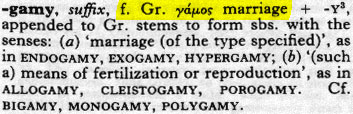
The Oxford English Dictionary, 1989, “-gamy”:
http://www.perseus.tufts.edu/cgi-bin/enggreek?lang=greek&lookup=prostitution&type=begin&options=Sort+Results+Alphabetically, Search for English Words in Greek (or Latin) dictionaries, “Prostitution”:
|
Total for 5 words whose definitions contain "prostitution" |
|||||
|
Words in Literary_Greek |
Keys |
Max. Inst. |
Freq./10K |
Min. Inst. |
Freq./10K |
|
gamos LSJ, Middle Liddell, Slater, Autenrieth |
prostitution |
659 |
1.65 |
659 |
1.65 |
|
kataporneusis LSJ |
prostitution |
0 |
0 |
0 |
0 |
|
poluandros LSJ, Middle Liddell |
prostitution |
4 |
0.01 |
4 |
0.01 |
|
poluandrios LSJ |
prostitution |
11 |
0.03 |
0 |
0.00 |
|
porneia LSJ, Middle Liddell |
prostitution |
6 |
0.02 |
4 |
0.01 |
|
3984215 |
|
680 |
1.71 |
667 |
1.67 |
http://www.perseus.tufts.edu/cgi-bin/ptext?doc=Perseus%3Atext%3A1999.04.0057%3Aentry%3D%2321579, Henry George Liddell, Robert Scott, A Greek-English Lexicon, “gamos” (marriage):
A. wedding, …
II. marriage, wedlock, Il.13.382, etc.; agein [gunaika] epi gamôi X.An.2.4.8 ; agagesthai tina pros gamon Plu.Cat.Ma.24 ; ton Oineôs g. the marriage granted by O., S.Tr.792; g. theôn tinos E.Tr.979 , cf. IT25; eis g. tinos elthein Id.IA1044 (lyr.); more freq. in pl., A.Pr.558 (lyr.), 739 (lyr.), Ag.1156 (lyr.), etc.; cf. gameô 1 : also tois methêmerinois gamois, i.e. prostitution, D.18.129; Panos anaboai gamous, i.e. rape, E.Hel.190 (lyr.); of unlawful wedlock, as of Paris and Helen, Id.Tr. 932; gamoi arrenes Luc.VH1.22 ; g. andreioi Procop.Arc.16.23 :--E. Andr.103, X. Cyr.8.4.19, do not establish the sense of a wife; for E.Tr.357, v. gameô 1.1.
A Greek-English Lexicon, Liddell & Scott, 1996, p. 337, “γάμος” (gamos):
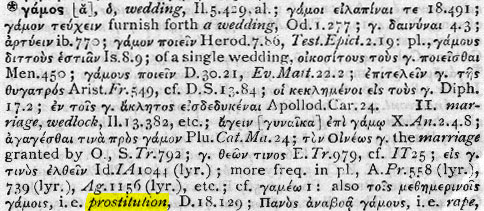
New Catholic Encyclopedia, 1967, vol. ?, p. 258, “MARRIAGE”:
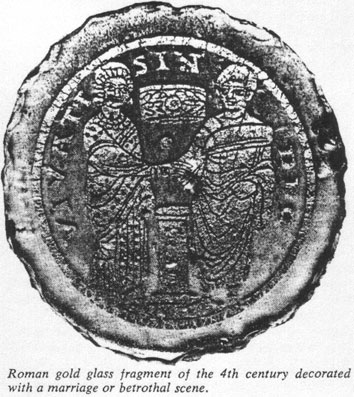
From the break in the name it looks like it’s calling it “SIN.”