Lewis and Clark, God’s Free Food, Etcetera
(More On This Subject)
http://www.pbs.org/weta/thewest/resources/archives/one/corona9.htm (PBS), Coronado's Report to the King of Spain, describing central Kansas 1541:
The country itself is the best I have ever seen for producing all the products of Spain, for besides the land itself being very fat and black and being very well watered by the rivulets and springs and rivers, I found prunes like those of Spain [or I found everything they have in Spain] & nuts and very good sweet grapes and mulberries.
http://www.kshs.org/teachers/trunks/pdfs/corps_4_lesson_3.pdf (Kansas State Historical Society), Explorer’s in Kansas: Explorer’s Journal: Francisco Coronado:
Pedro de Casteneda was with Francisco Coronado when he explored what is now Kansas. Casteneda wrote the following information about Kansas in his journal. …Judging from what was seen on the borders of it, this country is very similar to that of Spain in the varieties of vegetation and fruits. There are plums like those of Castile, grapes, nuts, mulberries, oats, pennyroyal, wild marjoram, and large quantities of flax,
http://www.rootsweb.com/~neresour/andreas/history/erlyhst-p3.html, Early History, “Description of Nebraska in 1541”:
Gomara, another chronicler, says: 'Quivera is on the fortieth parallel of latitude. It is a temperate country, and hath very good waters and much grass, plums, mulberries, nuts, melons and grapes, which ripen very well.
http://www.rootsweb.com/~neblaine/Pioneerpost.htm (Blaine County Nebraska), Pioneer Postings: My Father’s Memories, “A Venture in the Sand Hills Land Rush”:
Nature was a good provider. There were an abundance of wild fruits on the farm or along the rivers...strawberries, cherries, grapes, and raspberries. We kids used to fill our mouths with chock-cherries, a pea-size blue berry that grew in bunches like grapes
http://www.usgennet.org/usa/ca/state1/ridpath/spanish1911.html, Ridpath’s History of the United States: Spanish Discoveries in America [Expedition of Hernando De Soto, 1541]:
De Soto's men now found themselves in the land of the Dakotas [Eastern Arkansas]. Journeying to the northwest, they passed through a country where wild fruits were plentiful and subsistence easy.
http://www.indiana.edu/~iupress/books/0-253-33985-5.pdf (Indiana University), Land, People, and
Early Frontiers:
In April 1567 another Spanish detachment followed a slightly different route into Tennessee … Pardo’s men had seen enough of the fertile land, abundant and clean water, and wild fruit trees and grapevines to refer to East Tennessee as “tierra de angeles,” land of angels. You mean Spain (the civilized world) at that time didn’t look like a “land of angels”?
http://www.webspawner.com/users/bobbieel/, Humanities Project 3AB: Cabeza de Vaca:
Vaca later [after 1527] ventured to the Appalachians … Vaca found the native food sources to be fish, wild animals, wild fruits and vegetables.
http://www.americanjourneys.org/aj-014/summary/index.asp, (American Journeys: Eyewitness Accounts of Early American Exploration and Settlement), True Account of the Exedition of Oñate toward the East [Source: Bolton, Spanish Exploration in the Southwest, 1542-1706], “Oñate’s Expeditions, 1598-1604”:
Oñate describes the abundant wild fruits and plentiful fish in the Canadian River valley, which they followed into lands in present-day San Miguel County, Texas.
http://www.americanjourneys.org/aj-026/summary/index.asp, (American Journeys: Eyewitness Accounts of Early American Exploration and Settlement), First Relation of Jaques Carthier of S. Malo, 1534 [Source: Burrage, Early English and French Voyages, Chiefly from Hakluyt, 1534-1608], “Cartier’s First Expedition, 1534”:
they described the plentiful pine, cedar, and fir forests, wild fruits and berries, and diverse bird life of the Gulf of St. Lawrence [eastern Canada].
http://www.historyguide.org/earlymod/columbus.html (The History Guide), The Journal of Christopher Columbus (1492):
Arrived on shore [first landfall], they saw trees very green many streams of water, and diverse sorts of fruits. … In the meantime I strayed about among the groves, which present the most enchanting sight ever witnessed, a degree of verdure prevailing like that of May in Andalusia, the trees as different from those of our country as day is from night, and the same may be said of the fruit … A thousand different sorts of trees, with their fruit were to be met with, and of a wonderfully delicious odor.
http://home.aubg.bg/students/MII990/bumblebee/Reclaiming-the-Land_I/Look-For-America/Columbus/Columbus_FI.htm, Columbus' Letter to Ferdinand and Isabella Regarding the Fourth Voyage:
there are very wide and fertile plains, and there is honey; and there are birds of many kinds and fruits in great diversity.
http://www.ibiblio.org/pub/docs/books/gutenberg/4/1/1/4116/4116-h/4116-h.htm, Christopher Columbus, Complete: Christopher Columbus and the New World of His Discovery, Young, “The New World: The Voyage Home”:
Letter addressed to Luis de Santangel … It has also extensive plains, honey, and a great variety of birds and fruits.
http://www.dailyobjectivist.com/Heroes/ChristopherColumbus.asp, Christopher Columbus:
As they approached the shores they were delighted by the beauty and grandeur of the forests; the variety of unknown fruits on the trees which overhung the shores
http://www.classicreader.com/read.php/sid.1/bookid.1293/sec.10/, The Life of Christopher Columbus:
Another party brought back rich bunches of grapes, and other native fruits
http://www.holidayorigins.com/html/columbus_day.html, Columbus Day:
On shore, they encountered curious natives, many trees, fresh water, and much fruit.
http://members.fortunecity.com/connectjv/christophercolumbustomatoes/id3.html, Christopher Columbus Tomato:
Among the many fruits and vegetables they found, the tomato was first discovered.
http://www.libraries.wvu.edu/delany/rights.htm (West Virginia University Libraries), “Claims of Colored Men as Citizens of the United States”:
The natives were numerous, then easily approached by the wily seductions of the Europeans, easily yoked and supported having the means of sustenance at hand, the wild fruits and game of the forests, the fish of the waters and birds of the country
http://www.spinnerpub.com/Images/cran%20history.pdf, The American Cranberry, “Naming the Cranberry”:
Granny Squanit, or Squauanit, the traditional women’s god or spiritual guardian who ensured the survival of the many wild fruits and herbs they depended upon.
http://www.winthropsociety.org/doc_adverts.php, Advertisements for the Inexperienced Planters of New England … [1614-1630], “A description of the Coast, Harbors, Habitations, Landmarks, Latitude, Longitude, with the map”:
This Country we now speak of lieth betwixt 41º and 44½º … more than three hundred isles overgrown with good timber or divers sorts of other woods; in most of them (in their seasons) plenty of wild fruits, fish, and fowl, and pure springs of most excellent water pleasantly distilling from their rocky foundations.
http://www.conservation.state.mo.us/conmag/1995/aug/aug4.html, Missouri Conservationist online: Before Lewis & Clark, “Bourgmont” [“Éttienne de Veniard, sieur de Bourgmont”, 1714]:
As did other early explorers, Bourgmont spoke highly of the lands in the Mississippi Valley. "It would be impossible to speak too highly of this river with respect to its abundance of beasts, game, fruits, roots and pot herbs."
http://v6.marinij.com/Stories/0,1413,234%257E24409%257E2069064,00.html (Marin Independent Journal, Marin County, CA; April 12, 2004), Comfort foods: Cream of the crop:
By the time those European food traditions made it to the Colonies in the 17th and 18th centuries, creamed vegetables became a democratic dish. All you needed were some vegetables. And on the frontier, wild vegetables were plentiful.
http://memory.loc.gov/gc/lhbtn/th027/th027.bak (Library of Congress - Historical Collections [American Memory]), [what is today southern Illinois]:
Crossing Aubuchon, formerly called St. Philippe; a passage from the Mississippi to the Kaskaskia ... the path lay through a tract of astonishing fertility, where the wild fruit flourishes with a luxuriance known to no other soil. Endless thickets of the wild plum and the blackberry, interlaced and matted together by the young grape-vines streaming with gorgeous clusters, were to be seen stretching for miles along the plain. Such boundless profusion of wild fruit I had never seen before. Vast groves of the ruby crab-apple, the golden persimmon, the black and white mulberry, and the wild cherry, were sprinkled with their rainbow hues in isolated masses over the prairie, or extended themselves in long luxurious streaks glowing in the sun. The pawpaw, too, with its luscious, pulpy fruit; the peach, the pear, and the quince, all thrive in wild luxuriance here; while of the nuts, the pecan or Choctaw nut, the hickory, and the black walnut, are chief. As for grapes, the indigenous vines are prolific; and the fruit is to be so excellent,
http://www.rootsweb.com/~wicrawfo/chap4.htm (Crawford County, Wisconsin Genealogy), Chapter 4 - Early Explorations, “The Journey of Jonathan Carver”:
The first to ascend the river after Great Britain had assumed control of the country, was Jonathan Carver. In 1766 he reached the mouth of the Wisconsin … From thence the most beautiful and extensive prospect that imagination can form opens to your view. Verdant plains, fruitful meadows, numerous islands, and all these abounding with a variety of trees that yield amazing quantities of fruit, without care or cultivation, such as the nut-tree, the maple which produces sugar, vines loaded with rich grapes, and plum trees bending under their blooming burdens
http://skyways.lib.ks.us/genweb/washingt/70th-1.htm (Kansas State Library), Washington County, “Written in 1876”:
in the northern tier of counties in the State, was organized in 1860 … It has eight principal streams, whose banks are lined with timber, such as oak, walnut, hickory, elm, cottonwood, ash, locust and box-elder. Also plenty of wild fruits such as plums, strawberries, grapes, raspberries, mulberries and gooseberries.
http://www.couchgenweb.com/arkansas/scott/biog-1.htm, Biographical and Historical Memoirs of Western Arkansas [Scott County]:
Wild fruits in their season have abounded from the first–strawberry, blackberry and huekleberry, the wild plum of different varieties, wild grapes, a summer sort about the size of the Delaware, and equally as finely flavored, a smaller grape that ripens after the frost, then a grape called Muscatine, about as large as the Concord, usually growing singly, but sometimes in clusters, with a thick skin, and excellent for sauce when cooked. All these natural provisions the early settlers availed themselves of.
It sounds like the homeless could easily live in an area rejuvenated to 200 years ago (seeds dropped from crop-duster), and happily if you de-derogated the name “hillbilly.”
http://freepages.family.rootsweb.com/~fgris/jwbmem.html, An Autobiography of John Wesley Bray, September 7, 1849 to December 30, 1916 [Erie County, PA]:
The country was very prolific in bearing lots of wild fruits as well as tame fruit such as raspberries, strawberries, blackberries, etc. The woods and pastures were full of them and of the most delicious varieties. I have never seen anything like it anywhere since and the consequence was we were never without fruits. We had apples the year around as we had some that lasted until they grew again the next year
http://www.beforetime.net/iowagenealogy/mahaska/Roustabout/RoustaboutHistory.html, Roustabout’s History of Mahaska County, Iowa, “Chapter XV- Supplies”:
Game was quite abundant then, and the undisturbed timber yielded a harvest of wild fruits, such as has not since been known.
http://ftp.rootsweb.com/pub/usgenweb/ia/story/history/story.txt, History: Story Co., IA [1875]:
In the early settlement of the county, wild fruits, so common
throughout the state, were found in great profusion, but they have gradually
given place to cultivated orchards and vineyards
http://www.scottlee.com/newtonhist/newton05.html, History of Newton County, Mississippi, from 1834 to 1894:
Besides this mast of acorns, nuts, etc., from trees, a fine amount of food for the hog was obtained from the ground, of succulent roots, worms, herbs, etc., which added much to their stock of provisions, and the summer wild fruits of plums, haws, grapes and all kinds of berries which grew in great abundance, caused the hogs to thrive like the cattle at all seasons of the year. … The wild fruits of the county were very abundant; strawberries … plum … huckleberry … grapes … muscadines … There was a summer plum something resembling the wildgoose plum of this county at this time, only had better taste and an odor equal to the most fragrant of apples; it was considered the finest wild fruit that grew; it was confined mostly to prairie or lime land. Some of them still remain, but the best production of this kind is stamped out. … persimmons … Most of the earlier fruits still exist in the county, but as a general rule, like grasses, they appear to be stunted by "civilization," and are giving way to cultivated fruits and grasses. When the ground has been cultivated and the original grasses and trees have been exterminated, if this land is left uncultivated a new growth of trees, different from the original, will come up.
http://www.rra.dst.tx.us/c_t/history/foard/default1.cfm, History of Foard County, Texas:
In the eighteenth and nineteenth centuries, the abundance of wild fruits and herbs made this area a favorite haunt of Comanche and Kiowa bands
http://www.pa-roots.com/~westmoreland/historyproject/vol1/chap15a.html, History of Westmoreland County [Pennsylvania]:
The woods also at that time were full of wild fruits, and moreover all small berries and fruits grew more abundantly and were more luscious than now. Horace Greely noticed this same change in the New England states, and attributed it entirely to the destruction of the original forests. This so changed the moisture of the atmosphere and the earth, and thus so subjected the tender buds to intense heat, stormy blasts of wind and severe cold, that small fruits scarcely thrive at all now compared with what they did when the country was in its original condition. Blackberries, whortleberries, raspberries, wild plums, wild strawberries, haws, wild grapes, and sarvesberries, the latter ripening early in June, were plentiful then, and of a much finer quality than the few stragglers which the woodsmen now occasionally find. Peach trees bear fruit in their third year, and were easily raised, while, owing to climate changes, can scarcely be grown at all now. Then they grew in every community. So also with cherries, another early bearer and rapid grower. As we have seen from Dr. McMillen's statement, our ancestors lived sometimes for days without bread. Often an escaping captive traveled hundreds of miles through an almost unbroken forest subsisting entirely on wild fruits.
Say, there’s “a” reason why it’s good for God’s free food to be missing: an escaped prisoner can’t just go live in the woods; instead, today, they’ll have to break into someone’s house or something to survive, which probably increases their chances of getting caught, especially if they have to take hostages. Maybe that’s the only reason for why God’s free food has been purposely eliminated, then it just so happens that people have to get a job to eat, then it just so happens that we all still have to maintain the marriage standard, so women with children will be able to eat also.
Wild fruits that not longer exist can simply be replanted; or, the government could just replant them.
http://www.co.summit.ut.us/history/marion_-_myrick_house.html (Summit County [Utah] Historical Society), William and Martha Myrick House:
Before Hoyt arrived the valley is said to have been filled with plants, animals, streams overflowing with fish and meadows that bore wild fruits, sego lilies. Trappers, random settlers and eventually the entrepreneurs of the Mormon Church would take their toll on the area by over harvesting the wildlife and brining in thousands of head of cattle.
http://seward.wathenadesigns.com/sc_chapter8.html, History of Seward County [Nebraska]:
We generally had a good supply of wild fruits, such as plums, grapes, gooseberries, elderberries, and raspberries.
http://www.homestead.com/DixonCoNEGenWebProject/GranAndrewAnnaLund.html (Dixon County [Nebraska] Explorer), Family Histories etc…:
For food the settlers also used wild fruits, which they made into sauces, jams and jellies. The most common were wild plums, gooseberries, wild grapes, choke cherries and buffalo berries.
http://home.earthlink.net/~haburt/pike/grimshaw.htm, History of Plke County [Illinois]:
wild fruits of this latitude were abundant, but cultivation has done away with them.
http://www.tngenweb.org/morgan/DEERLODGE.html, A History of Morgan County Tennessee: Deer Lodge:
The surroundings country is adapted to fruit and vegetables culture … The wild lands are covered with an indigenous grass on which, cattle, sheep or horses thrive and fatten. The mass of nuts and wild fruits sustain the hogs.
http://home.att.net/~HSONBOOK/book.html, History of Olde Northfield Township [Northfield, Ohio], “The First Settlers”:
There were, also, many kinds of nuts, berries, and other kinds of wild fruits to be had.
http://klesinger.com/jbp/firstwhite.html, The First White Explorers in Jefferson County [Colorado], “Red Rocks and Roxborough Park”:
All different varieties of wild fruits and game indigenous to the mountains are found here in greatabundance.
http://www.bonnercountyhistory.org/History/BChistory/bchistory.html, A Brief History of Bonner County [Idaho]:
They also picked berries and wild fruits, drying large quantities for use during the cold months.
http://freepages.books.rootsweb.com/~cooverfamily/western_60.html, History of Iowa: Ida County:
Among the wild fruits, the plum, grape, gooseberry and strawberry are found. … An abundance of material suitable for the manufacture of brick is found in all parts of the county.
http://freepages.books.rootsweb.com/~cooverfamily/western_54.html, History of Iowa: Crawford County:
Wild fruits grow in abundance; there are plums, grapes, raspberries, strawberries, gooseberries, cherries, crab apples, wild currants, and occasionally blackberries.
http://freepages.genealogy.rootsweb.com/~berta/mcbk1908/1-29.htm, History of Marshall County [Indiana]:
The woods, too, were full of a great variety of wild fruits, such as huckleberries, blackberries, raspberries, gooseberries, cranberries, wild cherries, paw paws, black and red haws, crab apples and plums, and other fruits in their season.
http://www.tdn-net.com/genealogy/stories/hist1880/b207-308.htm, History of Miami County Ohio, Early Settlement: “Food and Cooking”:
Green corn and wild fruits constituted important articles of food with many of the settlers.
http://www.tdn-net.com/genealogy/stories/hist1909/chap-02.htm, Miami County Ohio, Chapter 2, “First White Man in the County”:
the air was sweet with the blossoms of the wild grape, plum, cherry and crabapple and the whole land beautiful with the contrasting red and white of the dogwood and rosebud, or of elder and wild rose, and the fresh green of the young leaves. The country on both sides of the Miami was for many miles unbroken forest or a thicket of hazel bushes and wild fruit trees. Pioneers could in the summer, step out of their back doors into a boundless wild park of garden.
http://www.rockinghamremembered.com/RhamHistory.html, A Brief History of Rockingham [North Carolina]:
Berrries, grapes, and wild fruits grew along the banks. We now know that this was true because the early white settlers found these conditions to exist even though the Indians had already burned the woods … When the White Man was living in caves in Western Europe some 10,000 years ago, the Red Man was roaming the banks of the Pee Dee living off the land - eating berries, nuts, fruits, fish, and small game and wearing the skins of animals which he had killed.
Now, realize I am not saying the Indians were perfect: they killed buffalo, enslaved women to labor, and resolved their differences via war. These parts about Indians only have to do with the natural state of the Earth. I’ve never known any culture or person that was religiously / ethically perfect. I’m not even close to perfect myself, but my writing is.
http://www.stormpages.com/emtyville/Section_D_William&Rebecca_Egbert_Stories.html, Egbert Family History, “The Jersey Settlement”:
Their food came mainly from the forest, which abounded in game and wild fruits.
http://www.auduboncounty.net/oakfield/OakfieldHistory.html, The History of Oakfield, Iowa [no longer exists]:
Earliest settlers were pleased to find a wide variety of wild fruits available for the picking. Wild grapes, plums, strawberries, raspberries, blackberries, eiderberries, chokeberries, wild black cherries, crabapples, gooseberries, red haws and black haws substituted quite well for the fruits they had been used to "back east." The more the timber lands were cleared off and used for pasture or plowed for fields, the less fruite was available. … Planting of other tame fruits followed and the gradual loss of the wild fruit supply caused no hardship. Oh, what about the “hardship” of planting it? If there’s no hardship for planting foods then why does it cost money to get it?
http://www.hwaters.com/downloads/valuing_nature.pdf (Bowdoin College), Valuing Nature:
the dramatic depletion of the forests, countered the usually unqualified praise for the “improvements” that settlers had made to their environment and offered conceptual frameworks that suggested the beginning of an ecological consciousness. In 1903, David Turpie suggested that the forestry practices of Indiana pioneers in the 1830s had unanticipated future costs: “The wild fruits, flowers and nuts which we gathered all had their being and growth in the forest and many of them have disappeared with it.
http://www.mclib.org/people.htm (Michigan City [Indiana] Public Library), People From Our Past, “The Pottawattomie Indians: Eviction by Civilization”:
The Indians loved their lands with savage passion and those who dwelt in the Trail Creek region (away from the swamp and sand of the lakeshore) had special grounds for their attachment to the soil, for it was rich in all the natural resources upon which they depended for their sustenance … wild fruits grew everywhere in profusion Also: Drunkenness, stealing, murder for the purposes of robbery, other unknown vices, new diseases - all these were among the introductions of civilization which the untutored savage could not understand but which he gradually adopted or acquired
http://ftp.rootsweb.com/pub/usgenweb/pa/lawrence/history/local/1877durant/durant11.txt, History of Lawrence County, PA:
Cultivated fruits were scarce for several years after the settlement, and the wild fruits were used. The wild crab-apple, plum, cherry and smaller fruits and berries were quite abundant.
http://www.fairbank-ia.org/history.htm, History of the Founding of Fairbank, Iowa, As Recorded in the 1880's:
There are large quantities of wild fruits on the bottoms, such as plums, apples, and grapes.
http://searches1.rootsweb.com/usgenweb/archives/ia/fayette/history/stories.txt, Stories of Early Fayette County [Iowa] History, “The Pioneer Home and Mother”:
There was a scarcity of "set out" fruits, but a great abundance of wild fruits, berries, and nuts of all kinds. Until about twenty years ago where the new road runs up to the parking area in Echo park, there were many black hawes, hazelnuts, walnuts, wild berries, plums and crabapples. Sometimes there were nutting parties and several families would gather these wild fruits and nuts and take them home in large quantities. This was great fun for the children.
http://history.alliancelibrarysystem.com/IllinoisWomen/files/pi/htm1/pirambln.cfm (Alliance Library System, East Peoria, IL), Early Illinois Women: Ramblin’ Thru Spoon River Country, “Mahala Blout Mills (as told in 1906)”:
With happy hearts and the cheerful laughter of children we used to venture forth in the woods to gather wild flowers, pick blackberries, plums and other wild fruits, and I can never forget those old, old days in Fulton County.
http://www.rootsweb.com/~tncampbe/hist-bogan/pioneers.html, History of Campbell County, Tennessee:
Blackberries, plums and other wild fruits were considered a lifeline in the pioneer days.
http://www.unlv.edu/faculty/mccool/WK4_Native_Americans.pdf OR http://www.unlv.edu/faculty/mccool/HWK4_Native_Americans_HOUTS.pdf (University of Nevada, Las Vegas), Native Americans:
NAVAJO FOODS
▪ TRADITIONALLY, MANY PLANTS GATHERED WILD AND USED IMMEDIATELY OR DRIED FOR LATER USE
▪ PLANTS INCLUDED:
– WILD VEGETABLES
▪ CELERY, ONION, SPINACH, POTATOES, PIGWEED
– WILD FRUITS
▪ WOLFBERRIES, JUNIPER BERRIES, SQUAW BERRIES OR WAX CURRENTS, SUMAC BERRIES, PRICKLY PEAR FRUIT, WILD BANANAS, YUCCA FRUIT
http://www.oldstatehouse.com/pdf/94Spring.pdf (The Arkansas News), Native Ameicans In Arkansas, Spring 1994, “Earliest Americans Survived By Hunting, Gathering Food“:
Through most of their early history, Native Americans in the land that would be Arkansas lived by hunting wild game and gathering foods that grow naturally.
… “Cherokee Women Had Important Influence in Daily Life of Tribe”:
Children helped the women collect wild vegetables, berries, fruits, nuts, and seeds. There were some wild foods available every season of the year.
http://www.stgeorgesgeorgetown.com/wildfood.html (St. George’s Anglican Church, Georgetown, Ontario, Canada), Wild Food Dinner [modern day event]:
vegetarian dishes will be featured on the menu. Wild vegetables including Jerusalem Artichoke and wild carrots will be served with innovative sauces that reflect food choices that were plentiful 150 years ago.
http://iagenweb.org/history/annals/jul1869.htm (Iowa History Project), Annals Of Iowa: Recollections of the Early Settlement of N.W. Iowa:
Wild fruits of the choicest and most luxuriant character common to the western country, such as grapes plumbs, raspberries, &c., were found here in great quantities, and supplied our pioneer settler's tables with many luxuries.
http://www.sarasotagov.com/InsideCityGovernment/Content/Commissioners/CelebrateSarasota/CelebrateSarasotaHistory.html (City of Sarasota, Florida), Sarasota’s History:
Long before the name [Sarasota] came into question, Indians had discovered the lush area and knew the bounty of the abundant wild fruits and game in the vicinity.
http://www.motherearthnews.com/index.php?page=arc&id=5431, Mother Earth News, Issue # 4 – July/August 1970:
I learned at an early age that our home in the country was surrounded by groceries "free for the picking". Wild strawberries, raspberries, blackberries, dewberries, elderberries and wild grapes contributed to my summer fare. The aroma of fresh berry pie and canned wild fruits remains quite vivid in my memory of those days. … Most folks view wild vegetation with contempt and as an enemy of the lawn and garden. That which is not a planned part of the suburban development is viewed as being worthless; as an eyesore which detracts from a well-manicured environment. A wide variety of dangerous chemicals has been developed to eliminate such "worthless weeds". Unfortunately, I've seen many a fine wild strawberry patch succumb to chemicals and the lawn mower. Countless vacant lots, once lushly overgrown with a live supply of wild foods, have been transformed into wastelands of barren stubble. I'd like to suggest with this article that our so-called "weeds" may serve some fundamental purpose - not only to a balanced ecology - but also to human nutrition. Additionally, although the experience of foraging for wild food may not be a panacea for our times, it may yield some positive alternatives to our present system of control. … Few people will dispute the fact that wild strawberries are superior to cultivated varieties.
http://www.erraticimpact.com/~american/html/thoreau_quotes.htm, American Philosophy: Henry David Thoreau Quotes: Huckleberries (Notes On Fruits):
I suspect that the inhabitants of England and the continent of Europe have thus lost in a measure their natural rights, with the increase of population and monopolies. The wild fruits of the earth disappear before civilization or only the husks of them are to be found in large markets. The whole country becomes, as it were, a town or beaten common, and almost the only fruits left are a few hips and haws. What sort of country is it that were the huckleberry fields are private property? When I pass such fields on the highway, my heart sinks within me. I see a blight on the land. Nature is under a veil there. I wake haste away from the accursed spot.. Nothing could deform her fair face more. I cannot think of it ever after but as the place where fair and palatable berries, are converted into money, where the huckleberry is desecrated.
http://www.scienzavegetariana.it/nutrizione/vnhl/LLcancer.html (Loma Linda University), Vegetarian Nutrition & Health Letter, Vol. 1, n.1, Diet and Cancer, by John Weisburger, PhD:
Early humans consumed foods that were freely available from nature-wild fruits, berries, greens, seeds, and roots.
http://www.ankhoaagency.com/prehistory%20of%20mankind.htm, Prehistory: Remote Ancestors of the Chinese People:
Primitive human beings followed many of the habits of animals. They lived in caves, ate wild fruits, moved in small groups and practiced promiscuity. Now you’re going to say that promiscuity is not civilized, like we’ve improved from that natural impulse. Then you’re going to say that homosexuality is wrong because it is not natural. So the status-quo needs to make up its mind whether the basis of the natural or the non-natural should be pursued.
http://www.glbtq.com/social-sciences/new_orleans.html, New Orleans, “The Early Years”:
After the Louisiana Purchase, the Territorial Convention of 1805 imposed the harsh sodomy statute the Americans had written for Mississippi. The first Louisiana Criminal Code prescribed a mandatory life sentence for indulging in "the abominable and detestable crime against nature." Later, the penalty was reduced to ten years in prison; and, later still, to five years.
http://www.rootsweb.com/~iabiog/linn/b1901/b1901_b.htm, Biographical Record of Linn County, Iowa:
The pioneers who came to Linn county and stood the brunt of the hardships, the exposures and privations of a frontier life, found this country to be a wilderness, a vast unbroken pasture field, with frequent groves and streams, an abundance of wild fruit and game.
http://www.nornet.on.ca/~jcardiff/transcipts/bios-photos/essays/glorious.html; Glorious Old Norfolk [Ontario, Canada]; Compiled by bruce M. Pearce, B.A., in 1924; “First Explorers”:
Two centuries and a half have elapsed since those intrepid French priests and explorers, De Galinee and Dollier de Casson, first visited the forest-covered area that now comprise the County of Norfolk … a country laden with wild fruits of finest quality.
http://www.historicomaha.com/ofcchap3.htm, Omaha’s First Century [Nebraska], “Early Expansion 1858-1870”:
Wild fruits and flowers were in great abundance. There were currants, raspberries, strawberries, red berries, elderberries, choke berries — which the children enjoyed gathering — and walnuts and hickory nuts.
http://www.rootsweb.com/~laallen/sugartwn.html, History of Sugartown [Louisiana]:
These early pioneers couldn’t run down to the supermarket (grocery store) and pick up a frozen dinner, but they still had a wide selection of foods for the table. They used a lot of wild fruits such as the Muscatine grape, wild huckleberry, blackberries, mayhaws, wild plums, and various edible nuts.
Sexualia: From Prehistory to Cyberspace, Bishop / Osthelder, 2001, p. 137, “Origins – The Evolution of Sexual Culture | Human and Prehuman”:
http://www.smcallister.co.uk/hamearly.htm, Hamilton [Scotland] – Early Settlement:
The earliest people here were nomads – hunter - gatherers who moved with the food supply, exploiting whatever was to hand, around 6,000 years ago … gathered wild fruits in season from the scrub woodland close by … Somewhere between 5,000-4,000 years ago farming began.
http://www.student.nada.kth.se/~f95-mwi/fun/encyclopedia.html, The Encyclopedia of Fruitarianism and Rational Living, “Agriculture”:
The science of agriculture was begun by early peoples around 10,000 years ago. It was a momentous occasion in human development and would bring about a revolution in the human diet and lifestyle from then on. For the first time in their total history humans would exert a deliberate control over what they ate. Sounds great except for one thing: what about the losers: the people for whom this great competitive system doesn’t work: the victims of this great society? Those that attended years of schooling, but failed to “win” from it? Should there be recourse of fairness to them, since it seems all the land must be totally taken for this great system to work? You see, when you have a “great system” that is just a big greedy game, you are going to have some winners of the game and some losers of the game. What about the marriage standard that has to be applied (so women will be able to feed their children: so “the system” won’t have to pay the bill – today’s only reason), which wrecks havoc on many people’s reason for happiness? I don’t think the day of utopia is going to come where everyone will always meet that one perfect mate, and no one will ever divorce or be unhappy in a marriage again. But, my solution can establish such a thing. Mine is the only realistic way for a Kingdom of God as Jesus spoke about in the Bible. What about all the diseases that our bodies can’t fight off because of the marriage standard which prevented the transfer of God’s natural vaccine? Yeah, farming IS a great idea, but since it’s a monopolizing organizational thing: it is easy for the richest reapers of this system, to “take all” and forget about “fairness,” especially when society’s ignorance (including the media) is on their side. – This “free food of the past” requires a two step thinking process to understand: therefore, most people are not going to get it, even after reading my entire website. But, as Jesus spoke, this is a very, very, very idolatrous society: people WILL “just believe it” if someone well looked upon says it. So, I don’t know exactly who I’m needing to talk to, but they need to listen. Money verses barter? Money makes trade much easier; however, it opens a means for the few and smart to take an unfair advantage less easily seen by the majority of people and lawmakers.
Surely our ancestors of bygone days had to labor intensively just to obtain enough food to stay alive:
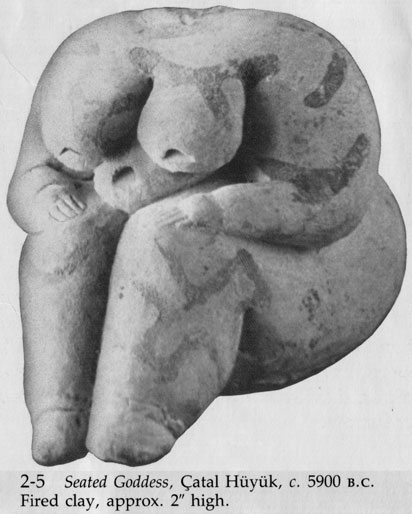
Art Through the Ages, Gardner, 1986, p. 42, figure 2-5:
Want something older:
|
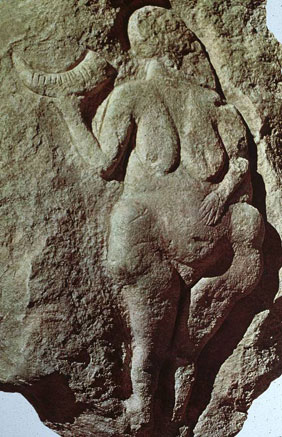
http://www.arthistory.sbc.edu/imageswomen/laussel.html, The "Venus" of Laussel: c. 20,000-18,000 BCE
|
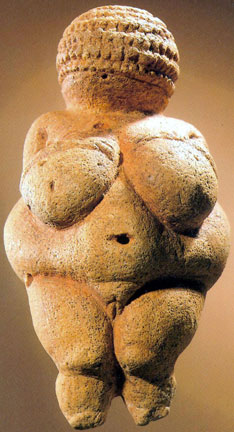
http://witcombe.sbc.edu/willendorf/willendorf.html, The Venus of Willendorf: c. 24,000-22,000 BCE
|
SparkCharts (informational inserts for college notebook binders): Anthropology, 2005, “Human Cultural Evolution | The Mesolithic Period”:
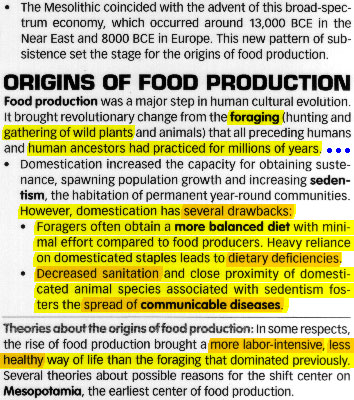
Therefore, further justification why the government “should” pay for poor people’s medical bills (without disgrace, without “motivating” otherwise). And those drawbacks are before we started putting all the harmful chemicals, etc. in our food, geared to help the rich get richer. Again, just for fairness (excluding any progress), those who reap the benefits of our system (the rich) “should” be the ones who pay the bills for its caused problems.
SparkCharts (informational inserts for college notebook binders): Anthropology, 2005, “Human Cultural Evolution | Origins of Civilization and the State”:

SparkCharts (informational inserts for college notebook binders): Anthropology, 2005, “The Study of Human Culture | Economic Systems”:

http://www.newcastle.edu.au/school/aborig-studies/about/yutilliko.htm (The University of Newcastle – Australia: Wollotuka School of Aboriginal Studies), Yutilliko, “Life living with the land”:
the area was a visual paradise of plenty before 1788. Certainly the records and accounts of early settlers testify to the rich and seemingly inexhaustible supply of food within the local area. … It was little wonder that the local Aboriginal groups were in such noted physical condition. The surrounding area was abundant with a rich and varied supply of foods. … There were edible roots in the gullies, wild fruits in the bushes. It was really a land of plenty" (Scott, 1871-1828,18-20).
http://www.electricscotland.com/history/canada/pioneers.htm, Canadian History: The Pioneers, by Angus A MacKenzie:
Wild fruits such as strawberries, raspberries, blueberries and blackberries were plentiful in most areas, also beechnuts and hazelnuts.
Even though this is a vegetarian based website, there are many writings out there that tell the same about the wildlife / animals / game once being abundantly available as food, which have apparently been fenced-in for the same commodity reasons. Plus, outside the fences, the abundance of wildlife may have been reduced simply because of the missing food.
http://www.shaweb.net/GenWeb/WebHist/Leavitt4/History.htm, History of George and Jeanette Brinkerhoff Leavitt [Mormons]:
They started to the Rocky Mountains in the Spring of 1847 with Peregreime Sessions as captains of their fifty. The buffaloes that roamed the plains furnished their meat and the wild fruits were plentiful enough that they were able to obtain some to eat and some to dry for future use.
http://www.hort.purdue.edu/newcrop/tropical/lecture_34/fruits_nuts_Rl.html, Reading Fruit & Nut Crops: Fruit Crops:
In temperate climates the collecting of wild fruits and berries, once commonplace in rural societies, has now largely given way to mass marketing of specially grown cultivars.
http://www.couchgenweb.com/arkansas/prairie/biog-pra.htm, Biographical and Historical Memoirs of Eastern Arkansas [Prairie County]:
Fruits grow almost to perfection, especially peaches, plums, pears, quinces, grapes and berries of every variety. Apples also do well, but not so well as in higher altitudes. Wild fruits, such as grapes, plums, mulberries, blackberries, etc., grow abundantly in the timbered portions of the county.
http://www.couchgenweb.com/arkansas/crittenden/biog.htm, Biographical and Historical Memoirs of Eastern Arkansas [Crittenden County]:
A good variety of domestic and wild fruits is found: Apples, peaches, pears, cherries, plums and the several berries. Of apples, early varieties do best; of peaches, the medium and late; of plums, wild goose and other native plums; of the berries, strawberries and blackberries are the best, and requiring but little cultivation grow abundantly.
http://www.islandregister.com/1832bna.html, British America, by John M'Gregor, Published 1832, Book IV: Prince Edward Island [Canada], Chapter II:
Sarsaparilla, ginseng, and probably many other medicinal plants, are plentiful in all parts of the island. Among the wild fruits, raspberries, strawberries, cranberries, which are very large, blueberries, and whortleberries, are astonishingly abundant.
http://etext.lib.virginia.edu/etcbin/eafbin2/browse-eafall?id=eaf113&data=/texts/eaf/browse&tag=private (University of Virginia Library), Legends of the West, by James Hall, 1832, “The Backwoodsman”:
The wild fruits were abundant. The grape vines were loaded with purple clusters. The persimmon, the paw-paw and the crab-apple, hung thick upon the trees, while the ground was strewed with nuts.
http://freepages.history.rootsweb.com/~logancem/hschwab/hschwabjr.htm, Obituary – Louisa Christina Weigle Schwab [born 1855] [ref. Washington County, Nebraska]:
The Logan Creek country was filled with wild fruits, plums of many kinds abounded, choke-cherries, wild gooseberries and wild grapes gave the pioneer families an added variety to their plain diet of food. Man never had to prune the grapes for the spring and fall prairie fires took care of the dead vines and the over-abundance of wild fruits. “Over-abundance of wild fruits”… Is that like an over-abundance of money?
http://www.villageronline.com/subscription/05-26-2004/Villager%20Journal%2005-26-2004.pdf (Villager Journal: Sharp County, Arkansas’ Newspaper, May 26-June 1, 2004), Reliving Sharp County History, “Early farming around Sidney”:
Foods were preserved in stone jars sealed in wax. Women made their own brooms and corn husk mops. They also found plenty of wild fruits, nuts and greens.
The reason for all this information (my point) is because when I suggest to people that people should not have to pay for food because it’s a natural thing, they tell me that, no, I’m wrong because we cannot just start walking down the road and then reach over to eat whenever we become hungry; therefore, the food has to be farmed and labored for, or we wouldn’t have it, hence deserves payment. You see, many people today simply don’t realize that all the food we have today once grew naturally, abundantly, and in variety, or our forefathers would not have been able to exist. Sure, the aptitude of the intelligent human can and should perfect its attainability, but like with anything complicated, greed / selfishness can easily cause it to not only be an unfair distribution / organization, but a way to motivate the maximum amount of people to further serve the greedy / wealthy. – That’s where the pressure is today. Plus, we know today that most of the greed-based processing of food is not healthy for you anyway; therefore, “intelligent” human is far from perfect when it comes to feeding people. We just “think” we’re all perfect simply because there is no higher living competitor. That kind of conservatism makes dying a good / productive thing, for the gain of the rest of the world and future generations. But, until religions stop preaching all the lies and cop-outs, real perfection has to take a backseat to greed. Along with the priority pride of saving face, it is a lot less work to have a conservative mind.
Why I obtain several sources to make a point is because people have told me in the past “…well, that’s just one thing that says that”; because, they aren’t honest enough to admit to “logical” truth, and because they don’t want me to be right about anything: admitting error to one’s self is next to impossible. For example, I’ve mailed out thousands of letters asking mainstream leaders (religious, government and media) for them to explain to me how I’m wrong, and to date, I’ve received no rational explanations, other than they’ve been taught (“believe”) otherwise, which makes me conclude how dumb and gullible everyone really is. Therefore, descriptive explanations regarding how dumb and gullible people really are is becoming a paramount for me just get to first base on these issues. When people actually believe that they’re not gullible but really are, my point(s) stop there. Everyone I’ve every met believe exactly what the “majority of influence” has taught them to believe (before they became conservative). Deviations from that appear to always be just what satisfies their self-centered interest, and they just become bias to the other extreme. But, when you start actually making one believe that they are dumb and gullible, they’ll usually totally ignore the subject from then on, or they’re do something evil, as a society allowed default, intended to uniquely prove their intelligence, but really only demonstrating the mindset of a revengeful child. They’ll love it when I make a spelling error, which justifies their “just believing” traditional teachings; but, again, that just proves to me their gullibility to wealth, power and abundant teachings (and, or course, my eyes not seeing the blackboard very well in school, which glasses could not correct).
http://overlandtrails.lib.byu.edu/mtrail.htm, Trails of Hope: Overland Diaries and Letters, 1846-1869 [along the Mormon Trail]:
When they finally started, William Ajax was thrilled at the abundance of berries and fruit that grew along the road. He picked wild grapes, black currants, plums, gooseberries, buffalo berries, and ground cherries. They used these wild fruits and berries to make pies, tarts, and puddings. His descriptions make it sound as if they were in a veritable miles-long Edenic paradise: "I went for nearly a mile and a half down the banks of the river, and the whole distance was liteerally strewn with vines and grapes."
http://www.britannica.com/ebi/article?eu=298524&query=wild%20species&ct="ebi", “plants, domestication of”:
Domestic plants differ from their wild ancestors because they have been modified by human labor to meet specific human needs. Wild fruits, nuts, and berries were probably the first plant foods of ancient peoples. Later, humans learned to dig up roots and scrape or pound them to a paste for eating.
http://fp.uni.edu/historyofblackhawkcounty/peoppioneers/Adams.htm, The Story of Erasmus Adams [born 1814]: Early Settlers of Black Hawk County [Iowa]:
they found in the thickets and woods the different wild fruits and nuts in abundance, also wild honey. The river was alive with fish and easily caught. It was indeed another "land of promise."
http://memory.loc.gov/gc/lhbtn/07544/07544.bak (Library of Congress - Historical Collections [American Memory]), Memoirs of an American lady. With sketches of manners and scenery in America, as they existed previous to the revolution:
Strawberries and many high flavoured wild fruits of the shrub kind abounded so much in the woods, that they did not think of cultivating them in their gardens
http://www.swansoncorp.com/pdf/RSVPsprg02.pdf, Tasty Tidbits from Swanson, “Strawberry Facts”:
The rich bottom lands of the old Cherokee country were noted for their abundance of strawberries and other wild fruits.
http://www.calverley.ca/Part08-Agriculture/8-28.html, Pioneers into the Peace River District [Alberta, Canada]:
Now some gardens have large fruit garden of rhubarb, strawberries, raspberries, red and black currants, gooseberries and Saskatoons are favorites. There was an abundance of wild fruits but these are getting harder to find with the prairie cultivated and the rougher land grazed by cattle.
http://www.allspecies.org/neigh/earlykc.htm, Early Kansas City – Crossroads or Heartland Bioregion, “Wild Fruits by the Uncounted Bushels”:
Wild fruits were quite as plenteous as the nuts. Almost anywhere, but more especially along the edge of the timber around prairies, the wild goose plums, yellow and red, large, juicy and sweet, we gathered by bushes. No “dinkey” little baskets were carried to bring them home. Tubs were taken in wagons and carriages and quickly filled. Progress--the insatiate iconoclast--long since destroyed these numerous plum thickets. Housewives had barrels in cellars filled with plumbs,
http://www.vegsource.com/talk/raw/messages/15830.html:
Cultivated fruits are much higher in sugar (and therefore lower in other nutrients, including protein) than wild fruits.
http://www.thepeacefulplace.com/celltech/articles/Wild%20Foods1.html, Wild Foods, More Bounce to the Ounce:
Professor Milton also found that wild Panamanian fruits are considerably more nutritious than cultivated fruits found in supermarkets, and that the wild fruits had higher levels of calcium, potassium and other micronutrients-plus a different sugar content-than the fruits found at the supermarket (Living Nutrition, Vol. 12, p. 61).
http://www.bioone.org/bioone/?request=get-document&issn=0276-4741&volume=024&issue=02&page=0110, Bioprospecting of Wild Edibles for Rural Development in the Central Himalayan Mountains of India:
Wild fruits are richer in nutritional composition than cultivated fruits.
http://www.dentongenealogy.org/Journal%20of%20Miss%20Sarah%20Foote.htm, A Journal Kept by Miss Sarah Foote Smith
While Journeying with Her People from Wellington, Ohio to Footeville Town of Nepeuskun, Winnebago County, Wisconsin April 15 to May 10, 1846:
Wild fruits and nuts were luscious and abundant and, to be sure, the watching and the gathering of the wild strawberries, the wild raspberries (white ones, red ones, black ones!), the wild plums and frost grapes, the hickory nuts and beechnuts and walnuts and butternuts
http://www.usgennet.org/usa/topic/historical/newcastle/newcastle_2.htm, Historical Department of Iowa, Des Moines, July 26, 1921:
In these days of comfort and luxury few realize the life of those who first saw the woods and prairies of this beautiful state, who enjoyed to the full the fragrant woods, the wild-flowers, the fish and game, the pure air and clear water, the wild fruits and nuts which abounded everywhere in those days, and which have almost wholly vanished never to return.
http://members.shaw.ca/gmcclelland/mcclelland.htm Descendants of John McClelland:
He and his younger sister Jane came to Canada in 1837. … The property had a creek running through it. Wild fruits were plentiful, including strawberries, goose berries, black and red raspberries, currants, cherries, plums, hazel and beech nuts.
http://digital.library.okstate.edu/Chronicles/v014/v014p162.html
(Oklahoma State University); Oklahoma Historical Society’s Chronicles
of Oklahoma; Volume 14, No. 2; June, 1936; Early Advancement
Among the Five Civilized Tribes; p. 166:
The Indian agents,
blacksmiths, and interpreters did fine work for a number of years inducing the
Indians to use horse culture, to raise more livestock, to change communal
cultivation for individual fields, and to induce the Indian men to do a greater
portion of the work in cultivating the fields. They showed the Indians how to
care for, protect, and increase their livestock. They taught the Indians to plant
and care for many varieties of fruit instead of depending
on the wild fruits as they had formerly
done.
http://www.geocities.com/cbmshistory/womenoftheWestRFTC/, The History of Western Expansion: Women Of The West, “Food The Pioneers Ate”:
One of their major sources of food were the will fruits such as, blackberries, plums, and other wild fruits.
http://employees.csbsju.edu/rculligan/richmond/churches/history.html (College of Saint Benedict / Saint John’s University); Richmond, Minnesota Centennial History:
In contrast, wrote Pierz, central Minnesota offered many special advantages for settlement. Wild fruits grew in abundance,
http://www.rootsweb.com/~neresour/andreas/otoe/otoe-p1.html, Andreas' History of the State of Nebraska: Otoe County:
The wild fruits are also numerous and exceedingly good. In all the timber belts and groves, plum trees are found bearing excellent fruit, six species in all, while wild grapes and gooseberries are abundant, and in patches on the prairie grow to great perfection.
http://freepages.genealogy.rootsweb.com/~sheboygan/news70.htm; Sheboygan County, Wisconsin Genealogy & History, “Three Families Came In 1844, Followed Soon By Influx Of Settlers”:
In its primitive state Township 14, north of Range 21, East, was a wilderness alive with wild animals and fowl, forming a paradise for the hunter and trapper. It was also filled with wild fruits and medicinal barks and roots claimed t possess healing virtues. Wild bees produced lots of honey and the forests yielded abundant nuts, making the town of Lyndon a perfect arcadia for the coming pioneer.
http://freepages.genealogy.rootsweb.com/~lhsetzer/Boll.html, The Bollinger Migration To The Louisiana Territory [to what’s now Cape Girardeau, Missouri, 1797]:
the new land rich in fertile soil, virgin timber and abounding with wild fruits, nuts and game, to be had almost for the asking.
http://waterford.lib.mi.us/adult/biography1903/bio283.htm (Waterford Township Public Library), Daniel Green [Oakland County, Michigan 1832]:
The plentiful supply of fish and game, they honey found in the forest trees and the wild fruits and berries which grew in abundance, not only prevented fear of famine, but gave the pioneers healthful fare which the fresh and invigorating air caused them to enjoy.
http://users.ap.net/~chenae/chiphist.html, History
of Chippewa County, “An Illustrated History of the state of Wisconsin 1875
Chippewa County”:
Almost all kinds of wild fruits grow in abundance.
http://www.rootsweb.com/~neresour/OLLibrary/Johnson/jhne083.html, Johnson’s History of Nebraska [1870s-1880s]:
WILD FRUITS.
Probably no State in the Northwest is better supplied with wild fruits than Nebraska: The plum grows in great profusion, along almost all the watercourses, and on the outskirts of the timber belts. The bushes are from six to twelve feet high, and when in bloom the thickets present a vast sea of white flowers, whose fragrance is wafted on the breezes a long distance. There is an endless variety of plums, ranging in size from half an inch to an inch in diameter, and of various colors, from almost white to many shades of yellow, and red tinged with blue. They are finely flavored, and make most excellent preserves and table-sauce. … The sand-hill cherry, so famous on our western plains … and is very finely flavored. Choke cherries are also abundant. They grow on a small shrub or bush from four to eight feet high, and are much used for making jelly and in pastries. The Buffalo berry is found along the banks of the Missouri, Platte, Elkhorn and Loup Rivers, and their tributaries, in the northern part of the State, and on the Republican, Nemahas and Blues, and some of their tributaries in the southern part. … Wherever this berry becomes known it is at once a favorite, and is highly prized for the manufacture of jellies and canning. Gooseberries of the largest and finest qualities grow in great abundance all over the State. There is scarcely a brook but what has a plentiful growth of this delicious fruit along its banks, and in the timber adjacent. There are four varieties of this berry growing wild. … Currants, of two species, abound mostly in the western portion of the State … Strawberries are abundant in the eastern portion of the State, but scarce in the western portion. They grow in the valleys, on the sides of the hills, and near the timber belts, and are almost equal to the tame strawberry in size and flavor. Black raspberries are plentiful, in the eastern Counties especially. These berries are very large and fine, and are among the choicest of the wild fruits … Blackberries are plentiful in the southeastern portion of the State, and rather scarce in other sections. The grape is the most abundant of all the wild fruit. It is hardy and very prolific, and a failure of the crop is an unheard of thing. It is found in great profusion along the Missouri and almost all the other water-courses. Some of the timber belts are almost impassable from the number and length of the vines, which form a complete net work from tree to tree, in many instances climbing to the very tops, and when the fruit is ripe the tree will be black from the ground to the top. In other places the vines run over the tops of the brush for many rods, and frequently straggling vines are found far out on the prairies. Where deprived of any other support they creep along the ground over the weeds and grass. There are several varieties of these grapes … In many places along the Missouri and other large streams, they are gathered by the wagon loads and made into native wines, which is used at home and sold abroad.
The land’s not what it used to be (added 11-4-10):
http://www.archive.org/stream/historyofmissour01houc#page/n55/mode/2up (actual book); http://www.archive.org/stream/historyofmissour01houc/historyofmissour01houc_djvu.txt (in text), A History of Missouri: From the earliest explorations and settlements until the admission of the state into the union, Louis Houck, 1908, vol. 1:
P. 31 book (p. n55 website), “Beauty of Landscape”:
The earliest adventurers uniformly record that the woods and the
margins of the prairies were full of wild grapes, wild plums, red and black haws, mulberries and pawpaws; that the pecan- tree, hickory
and walnut were of enormous size in the river bottoms; that the
sweet chinkapin and hazel grew in abundance in the open woods and prairies, as well as the wild strawberry and blackberry.
…Speaking of the country along the Missouri river, Sieur Hubert, in
1 7 17, says: "The country along the banks of this river surpasses in
beauty and fertility the rest of the colony, possessing a happy climate
which, without fail, produces everything in abundance."
Missouri is a land of beauty now, but, in a state of nature, before touched, and too often defaced, by the work of man, Missouri was a
terrestrial paradise.P. 32 book (p. n57 website):… The broad alluvial bottoms along the great rivers, within the limits of the state were
covered then with immense and towering open forests. Here wild
fruits were abundant, "the grape, the plum, the persimmon, the
pawpaw, and cherry attained a size unknown in less favored regions."
Early in February, on the slope of the hills, the maple yielded its
sugar. In autumn the walnut, the hickory-nut, the pecan and hazel
strewed the ground.
But the extensive prairies of what is now north and west Mis-
souri, by their vast extent and luxuriance, mocked human labor and dwarfed it into insignificance. It is difficult for us now to imagine the natural beauty of this virgin landscape. The outline remains — the swelling hills, the valleys, the rocks and streams; but the pictur-
esque clumps of trees, the narrow line of woodlands here and there
along the creeks, or on the isolated hill-tops, far away, are gone; then, too, bordering these prairies, the immense thickets of wild plum and
the varieties of crab-apples, and copses matted with grape-vines
have disappeared.P. 134 book (p. n157 website):Finally, the country graphically pictured by Jaramillo certainly
describes western Missouri. He says: "This country presents a
very fine appearance, than which I have not seen a better in all our Spain, nor Italy, nor any part of France, nor indeed, in the other
countries where I have traveled in his majesty's service …”
P. 135:The narratives all say that the country abounded in fruit, "a variety of Castilian prunes which are not all red, but some of them black and
green," and that there were "grapes along some of the streams of
fair flavor not to be improved upon." If this description could
possibly identify the locality, Coronado certainly found Quivira
in Missouri.
P. 143 book (p. n165 website):Penalosa, as he progressed farther, found more and greater herds
of buffaloes "and many very beautiful rivers, marshes, and springs,
studded with luxuriant forest and fruit trees of various kinds, which
produce palatable plums, large and fine grapes in great clusters, and
of extremely good flavor, like those of Spain, and even better .... abundance of roses, strawberries without end,
… very delightful and beautiful prairies, so fertile that in some they gather the fruit twice a year
P. 146 book (p. n169 website):… Penalosa must have seen the western slopes of the Ozarks, in the present state of Arkansas or southwest Missouri.
There, he would find "a very high and insuperable ridge," which
he supposed to be near the sea, and beyond this ridge, on the eastern slopes of the Ozarks, he found Quivira, so he marched ahead, finding
the country "pleasant and delightful," full of beautiful rivers and
springs, with marshes we now call swamps, and fruit trees of every
kind, and grapes of fine flavor, "like those of Spain, and even better,"P. 183 book (p. n205 website):… I ought to have stated that these people derive a portion of their subsistence regularly from wild fruits their country abounds with. Walnuts, hazelnuts, pecans, acorns, grapes, plums,
pawpaws, persimmons, hog-potatoes, and several very nutritious
roots — all these they gather and preserve with care, and possess the
art of preparing many of them, so that they are really good eating. …
While not indifferent to the agricultural skill of the white set-
tlers, and the profit arising therefrom, the Indians could not be induced to devote themselves to agricultural pursuits. "I see," said a noted Osage chief, Has-ha-ke-da-tungar, or the Big Soldier,
"and admire your way of living, your good warm houses, your extensive corn-fields, your gardens, your cows, oxen, work horses,
wagons and a thousand machines that you know the use of; I see
that you are able to clothe yourself, even from weeds and grass. In
short, you can do almost what you choose. You whites possess the
power of subduing almost every animal you use. You are surrounded
by slaves. Everything about you is in chains, and you are slaves yourselves. I fear if I should change my pursuit for yours, I, too, should become a slave. Talk to my sons; perhaps they may be persuaded to adopt your fashions, or at least recommend them to
their sons; but for myself, I was born free, was raised free, and wish to die free." And he added, "I am perfectly contented with my condition. The forests and river supply all the calls of nature in
plenty, and there is no lack of white people to purchase the supplies of our industry."
P. 238 book (p. n267 website):
One little authentic glimpse we get from Joutel's "Journal,"
noted down as he hurried home in 1687
… Then he gives us this charming glimpse of the landscape: "The country was full of hillocks, covered with oak and
walnut-trees, abundance of plum-trees, almost all the plums red and
pretty good; besides, great stores of other sorts of fruits whose
names we know not, and among them one2 shaped like a middling pear, with stones in it as large as a bean. When ripe, it peels like
a ripe peach, taste is of indifferent good, but rather of the sweetest."
First white settlers in Kansas (more in my backyard, added 6-9-11):
http://www.examiner.net/lifestyle/storytellers/x1277014049/Stillwell-Adventures-in-Kansas-for-Daniel-Boone-s-grandson (Examiner.net: Independence, Blue Springs, Grain Valley), Stillwell: Adventures in Kansas for Daniel Boone’s grandson [Napoleon Boone]:
Morgan
Daniel Boone was the son of our greatest American pioneer, Daniel Boone, and
was probably the first American-born white man to
step foot in what was to become Jackson County [Missouri]. … He was probably here long before
the Americans had any right to be. …
Morgan Daniel Boone took his wife and their 11 children into Indian
Territory, settling along the north bank of the Kansas River about seven
miles from where the city of Lawrence is today. They were sent there to teach the Kanza Indians
how to farm the white man’s way. It was shortly thereafter that the luckiest
baby in Kansas was born.
Little Napoleon Boone was born on Aug. 22, 1828, and that is why he was so lucky.
He was not only the first white child born in Kansas, but he was named on behalf of
Napoleon Bonaparte, the great French leader. Except for his uncle, Gabe Phillibert,
and a storekeeper, Frederick Chouteau, all of Napoleon’s neighbors were
Indians. …
Napoleon’s mother and father were the only white farmers in Kansas at the time, and they knew well how to live
off the land and make almost everything they needed. Morgan cut the trees and
built their log cabin. He plastered the inside with lime that he made himself.
They had no stove, but Mrs. Boone cooked supper on the fireplace they made of
field stones.
… Napoleon had many playmates, not
only his many brothers and sisters, but the neighborhood Indian children as well.
In the summer, they had lots of fun picking wild strawberries, wild grapes,
wild plums and other wild fruit.
It ain't there anymore!
(More in my backyard, added 6-9-11):
http://www.allspecies.org/neigh/earlykc.htm, Early Kansas City-Crossroads or Heartland Bioregion:
KANSAS CITY AREA BEFORE NEIGHBORHOODS
How the Forests Fed Our Fathers
From Reminiscences of Pioneer Days by Nelly McCoy Harris, started in 1891 and Published in the Kansas City Star, about 1912.
Mrs. Emmelin Heiskell, a niece of Dr. Johnston Lykins, the first mayor of Kansas City, who has spent the winter in Kansas City, and who came here first in 1852, said in an interview recently it was a mistaken idea that pioneers hereabouts were entitled to any sympathy. They had an abundance of Nature’s food supply and kind neighbors and were content and happy. At the hazard of being called a Nature faker by those unfamiliar with primitive conditions and the bounteous supply of wild foods that the woods and prairies yielded I will review the edible products pioneers found in this favored corner of the world.
Actually we would not have suffered nor felt greatly inconvenienced in earliest times if we could not have had a dust of flour or a pound of store sugar.
In our list of indigenous food were walnuts in superabundance, a few butternuts, hazelnuts in plenty, hickory nuts--the mammoth variety and the plump little shellbarks--to say nothing of chinquapin and other acorns. These last were abundant and nourishing enough to fatten our hogs until the hardening of the flesh necessary before “killing time” when some corn was given them. Wagon loads of all these native nuts were to be had for the mere gathering.
WILD FRUITS BY THE UNCOUNTED BUSHELS
Wild fruits were quite as plenteous as the nuts. Almost anywhere, but more especially along the edge of the timber around prairies, the wild goose plums, yellow and red, large, juicy and sweet, we gathered by bushes. No “dinkey” little baskets were carried to bring them home. Tubs were taken in wagons and carriages and quickly filled. Progress--the insatiate iconoclast--long since destroyed these numerous plum thickets. Housewives had barrels in cellars filled with plumbs, rainwater poured in to fill the interstices, and they made pies from the supply throughout the winter. By the following fall the water remaining in the barrel was the finest kind of vinegar. You remember what Thomas Benton said in his report of his visit to Kansas City and vicinity about 1853.
In driving over the flower bedecked prairies the horses’ hoofs were crimson--dyed with the juice of wild strawberries, which almost covered the surface of the ground beneath the varied blossoms alone.
Blackberries were in such profusion that half were not gathered by us or the birds and the same can be said of wild gooseberries. Raspberries were not so abundant, but plentiful in some localities. A few service berries black and red haws, sweet and succulent--not the dry, tasteless variety we find here now. Groves and clumps of wild crabapple trees, those pretty pink blossoms filled the air with sweet odors for rods around, furnished an excellent fruit for making jelly. Slough grapes--the sweet, almost seedless fruit--whose vines festooned every bush and tree in the island off the coast bottoms and along the Kaw and Missouri River lowlands were used fresh and preserved in syrup for pies--and powerful good ones they made. The “winter grapes” so abundant, so sour before frost, it was said the pigs squealed in merely passing beneath the vines, yet so fine after being slightly frozen, were not only mighty good for food but considered a specific for chills and fever, so prevalent in newly opened sections.
What was called the summer grape (why, I know not, for neither was it good until after frost) was a most delicious variety, almost as large as Concords and a lot superior. These grew in abundance hereabouts, especially on higher land. Occasionally we would find trailing along a rail fence, vines of the fox grape, the fruit nearly as large as partridge eggs, somewhat pleasant to eat, but as we had such an abundance of better, we rarely robbed the foxes of their favorite food. Persimmons enough and more for ’possums and people we had here. A fine grove of unusually large persimmon trees, which bore an abundance of fine fruit, grew near (now) Thirty-third and Harrison streets. One large tree that stood alone near (now) Thirty-fifth and Locust streets, bore incomparable persimmons, so large, so finely flavored, were they. If eaten at the proper stage, persimmons are as delicious as any prepared conserve. Mushrooms were abundant in rich timbered land and along the bluff sides. And pawpaws--Missouri bananas, they are sometimes sacrilegiously called--this juicy sweet scented, abundant fruit of the forests, could be eaten all day by their admirers, without producing a sensation of surfeit, so digestible and wholesome are they. But, like persimmons, these must be eaten at the proper stage of ripeness.
Get the picture?
(Added 6-9-11):
http://www.kancoll.org/books/cutler/wabaunsee/wabaunsee-co-p1.html,
William G. Cutler's History of the State of Kansas
was first published in 1883 by A. T. Andreas, "WABAUNSEE COUNTY" [just west of Topeka]:
In the timber along the streams and creeks, natural, or wild fruit, grows in abundance. This consists chiefly of wild plums, grapes, strawberries, mulberries, gooseberries, raspberries, blackberries and wild currants, while in some localities, after the trees have shed, walnuts and hickory nuts can be shoveled up by the bushel.
http://www.ilangdr.com/en/taino.asp, The Tainos [inhabited the Caribbean islands], “Precolumbian Civilizations”:
They gathered roots and wild fruits, such as guava, guanabana and mamey, but did not cultivate plants.
http://ancient-pictures-books-rome-greece-egypt-history.org/middle-ages/, History Online: Middle Ages, “Medieval Society: Wedding Feasts and Food”:
Wild fruits like pears, quinces, and even peaches were served on some medieval tables. Strawberries raspberries, red currants could be found in the woods. Nobility could afford exotic foods like dates and pistachio nuts. Many kinds of vegetables were known during the Middle Ages, but few were eaten. Vegetables of this period include: carrots, cabbage, lettuce, leeks, cardoons, onions, shallots, parsley and asparagus.
http://www.burlington.k12.ia.us/bcsd2/history2.htm (Burlington Community School District), Early History of Burlington [Iowa}, “The Fur Traders”:
It was the spring of 1829, the wildflowers were all in bloom, Hawkeye Creek went flowing across to the river (it is still there, under Jefferson and Market streets), and the hills were loaded with full blooming wild fruit trees
http://cherokeehistory.com/fire.html (History of the Cherokee), Fire in the Mountains:
Clans moved down the shorelines with the animals and gathered wild fruits and vegetables along the way.
http://www.rootsweb.com/~arrandol/books/daltonintro.htm, History of Randolph County, Arkansas, “Randolph County in 1800”:
We who now live, being used to the mars and scars made by human habitation upon the face of the land, can scarcely realize just how our country looked before the devastating hand of man started working. Where broad fields now spread, once stood giant hardwood trees, the age of which dated back to the Dark Ages. Where we now see old fields wounded by deep gullies and overgrown by sage grass, once stood walnut trees which would fit in with any cabinet-maker's wildest dream. The lowland sections of the county was a vast carpet of trees and vines divided here and there by sloughs and marshes. Black virgin soil, three feet deep, made up of the accumulation of decayed vegetation for centuries. Wild fruits and berries grew in abundance everywhere. On the uplands were found practically the same picture except that it was higher and not marshy.
http://www.ls.net/~newriver/va/eta.htm, The First Explorations of the Trans-Alleghany Region by the Virginians 1650- 1674:
Even today [written in the 1600’s] the country abounds in wild fruits and flowers as do few other regions, and berries of every sort line the road-sides and fill the open spaces in the woods in midsummer.
http://www.naha.stolaf.edu/publications/volume28/vol28_10.htm (St. Olaf College, The Norwegian-American Historical Association), The Vossing Correspondence Society of 1848 and the Report of Adam Løvenskjold translated and edited by Lars Fletre (Volume 28: Page 245):
1844. Ashippun, northwest of Pine Lake, some twenty miles northwest of Milwaukee … In the woods grow wild fruits, especially good plums and cherries.
http://www.ibiblio.org/pub/docs/books/gutenberg/etext04/7vnmm10.txt, A Glance at Canada in the Days of the Venerable Mother Mary of the Incarnation:
Champlain, the founder of Quebec, describes the Canada of his day as beautiful, agreeable, and fertile; producing grain of every kind; abounding in valuable trees; yielding wild fruits of pleasant flavour, and well-stocked with fish and game. Later observation was to add to the catalogue of its natural riches, mines of iron, lead and copper. The early colonists, too, have recorded that the river banks were covered with a profusion of vines so productive, that it seemed difficult to trace all their luxuriance to the unaided hand of nature.
http://www.scsonline.freeserve.co.uk/olv2p7.pdf (The Society For Caribbean Studies); Natural Hedonism: The Invention of Caribbean Islands as Tropical Playgrounds; Mimi Sheller, Dept. of Sociology, Lancaster University; “Tourist Economies: Entering Tropical Paradise”:
As one American described Dominica in typical racist fashion in 1888: ‘Food is abundant, living is cheap, the island is not overcrowded; therefore the darkies have an easy time, as no one needs go hungry at any time of the year – no one, at least, who will walk into the woods, where are fruits and vegetables to be had at no more trouble to the would-be eater than to put forth his hand and pluck.’ --William Agnew Paton. Down the Islands: A Voyage to the Caribbees (London: Kegan Paul, Trench and Co., 1888), p. 95.
You see, when God’s free food is available, a woman doesn’t “need” a husband to feed herself and all her children: when anyone gets hungry, all they have to do is just reach out and grab it. Today, financial “child support” from the father is the only reason society still believes that marriage should be the standard; thereby justifying the planting of STDs and/or the suppression of cures and, mainly, preventives (to scare people into getting or staying married). I know you don’t believe that “our” leaders would do such a thing, but they do it thinking they are smarter than you. And they do it knowing that you trust them. In a God’s free food environment, unlike in today’s world, children would not be a financial burden, nor a burden at all, they would actually be an asset, to play with, to help a single mother build, etc.; and, the more the merrier: the more to help mother build shelters, etc. the better. In Indian culture, I understand that the men were constantly preparing their skills for war; therefore, other than spreading their seed, they were totally productively / progressively useless. And, I wouldn’t want to be a lion coming down the trail, meeting a woman that knew how to use a bow and arrow. It should be obvious who’s been ruling this world for millions of years: who the real “king of the jungle” is. The lion is dangerous, but the human is going to win – especially today.
http://etext.lib.virginia.edu/etcbin/jamestown-browse?id=J1001 (University of Virginia Library), Virtual Jamestown: First Hand Accounts of Virginia, 1575-1705, “Of the Wild Fruits of the Country”:
Of fruits natural to the country, there is great abundance
http://www.mhs.mb.ca/docs/transactions/3/beautifulplains.shtml (Manitoba [Canada] Historical Society), The Story of Beautiful Plains, by Irene Lawrence Richards:
The variety and profusion of wild fruits amazed and pleased the settlers since they gave variety to a restricted diet. "Strawberries were so plentiful their juice stained the wheels of the carts and wagons crossing from South to North Trail." [38] … 38 George Kerr, "Reminiscences of Old Timers," The Neepawa Press, July 7, 1933.
http://www.dentongenealogy.org/Brief%20Description%20of%20New%20York.htm, A Brief Description of New York: formerly called The New-Netherlands, With the Places thereunto Adjoyning [1600s, Long Island, NY]:
The Fruits natural to the Island are Mulberries, Pesimons, Grapes great and small, Huckelberries, Cranberries, Plums of several sorts, Rasberries and Strawberries, of which last is such abundance in June, that the Fields and Woods are died red
http://www.rootsweb.com/~kyfloyd/familyfiles/Spradlin.txt, Spradlin-Music Family History and Genealogy [Kentucky, 1700s]:
the forests contained maple trees for syrup, and many wild fruits and berries.
http://www.gutenberg.net/dirs/1/2/7/6/12767/12767.txt, The Beginnings of New England, by John Fiske:
If we look back for a moment to the primitive stages of society, we may picture to ourselves the surface of the earth sparsely and scantily covered with wandering tribes of savages, rude in morals and manners, narrow and monotonous in experience, sustaining life very much as lower animals sustain it, by gathering wild fruits
http://www.wnfoundersmuseum.org/jamesrobertson.htm, James Robertson’s Life & Times, “Tracing James Robertson's Scot-Irish Origins and Youth in Colonial Virginia and North Carolina”:
This section of North Carolina was sparsely settled in the mid-1750s. The backwoods families enjoyed forests full of wild fruits and berries
http://www.dardenneprairie.org/index_files/Page346.htm, (City of Dardenne Prairie, Missouri), The Earliest Records— Gladys Griesenauer:
The best description of Dardenne Prairie is contained in a letter written July 12, 1912, to Dr. J. C. Edwards from Mr. Onward Bates … “during my boyhood … Nature was lavish in its provision for man and beast, grass was plentiful for the latter, and an abundant variety of wild fruits and nuts”
http://historymatters.gmu.edu/d/6373.html (History Matters, George Mason University), “Kentucke, Which I Esteemed a Second Paradise:” Daniel Boone Crosses the Mountains and Visits Kentucky, 1769–71, from: Discovery, Settlement, and Present State of Kentucke (1784):
We had passed through a great forest on which stood myriads of trees, some gay with blossoms, others rich with fruits. Nature was here a series of wonders, and a fund of delight. Here she displayed her ingenuity and industry in a variety of flowers and fruits, beautifully coloured, elegantly shaped, and charmingly flavoured
http://www.manataka.org/page53.html (Manataka: The Place of Peace), Potawatomi Medicines, “Potawatomi Vegetable Foods”:
Originally they took full advantage of their native wild fruits, nuts, seeds, and other edible plants that occur freely in our region and have often expressed themselves as being well satisfied with the native foods that they found in Wisconsin. They believe today that many of the white men's diseases have been brought to them by the changing from their aboriginal types of food to the white-man's food. They especially mention their present day use of white flour made from wheat, which they all use, but realize that certain of the valuable food elements have been taken away from the wheat in the process. They feel that their wild foods which have more or less disappeared from the picture under processes of cultivation with the coming of civilization for it is a fact that wild plant life once eradicated does not recur.
http://www.kyseeker.com/christian/meacham/chap5.html, History of Christian County, Kentucky, “The First Quarter Century”:
Many fruits grew wild and flowers adorned the landscape.
http://www.lib.ecu.edu/ncc/historyfiction/document/mco/entire.html (Joyner Library, East Carolina University), Old Time Stories Of The Old North State [North Carolina], “The Indian Massacre, 1711”:
So rich was the soil, and so great the abundance of good things to be found within its borders, that the colony grew rapidly. Settlers came hither from various parts of Europe, attracted by the wonderful accounts which they had heard of this land of plenty. Here all sorts of delicious fruits grew wild. The fields were filled with strawberries, blackberries, and plums. In the forest grew the red “Indian peach,” and wild grapevines held out their juicy clusters from many a bush and tree.
http://free.freespeech.org/nhn/nativetexans.html, Prehistoric Eating Habits In Texas, “The Cadones”:
In season in the hardwood forests, nuts were collected - pecans, acorns, chestnuts, etc. - and wild fruits - plums, cherries, mulberries, blackberries, grapes, etc. - and roots and tubers.
http://www.texancultures.utsa.edu/hiddenhistory/Pages1/abernethycaddo.htm (The University of Texas, Institute of Texan Cultures), The Caddo Indians Through Time:
The East Texas river bottoms were rich in vegetation and natural foods such as pecans, acorns, black walnuts, hickory nuts, and chinquapins. Wild fruits such as grapes, plums, paw-paws, blackberries, dewberries, and mulberries supplemented their diet.
http://www.geocities.com/willow1d/factpeno.html#peno, Native American Tribes, “Penobscot”:
The Penobscot occupied the coastal lands of the Northeast … the women combed the woodlands for wild fruit, berries, nuts, and other plants. There were onions and fiddlehead ferns, strawberries and raspberries, beach plums and beech nuts, lily roots and grapes, cranberries, elderberries, and more. In early spring, when the maple sap started running, the women would boil it down to make sugar
http://www.angelfire.com/in3/weatribe/EgyptofIndiana.htm, The Wea Indian Tribe: Egypt of Indiana:
The natural scenery of the Wabash Valley, as it was found by the first settlers, although bluffy and broken, was nevertheless beautiful, fertile, and picturesque. … No country ever produced a greater variety of wild fruits and berries. The wide fertile bottom lands of the Wabash in many places presented one continuous orchard of wild plum, crab apple, wood grapes, wild hops, honeysuckle, crimson plum, yellow crap apple, blue grape, red berries, sweet briar, gooseberries, strawberries, blackberries, dewberries, raspberries, huckleberries, whortleberry, and cranberries at every turn on the paths.
http://www.wou.edu/las/natsci_math/geology/luckiamute/Luckiamute_24Dec03-DRAFT.pdf (Western Oregon University), Luckiamute/Ash Creek/American Bottom Watershed Assessment [near Salem, Oregon], “Historic Land Cover Conditions”:
One of the earliest European-American settlers to the Luckiamute valley, Anna King, described her impression of the landscape as follows: … There are thousands of strawberries, gooseberries, blackberries, whortleberries, currants, and other wild fruits but no nuts except filberts and a few chestnuts
http://www.webroots.org/library/usahist/kiiael01.html (WebRoots.org: Nonprofit Library for Genealogy & History-Related Research), Kansas; Its Interior And Exterior Life, Chapter I, “Soil”:
Wild fruits are abundant. Pawpaws, a fruit resembling somewhat a banana, are very sweet and luscious, in the estimation of some, while others think them quite unpalatable. The mandrake, or custard-apple, is a pleasant fruit, ripe in August, of the size and appearance of an egg-plum, medicinal also in its nature. The wild plum, cherry and mulberry, grow in many places. The plum is very good of itself, and, as a tree to graft upon, valuable. Gooseberries, blackberries, strawberries and raspberries, grow spontaneously. With a very little pains, the settlers in Kansas can soon surround themselves with all the fruits which require several years in New England to cultivate to any degree of perfection.
http://www.cyberkwoon.com/forum/viewtopic.php?t=5520&highlight=, Traditional Diet, the Secrete to Native American Health, by Kendal H. Coats:
Living in what is now the U.S. Northeast, Iroquois also gathered a cornucopia of 34 wild fruits, 11 nut species, 12 kinds of edible roots, 38 types of bark, six fungi, and maple syrup, their main confection, according to the 1991 reference work The Native Americans.
http://skyways.lib.ks.us/genweb/archives/wyandott/history/1911/volume1/488.html, History of Wyandotte County Kansas:
The native wild fruits and nuts are walnuts, hickory nuts, hazelnuts, persimmon, pawpaw, wild grapes, blackberries, strawberries, raspberries, gooseberries, plums, crab apples, red and black haws, dew berries, wild cherries, elderberries and service berries; native shrubs-wild rose, red bud, dogwood, wild currant, wahoo, buckeye, buckbrush, prickly ash, sumac, Indian cherry, hop tree, etc.
An optimistic point of view:
http://www.motherearthnews.com/index.php?page=arc&id=5456 (Mother Earth News), Food Without Farming, by James E. Churchill: Study Shows Thousands Of Americans Go To Bed Hungry – Recent Headline, Issue # 3 – May/June 1970 (modern day writing):
I hope no one who reads this article will ever go to bed hungry again. There is free food all around us. Here in Wisconsin it is impossible to walk through any field or forest and not spot dozens of edible wild plants. There are acorns, cattails, milkweeds, dandelions and many others. --Yummm. To continue: Look closely and you'll also see many edible and unprotected animals and birds. Turtles claw along sandy roads. Woodchucks peer from grassy knolls. Gophers sit up like tent pins. Crows and blackbirds whisk overhead. And, every time you pass a pond or river, you are passing fish and clams and crayfish and frogs. …Okay! Okay! I’ll get a job.
You forgot to say I’ll also need to boil the drinking water. I don’t know about the rest of you, but when I get that strong craving, I’ll go out into my yard and eat all those dandelions – the neighbors think I’m weird, but it saves me money on weed spray.
http://dictionary.reference.com/search?q=weed, “weed”:
1. a. A plant considered undesirable, unattractive, or troublesome, especially one growing where it is not wanted, as in a garden.
http://www.bartleby.com/59/4/eatcrow.html, The New Dictionary of Cultural Literacy, Third Edition, 2002, “eat crow”:
To suffer a humiliating experience: “The organizers had to eat crow when the fair they had sworn would attract thousands drew scarcely a hundred people.” The phrase probably refers to the fact that crow meat tastes terrible.
If someone thinks that great food exists in the wilderness, then why do bears ravish campground trash cans looking for it?
http://www.ivu.org/faq/definitions.html (International Vegetarian Union), Frequently Asked Questions –Definitions:
Land, energy and water resources for livestock agriculture range anywhere from 10 to 1000 times greater than those necessary to produce an equivalent amount of plant foods. And livestock agriculture does not merely *use* these resources, it *depletes* them.
As you can see, “the system” has stolen away God’s free food. Locally, I’ve walked many trails near creeks and wooded parks, and “I” haven’t seen anything to eat. You can’t say that overpopulation, by itself, is the cause, because all of God’s free food would / should still exist in the rural areas, the woods, the wilds: it’s gone even where nobody lives.
You see, no one should “have to” rely on the conditions and requirements of somebody else to live. But, today, no one is able to “work for themselves” without having to meet the conditions of, and bootlick to, somebody else. No one has true “freedom” as this country brags it has. A person should be able to live completely by themselves, where they can work exclusively for themselves using God’s free food and resources. This is a very evil society that thinks it “should be” otherwise, especially when they degrade to motivate those who only wish freedom from evil. Since the bootlick system has created these conditions and stolen God’s freedom, then (I believe) “the ones who benefit the most from the system” should be the ones who pay it back:
http://www.scubagrl.net/America.htm, Spirit of America:

It shouldn’t be, for the ones who reap the most by starving others with the “work or else” standard.
http://www.fact-index.com/l/li/live_free_or_die.html:
"Live free or die" is the official motto of New Hampshire. It is probably the best-known of all state mottos, perhaps because it speaks to an aggressive independence inherent in the American dream.
Missouri State Fair Official Daily Program, August 2003, Page 12, upper part of Missouri Army National Guard ad:

That would be great.
… fortunately for the oppressed, America's influence is considerable, and we will use it confidently in freedom's cause. … Eventually, the call of freedom comes to every mind and every soul. We do not accept the existence of permanent tyranny because we do not accept the possibility of permanent slavery. Liberty will come to those who love it. … one day this untamed fire of freedom will reach the darkest corners of our world. –George W. Bush; Inaugural Speech; January 20, 2005. That would be great.
http://www.personal.psu.edu/users/w/x/wxk116/antic/ (Penn State University), Anti-Capitalism:
The U.S. maintains nearly 15% of its people, and 20% of its children, in a state of perpetual poverty. The middle class works longer hours than the ancient Romans or Egyptians, yet supposedly we have advanced.
The Last News: All the News that Ever Matters (apocalyptic information); printed by Gospel Publishing House, Springfield, MO (I obtained 9-12-98 via Heritage Family Worship Ctr., Olathe, KS); page 3, “Prophecy in the News”:
http://bible.gospelcom.net/bible?passage=MATT+25&language=english&version=NKJV, Jesus speaking:
42for I was hungry and you gave Me no food; I was thirsty and you gave Me no drink; 43I was a stranger and you did not take Me in, naked and you did not clothe Me, sick and in prison and you did not visit Me.' 44"Then they also will answer Him, saying, "Lord, when did we see You hungry or thirsty or a stranger or naked or sick or in prison, and did not minister to You?' 45Then He will answer them, saying, "Assuredly, I say to you, inasmuch as you did not do it to one of the least of these, you did not do it to Me.'
http://thelibrary.springfield.missouri.org/lochist/periodicals/wrv/v2/n8/s66f.html (Springfield-Greene County Library, Local History), A Jolly Old Pedagogue From Stories of the Pioneers, (Taney County, Missouri in 1878):
The majority of the people when we came here did not work at all, but lived by fishing and hunting. They used wild fruits and such things. They usually cultivated a small patch of ground of four or five acres for garden, and for a little corn and a little wheat for meal and flour. Of course it was useless to cultivate more than enough for home use, for there was no market for products, and the woods furnished plenty of meat. It sounds more like they “worked,” they just didn’t work for anyone else. I can imagine the rewarding feeling of reaping everything you sow, so much so to describe it as “did not work at all.”
http://www.booksunderreview.com/Reference/Biography/D/Dean/Dean_98.html (Dean Reviews); Faith in a Seed: The Dispersion of Seeds and Other Late Natural History Writings; by Thoreau, et al.; 1996:
In Wild Fruits, Thoreau writes about the joys of hunting for wild berries, and teaches that "the value of any experience is measured, not by the amount of money, but the amount of development we get out of it.”
http://discoversd.tie.net/continuing/resources/daughter/edmund/baumgarten.html (Discover South Dakota); Pioneer Daughters Collection: Baumgarten, Emily Hoffmann. Edmund: 1885:
However, pioneer life had its lighter moments. The thrifty and ever resourceful pioneer had learned methods of combining business with pleasure. Wild fruits grew in abundance along the beautiful Missouri river and gathering the fruit furnished an opportunity for a pleasant outing. Mrs. Baumgarten, with her family and friends, would pack lunch and bedding in a lumber wagon or democrat; and away they would go for a short camping trip along the river. They would return laden with different varieties of wild fruits which made delicious preserves and jellies, a welcome addition to the diet of a prairie pioneer. It sounds like the “pleasure” part, not the “business” part, was the outing to gather the wild fruits.
http://www.blackmask.com/books14c/potsw.htm Pioneers of the Old Southwest: A Chronicle of the Dark and Bloody Ground, “Chapter II. Folkways”:
For these happy summer days were also the red man's scalping days and, at any moment, the chatter of the picnickers might be interrupted by the chilling war whoop. When that sound was heard, the berry pickers raced for the fort. The wild fruits--strawberries, service berries, cherries, plums, crab apples--were, however, too necessary a part of the pioneer's meager diet to be left unplucked out of fear of an Indian attack. Another day would see the same group out again. The children would keep closer to their mothers, no doubt; and the laughter of the young girls would be more subdued
This is saying that during the days of Indian conflicts, even in times of danger, obtaining those wild fruits was desired.
http://www.howardri.org/Trade2.html, Howard Richards, Professor: Peace and Global Justice Studies, Earlham College: Understanding the Global Economy, “Historical Discontinuity as Metaphysics”:
By the time when economists came to write about it, rent had already become the price paid for the use of land. There was a lingering awareness that this price had its origin in the subjugation of some people by others. Thus Adam Smith writes, "As soon as the land of any country has become private property, the landlords, like all other men, love to reap where they never sowed, and demand a rent even for its natural produce. The wood of the forest, the grass of the field, and all the natural fruits of the earth, which, when land was common, cost the laborer only the trouble of gathering them, come, even to him, to have an additional price fixed upon them. He must then pay for the license to gather them, and must give up to the landlord a portion of what his labor either collects or produces. This portion, or, what comes to the same thing, the price of this portion, constitutes the rent of land...." –, and in the price of the greater part of commodities makes a third component part. –The Wealth of Nations, Book 1, Chapter 6.
It appears that some people know what’s going on, but they don’t know how to apply it correctly.
http://www.ls.net/~newriver/de/dehis1.htm, Vignettes of Delaware History: The Land the First Settlers Found [State of Delaware in 1638]:
Every kind of vegetable life that flourishes in a temperate and humid climate grew in this fertile soil in profusion. Wild fruits, mulberries, cherries, plums, blackberries, raspberries, strawberries and grapes abounded. Medicinal plants and herbs, specifics for many ailments, flourished in the woods and marshes.
http://freepages.genealogy.rootsweb.com/~pamonval/townships/files/rostraverarone.html, Mon [Monongahela] Valley History: Early History - Rostraver Township [1773]:
Fortunately Rostraver's woods, like all others in Western Pennsylvania, were full of wild fruits such as strawberries, raspberries, blackberries, wild grapes, plums, servesberries (sarvisberries), etc.
http://www.faculty.fairfield.edu/faculty/hodgson/Courses/city/philadelphia/PHILHISTORY.html (Fairfield University), Arden Press of Philadelphia, A Short History of the City of Philadelphia…, “The Founding Of Philadelphia” (Watson's "Annals of Philadelphia," vol i, p.69):
There are also several sorts of wild fruits, as excellent grapes - which upon frequent experience have produced choice wine - walnuts, chestnuts, filberts, hickory nuts, hurtleberries, mulberries, raspberries, strawberries, cranberries, plums, and many other wild fruits in great plenty, which are common and free for any to gather. Also many curious and excellent physical wild herbs, roots, and drugs of great virtue, which makes the Indians, by a right application of them, as able doctors and surgeons as any in Europe.
Lewis and Clark Expedition interpretive sign, Lewis and Clark Point, 8th & Jefferson, Kansas City, MO, 10-24-04:
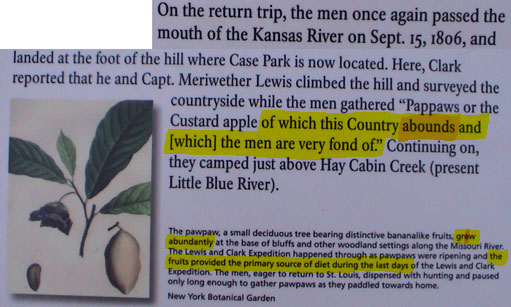
Visit With The Past, Exhibit, John Barkley Visitor Center, Shawnee Mission Park, 79th & Renner, Shawnee, KS, 6-12-05:
In addition to greed (for motivation) reasons, people today will argue that those who don’t work should not be feed simply because they don’t deserve it. This therefore, holds the general public’s ethics of the matter on their side. If everyone today also lived 200 years ago (in the Kansas City area) they would “realize” that there once was free abundant food.
http://www.bodley.ox.ac.uk/external/cross/herodotus-history.pdf (Bodleian Library, University of Oxford), 440 BC: The History of Herodotus [near Caspian Sea]:
Many and various are the tribes by which it is inhabited, most of whom live entirely on the wild fruits of the forest.
http://www.uppercanadahistory.ca/lteuc/lteuc14.html (Historic Narratives of Early Canada), Notes about Niagara 200 Years Ago:
Hops grew in abundance, as did wild fruits like plums, mulberries, blackberries, strawberries, raspberries and grapes.
Matthew 6:26 (NKJV):
“Look at the birds of the air, for they neither sow nor reap nor gather into barns; yet your heavenly Father feeds them. Are you not of more value than they?”
I guess not, because our sowing, reaping and gathering into barns just allows us a way to keep it from others, controlled mainly by those who reap but don’t sow. But, if we sowed, reaped and gathered in “fairness,” we all would have much more. Then, that would make us “of more value.”
http://www.unc.edu/~lauralo/bootstoilet1.jpg (via http://www.unc.edu/~lauralo/bootstoilet.html), Boots:

Simply put, I believe that obtaining God’s free resources should be “easier.”
However, for those of you who wish to not work (for others), it would not be right for you to own one Wayne Thermoplastic Submersible Utility Pump unless and until you have properly labored for it:

Great religions:
The Jewish Encyclopedia, 1901, Vol. 1, p. 230, “Agape”:
The Kansas City Star (newspaper); Wednesday, April 19, 2006:
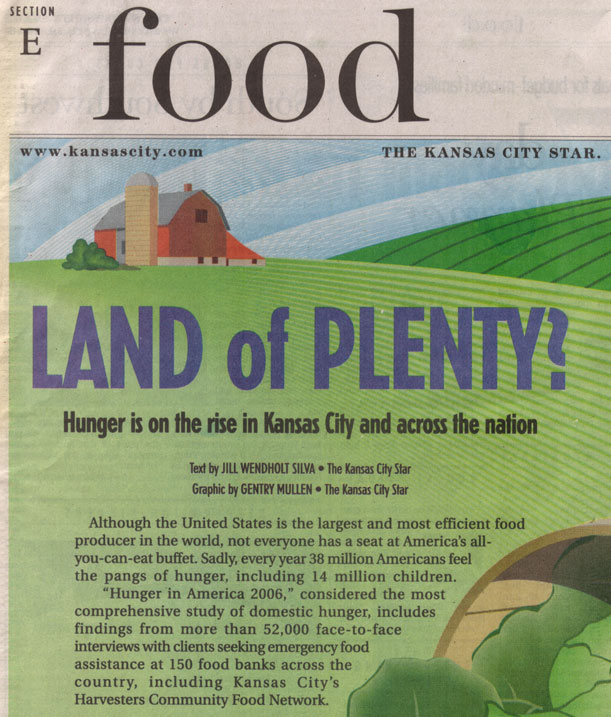
Is that right?
My Little Golden Book About God (children’s book), Watson, 1984, p. 11 (about):
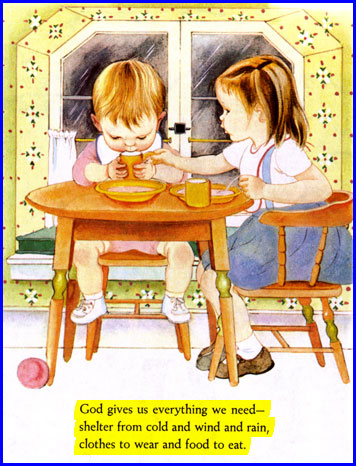
He used to, but now only when we submit to others.
Exodus 23:10-11:
And six years thou shalt sow thy land, and shalt gather in the fruits thereof: But the seventh year thou shalt let it rest and lie still; that the poor of thy people may eat: and what they leave the beasts of the field shall eat.
I interpret this as giving one-seventh of everyone’s income to those who do not work. That’d be a little over 14% unemployed. But, as God implies, in a free to not work society, there will probably still be less than 14% unemployed; hence, much left over for the beasts.
This Thanksgiving, let's build One America, email campaign newsletter I received 11-21-07 from John Edwards (info@johnedwards.com):
But as we give thanks, we should also remember that even in America, the richest country in the world, 35 million people are not getting enough food to eat.
That’s more than one in ten. Well, if they’d lived in Kansas City 200 years ago, they’d have more than enough, without having to feel the guilt of taking it. I say mankind’s advancements are not Godly advancements unless everyone is better off as a result, or at least the same (not ending up having less – where there are getting ripped off). In the newsletter, John challenges everyone to “volunteer one hour at a food bank, donate at least one can …” If my website ever gets disseminated, hopefully I alone have just feed the 35 million, and every day for the rest of their lives! And, with no guilt for taking it! – So their children won’t wish to become criminals! This is a very easy entry for me to do, but so very, very hard to get disseminated in this very, very, very dumb and evil society. You see, John Edwards’ intentions are good, and it will receive “some” added results, but mine would solve the “entire” problem. And the wealthy who disagree with me, are simply too stupid to realize that their 99% selfish greed is actually really not to their benefit, as they have to pay many times more to accommodate the prisons, etc. I bet it would even lead Microsoft to quit putting the screws to all of its users. I can actually even logically see why worker pride, motivation and enthusiasm would go up substantially. Workers that slave all week just to makes ends-meet, can’t be too enthused about the quality of their job and in doing it better. Only workers who make a good, healthy salary are the ones who have more motivational pride in doing their job right / better. America does do a lot better job of this than most other countries, and that is the only reason we have a first-rate economy. But, “35 million” just tells me that it could even be better. Plus, another thing that’s holding it (free food) back is everyone’s argument saying that none of those people deserve the hand-outs; but, my Lewis and Clark pages definitely prove that assumption incorrect!
You say, “If we offered free food for everyone, then no one would work, then there’d be no economy to feed even them (regarding how our farm to market, etc. system works today).” People will still work for “more,” and, most importantly, with more pride and enthusiasm. It’s like our current school system, or any government service: If everyone decided to not work and just took the service, then no one would be running the schools and government to take advantage of it. But, everyone seems to keep working anyway, which allows the schools and government to exist. Pride in being an idiot is the main cause for the underfed people.
They’d say: “How could we get anyone to work if we didn’t make it burdensome and degrading to get free food via shelters, lines and churches?” You’d say: “I agree: that’s a valid question.” I’d say: “No, even more people would work if working for more was really for more.” None of us had to work while we lived with our parents, but most did just for “more,” even with a full high school schedule. And hardly any of us were working a career job. And, I haven’t done a complete investigation, but I bet the teenagers who had to work just to help their parents pay the rent, didn’t work near as well, or as enthusiastically, as teenagers who lived in the middle class that got to spend (or save) all that they made. I’m saying this country would prosper much more, if every adult worked with the same attitude as the teenager who had his basic needs already met.
To spell it out: Basically, everyone should get a supply of food stamps (and more) from our government every month; initially paid by higher taxes, that will eventually bounce back to more for everyone, considering the way our free enterprise system currently works. That should also lift the pressures away from the purposeful manufacture of the abundance of faulty products made in, for and via this country; less “need” for dishonesty in products and services; more pride and enthusiasm for the more correct knowledge of one’s product and/or service (I’m reminded about flaw all the time); less abundance of inferior and faulty competitive products that only have good deceit campaigns (which employs probably 90% of our work force) (that hurts both consumers and the good achievers); a whole lot less “need” for crime; less Microsoft backstabbing their own customers; etc. This is far from communism as it simply will still pay the harder jobs more. The non-motivation work ethic of the “perfect” producing communism ideal probably produces 10% of the 10% of good product that the U.S. produces, mainly because of very strong worker apathy. So, free enterprise causes enthusiasm, but 90% into the realms of greed when basic needs aren’t met. So I predict an eventual 900 percent increase in “good” products and services for just the United States, once knowledge of fairness gets “accepted.” Or, 90% of all U.S. workers wouldn’t have to work, if we had someone who monitored quality in products and services (and that had the intelligence to do so). Then if we could somehow pay that 90% “more” to do even more “good” work, then we could make the productivity and progress of the last 200 years look like nothing. And “all” would reap of its benefits. Today, the way our current welfare degradation and “values” system works, if one man invented a machine that did all the work, then everyone else would starve to death, since no one else would be employed to be able to pay for any of the goods the machine made. And that one man would own and fence all the land to prevent any others from getting it God’s way. So I’m saying, progress is still slowly achieving, but at only 10% of the rate that it could be. The reason why communism failed proves that my idea of worker enthusiasm and worker happiness would cause achievement to soar. And all we have to do is implement the word “fair.”
The Book of Revelation concerning the three principle detriments of mankind: war, selling of food (relating to frilling wine and oil keep for her), and hunting animals, of the four horsemen, of the seven seals, verses 6:5,6,7: the selling of food is in vain if one can just go out into the woods and get it themselves.
This has not been an exhaustive search on this subject.
Lyrics:
They're makin' it hard on the workin' man
Tryin' to make a livin' any way he can
Makin' ends meet on the installment plan
His money goes right through his hands
Heaven, help him if you think you can
They're makin' it hard on the workin' man
–John Conlee, 1985.
All around I hear the sound of money; but, I ain't got a nickel to my name. And everywhere I look I see temptation: she stands on every corner and calls my name. Won't you tell me if you can – ‘cause life's so hard to understand – why's the rich man busy dancing, while the poor man pays the band. Oh they're billing me for killing me. Lord have mercy on the working man. … Hey St. Peter look down for a minute, and see this little man about to drown. There's quicksand all around and man I'm in it. Please help me up Lord cause I'm going down. –Travis Tritt, Brooks & Dunn, T. Graham Brown, George Jones, Little Texas, Dana McVicker, Tanya Tucker and Porter Wagoner; 1992.
Charlie's got a gold watch. Don't seem like a whole lot, after thirty years of drivin' up and down the interstate. –Kathy Mattea, 1988.
I'm a hard workin' man. I wear a steel hard hat, I can ride, rope, hammer and paint, do things with my hands that most men can't. I can't get ahead no matter how hard I try, I'm gettin' really good at barely gettin' by … I feel like I'm workin' overtime on a runaway train. I've got to bust loose from this ball and chain. –Brooks and Dunn, 1993.
'Cause it's a bittersweet symphony, this life. Trying to make ends meet: you're a slave to money then you die. –The Verve, 1997.