FORNICATION – WIFE / WOMAN / GUNAIKOS
1 Corinthians 7:1-2 (“touch”); Genesis 2:22-25 (“they shall become one flesh”)
{Greek: γυναικος [transliterated: gunaikos / γυνή (base) [transliterated: gunee]}
{Hebrew: “…אשה…” (characters: He, Shin, Alef) [transliterated: ’iššāh]}
1 Corinthians 7:1-2 (NKJV):
1Now concerning the things of which you wrote to me: It is good for a man not to touch a woman. 2Nevertheless, because of sexual immorality [fornication in others], let each man have his own wife, and let each woman have her own husband.
First of all, “woman” is “γυναικος” which is in the genitive / possessive case: “possessor of another noun.” The other noun is “man” (specifically in dative / indirect object case: “an object indirectly affected by the action of a verb”: “the means by which something is done”; as “to touch” is the verb. “Nevertheless because” is really “through / by / via,” and therefore there’s no period before (punctuation didn’t exist in the original text). “Sexual immorality” is “prostitutions” (plural). “Let” and “let” are both “the” or simply not there.
And therefore goes much more correctly as:
1… It is good for a woman’s/wife’s man/husband not to touch 2through / by / via the prostitutions [then put the period here]. Each man the himself woman/wife to hold in possession, and each woman the her own man/husband to hold in possession.
So, it sounds like Paul was simply telling husbands (women’s men) to not touch prostitutes (which Corinth was most popular for in abundance). And that monogamy is the standard in marriage (said as a “concession”: 7:6). Paul was talking about a woman’s man (likely a husband), not just any random sexual encounter particularly between unattached single people (as verses 8-11,28,32-34,36,39 define the context in definite marriage). So, even if you leave the period before “via prostitutions” (thereby negating “via prostitutions” out of the first sentence), if you’re single and unattached, you can do it (touch a woman). Those who have monogamy in marriage could still have their times of love-feast / open-sex rituals, not only to cause more tangible love between one another, but to suffice that urge to have sex elsewhere (particularly in prostitution, which was the very popular pagan standard in Corinth) [See my Early Christian Sex Orgies pages].
Otherwise, not changing the location of the period doesn’t flow well:
1… It is good for a woman’s/wife’s man/husband not to touch. [Not touch what?] Or: It is not good to touch a woman’s/wife’s man/husband [“who” shouldn’t touch the husband?]. 2[verbatim:] Through / by / via the prostitutions each man the himself woman/wife hold in possession, and each woman the her own man/husband hold in possession.
I like that version of verse 2 also, because it’s defining marriage as “prostitutions”; but, the first sentence just doesn’t make any sense leaving out “through / by / via the prostitutions.”
The breakdown is as follows:
Interlinear Greek-English New Testament: With Strong’s Concordance Numbers above Each Word, Green, Baker Books, 1996, p. 524, “1 Corinthians 7”:
(The far right text column is the KJV):
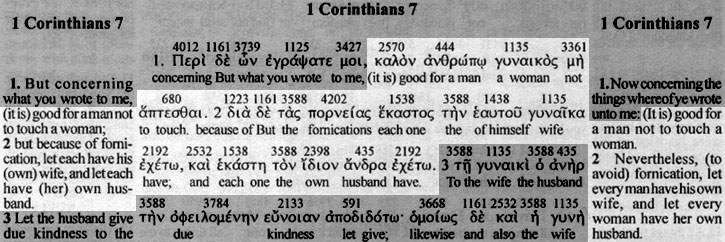
My outline:
|
Greek word |
Strong # |
Definition |
|
καλον |
2570 |
good / better |
|
ανθρώπω |
444 |
man / husband (dative noun) |
|
γυναικος |
1135 |
woman’s / wife’s (genitive / possessive case: “possessor of another noun”) (or could put: “of woman / wife”) |
|
μη |
3361 |
not / non- |
|
‘άπτεσθαι (.) |
680 |
(infinitive verb of άρτω [add “to”]) to touch / to burn / to set fire to; to fasten to, make adhere to, to take hold of, to attach oneself to (LXX: to set fire to, to cause to glow) |
|
(v. 2) δια |
1223 |
through / by / via |
|
δε |
1161 |
but, and, moreover, now: often unexpressed in English |
|
τας |
3588 |
the |
|
πορνείας (.) |
4202 |
prostitutions (plural) |
|
‘έκαστος |
1538 |
each, every; each one, every one: each man (masculine; singular) |
|
την |
3588 |
the |
|
‘εαυτου |
1438 |
himself |
|
γυναικα |
1135 |
woman / wife (accusative [direct object of a verb]; singular) |
|
εχέτω, |
2192 |
hold in possession; have, hold; have possession of; own, possess, belong to, have charge of |
|
και |
2532 |
and |
|
‘εκαστη |
1538 |
each, every; each one, every one: each woman (feminine; singular) |
|
τον |
3588 |
the |
|
ίδιον |
2398 |
one’s own, pertaining to self; his own, their own, her own; pertaining to one’s self |
|
άνδρα |
435 |
man / husband |
|
εχέτω. |
2192 |
hold in possession; have, hold; have possession of; own, possess, belong to, have charge of |
Note on the marital status of the “woman” (older entry):
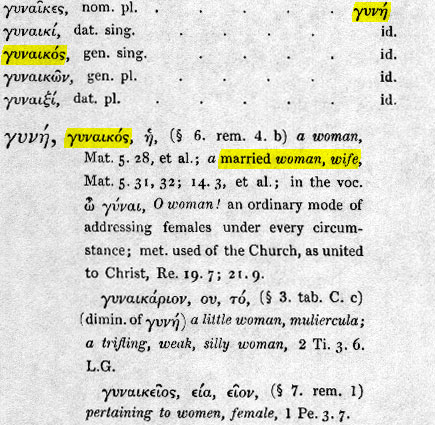
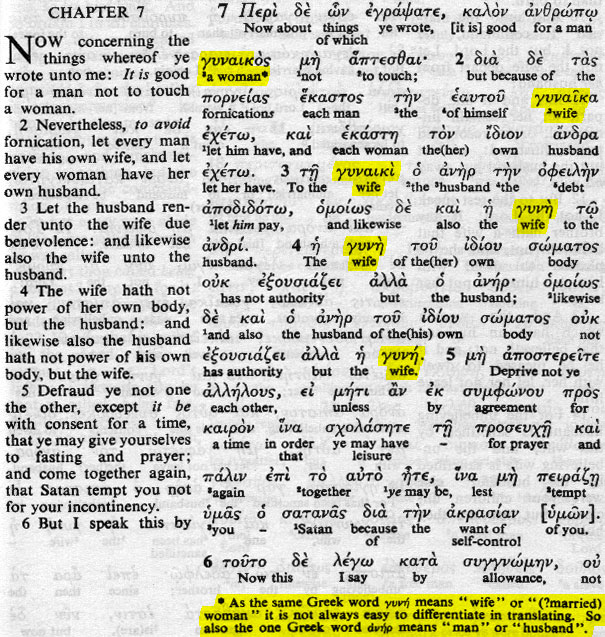
Traditionally, in 1 Corinthians 7, “γυναικ… / γυνή” is “woman” in verse one, but quickly changes to “wife” in verse two and further when they start having sex. The basic word default is “woman” but whenever possession is involved that word traditionally changes to “wife.” Since Paul does specify γαμος (gamos) meaning “married” in verses 9, 10, 28, 33 34, 36 & 39, and even αγαμος (agamos) meaning “not married” in verses 8, 11, 32 & 34, then that shows he’s likely talking about wives throughout:
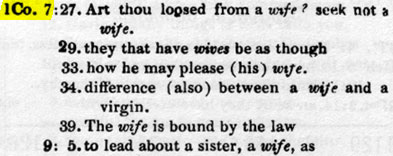
The Word Study Concordance (KJV), Wigram / Winter, Tyndale House Publishers, 1978, pp. 1135-1136, Strong number “1135” | “γυνή, gunee”(base form of γυναικ…):
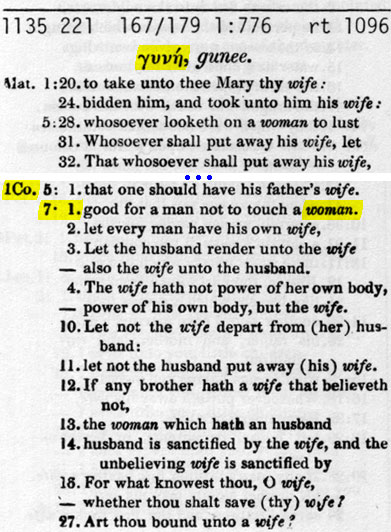
(Next column):
Genesis 2:22-25 (“they shall become one flesh”):
(I’m still talking about 1 Cor. 7’s Greek word here): The case form of the word has nothing to do in determining the marital status of the woman. Only the context tells whether she’s a “wife” or a “woman.” Therefore, the call is arbitrary, and is open for the vital translation support for “Christian” marriage, which does give it an entirely different meaning in many instances: an entirely different instruction from God. The best example is in Genesis 2:22-25 where God created “woman” in verses 22 and 23, but it quickly changes to “wife” in verses 24 and 25 just because she’s with a man. This is a corruption just to support the supposed original marriage contract. Otherwise, Adam would be having sex out of marriage, and we can’t have that! Hebrew uses the same kind of parallel word which is also either “woman” or “wife” determined only by context. The same is true in the Septuagint (the Greek Old Testament).
The Interlinear Bible: Hebrew-Greek-English, Green, Sovereign Grace Publishers, 1986, p. 2, Genesis 2:22-25:
(Hebrew is read from right to left.)
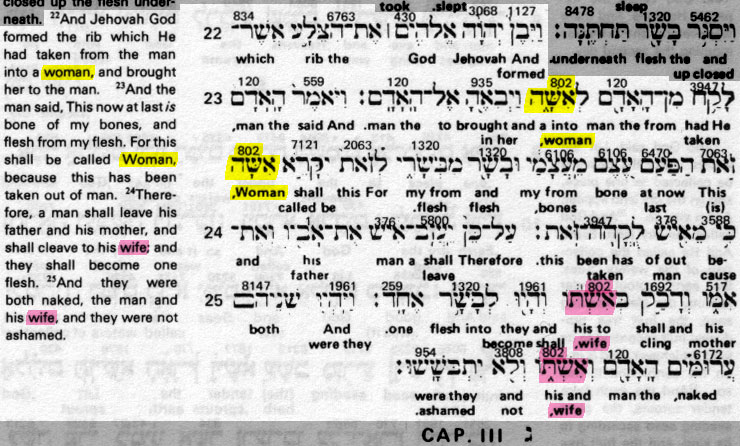
All are Strong Hebrew number “802.” It’s the same word; and, there’s really no context saying they got married, other than what corrupt minds want.
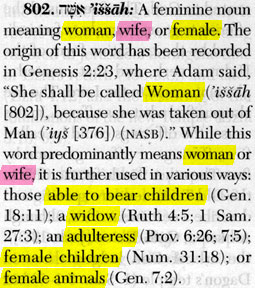
The Complete Word Study Dictionary: Old Testament, Baker / Carpenter, AMG Publishers, 2003, p. 104, “אשה” Strong Hebrew number “802”:
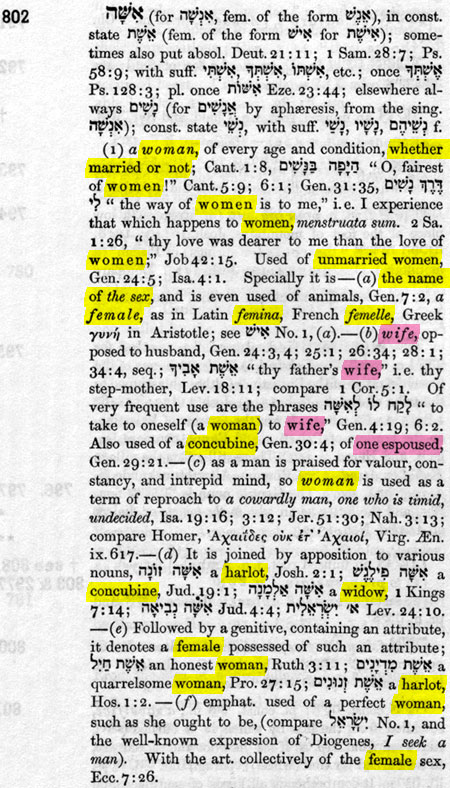
Yellow = woman / women occurrences.
Pink = wife occurrences.
Gesenius’ Hebrew-Chaldee Lexicon to the Old Testament, Baker Books, 1979 (original text 1847), p. 84, “אשה” Strong Hebrew number “802”:
Same in the Septuagint (the Greek Old Testament):
The Septuagint with Apocrypha: Greek and English, Brenton, 1986 (orig. text 1851), p. 3, Genesis 2:22-25:
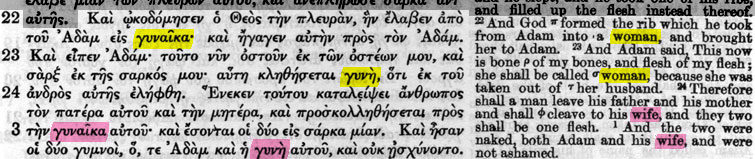
(Apparently verse 2:25 is verse 3:1 in the Septuagint. By the way, it’s the same scenario with man / husband.)
By the way, to take verse 24: “and they shall become one flesh” more literally, it indicates that the “one flesh” of the two parents is what’s better know as a “baby.” But, that’s only if you take it “literally.” Otherwise, it’s whatever you want it to mean. Right? Or, “shall become one flesh” can also simply mean the touching intercourse of sex, as two people touching as much and as close as possible, where one is actually party inside the other, would look like they are trying to become one person / one flesh. Plus, the rib basis for this union is told literally. Otherwise, a married couple today can place a husband in New York and his wife in San Francisco, which separates them very far from appearing as of the same body. You see, “flesh” is a worldly / tangible / physical thing, not a spiritual / imaginary / whatever you want it to mean thing. Now, just because corrupt church / synagogue leaders have warped Bible interpretation DOESN’T mean there’s no such a thing as God!
It would be really easy for church leaders to interpret this as Adam and Eve just having sex, instead of the more unstable marriage interpretation intended to strengthen God’s demand of no sex before marriage. Plus, if this is God commanding the woman and man to be married first – as churches today assert – then there’d be “something” during or before it to specifically indicate and decree that such is the case, by some kind of explanatory rule, ceremony, etc. defining exactly what is allowed and exactly what is not allowed.
This traditional interpretation is of this passage is supposed to be the basis for all our beliefs in marriage, the financially controlled family standard, and the wonder extended condemnation of sexually active single people. But, the reality is a very unstable interpretation for a super major issue. Again, the support for their argument is simply not there in the original text, other than the obvious “corruption” to substantiate same. And corruption is “possible,” because the last four verses of the entire Bible is Jesus informing us that God can’t stop Bible corruption (including errors of people who are not Jesus, like Paul).
Even the English at one time had the same scenario with “wif[e]”:
A Middle-English Dictionary (12th-15th century), Stratmann / Bradley, Oxford, 1891, p. 682:
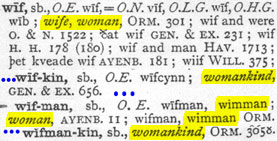
(Added 12-29-10):
Someone suggested that all possessive cases relating to gunee / gunaik… with a man (in both the Greek and Hebrew) would be correctly translated as “wife” instead of woman; and, it looks like Bible translators have taken the liberty in doing just that. However, if all possessive instances made the woman into wife, then how would the ancients have known about a man’s girl friend or fiancé? Instead, since neither the Greek or the Hebrew had a separate word for “wife” (thereby indicating something suspicious right there concerning the ancient’s supposed strong validation of marriage), the correct English translation should always be “woman” instead of wife, leaving the question if she’s married to any firm context stating such, like when it includes the word gamos – the Greek word for marriage – for instance. Translating as such (always “woman”) would not impede the fact when the context indicates she’s married. For example, if a man is definitely talking about his wife, and he says “… my woman went to …”, that would not negate that she’s his wife and make her single. But, stating she’s married in all (with a man) possessive instances can very well be incorrect, thereby corrupting the Word of God. Therefore, I say let readers determine if she’s marriage by the context, not by a mandated corruption or assumption just to advocate marriage as a standard. Like Genesis 2:24-25’s use of “wife” when there is no context indicating that the two are married, this one instance of corruption alone can cause a multitude of problems.
More miscellaneous Greek (referring to 1 Corinthians 7 above):
The Analytical Greek Lexicon, Zondervan Publishing House, 1973 printing, p. 83, “γυναικός”
The Interlinear Greek-English New Testament, Nestle / Marshall, Zondervan, 1958, p. 671, 1 Corinthians 7:
Essentials of New Testament Greek, Summers / Sawyer, 1995, (appendix) Greek-English Vocabulary, p. 175:

Many English Bibles translate 1 Cor. 7:1 against marriage instead of against single people:
Traditional against single people:
“… [It is] good for a man not to touch a woman.” –King James Version [KJV]
Others against marriage:
“… It is good for a man not to marry.” –New International Version [NIV]
“… You asked, ‘Is it best for people not to marry?’” –Contemporary English Version [CEV]
“… It is well [and by that I mean advantageous, expedient, profitable and wholesome] for a man not to touch a woman [to cohabit with her] but to remain unmarried.” –The Amplified Bible [AB]
“… A man does well not to marry.” –The Good News Bible (Today’s English Version) [TEV]
“… my answer is that if you do not marry, it is good.” –The Living Bible [LB]
“… Is it advisable for a man not to marry?” –International Standard Version, 2008
“… It's good for men not to get married.” –God’s Word Translation, 1995
“… It is well for a man to abstain altogether from marriage.” –Weymouth New Testament, 1912
“… whether it is best for a man not to marry?” –Mace New Testament, 1729
“… it is an excellent thing for a man to remain unmarried.” –The New Testament: An American Translation, by Edgar Goodspeed, 1923
“… That it is good for a man not to receive a wife:” –Translation of the New Testament from the Original Greek, by William Godbey, 1902
“… It would be well for a man to remain single.” –Twentieth Century New Testament, by Ernest Malan and Mary Higgs, 1904
1 Corinthians 5:1: the porneia incest interpretation (incidentally)
NKJV:
Paul talking: “It is actually reported that there is sexual immorality (porneia) among you, and such sexual immorality (porneia) as is not even named among the Gentiles—that a man has his father’s wife!”
Incidentally, “his father’s wife” indicates that it’s the stepmother. If it was the mother, it would simply say “mother.” If I addressed my mother as “Hey wife of my father …” she’d think I was pretty weird. Therefore, it’s not blood related incest. Plus, again, “wife” is really just “woman” so they might not even be married. But let’s give “wife” the benefit of the doubt. Prostitution was very popular in Corinth at the time; therefore, it would probably not be that unusual for a guy to do his father’s wife (or girl friend) especially if she worked the very popular Corinth occupation of prostitution. A simple “Let’s also ask my son if he’d pay us something for you” would likely get the deed accomplished. However, incest (and probably any near form of it) was taboo in the Gentile world, as Paul noted, and is also confirmed as taboo in my EARLY CHRISTIAN SEX ORGIES: Specific instances (further down this website’s home/index page). Those tell about a lot of early Christian incest practice, and is noted by government authorities as the base reason for 300 years of Roman persecution against Christians. Such were early Christian imperfections in the reenactment of the Last Supper’s order by Jesus to agape (including sexually) love one another. Incest must have been (erroneously) part of the ritual, as such was done in the darkness to probably lessen the Roman persecution evidence, as was the practice of all “mystery” religious which Christianity was (even according to the Catholic Church). Incest was accepted in Egypt, which begot a large Christian following. Basically there’s no victim in incest (I’d personally much rather everyone in my neighborhood flaunt into incest than myself become a victim if one was a burglar); however, I don’t recommend incest because there’s sufficient love between family members. In support, Jesus said you are not following righteousness unless you “hate” the members of your own family (Luke 14:25-26), thereby also denouncing incest. But, since incest was such an outstanding offense in the pagan world, its Christian practice did allow me in 2001 to find more specific orgy instances by adding “incest” to my Google searches. So, possibly early Christians did have some correct inspiration for incest just for my very important corruption findings of today, as this issue is HUGE (once it becomes well known).
But, back to Paul: Obviously Paul was against the prostitution part as well as the incest part, as he indicated Gentile law was against it. If Paul himself participated in the ritual free-love orgies including incest, as was indicated by Nero’s court, then I’d say that Paul was just aggrandizing the point against prostitution based on the incest taboo in the secular laws. It also makes sense that Paul would not have wanted to challenge the taboo / law in a letter (that would of got him killed if it was read by the government). Contrary to popular belief, monogamous marriage was the standard in the Gentile world, where brothels were allowed (for tax advantages) but looked down upon. In other words, the same basic morals of today’s society (like if you live in Nevada) (say 50 years ago). Christianity was persecuted for being different than that, and it’s just a fact that both marriage’s and prostitution’s biggest enemy (or, destroyer) is free-love. Therefore since Jesus was against marriage (see next webpage) and prostitution, then Jesus had to have been for free-love, as the logic of the more tangible touch between everyone will cause more real love to become blessed upon this Earth. You see, it makes sense why Jesus was crucified and it makes sense why the Roman Empire wanted Christianity out of their cities. Heck, Matthew 21:6-11 actually says that Jesus and His followers entered Jerusalem naked, trampling over their clothes (also compare Gospel of Thomas 37). People are extremely gullible (believing marriage is the Jesus standard).
There are two possible reasons why prostitution (porneia) is wrong: (1) Because it’s sex out of marriage (today’s traditional corruption), or (2) Because it’s selling something that should be free (my interpretation). And marriage itself conforms to number 2. And, since Jesus denounced marriage, then end of story!
Historically, regarding the very ancient religious justification against incest, marriage between tribes and outside of families would have lessened wars and feuds, therefore a moral practice. Jesus and I are just trying to greatly expand on that reality with open-sex between everyone.
Concerning Luke 14:25-26:
Jesus commands us to “love one another.” The only exception is members of our own family. You see, James Dobson’s, et al., voice is a very, very, very powerful voice in 2009. “I” need someone one step more powerful (Jesus) to strongly / harshly overrule him.
Last comment:
Porneia meaning only prostitution alone tells that there has been a major corruption, which strongly supports that any other Biblical “sex only in marriage” assumptions are likely part of the same corruption / bias.