CHERUB / SERAPH
Other names for Eros / Cupid / Amor in Christian art
The New Comprehensive A-Z Crossword Dictionary, Schaffer, 1995, p. 211, “cherub…”:
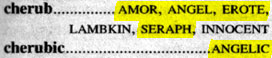
Random House Crossword Puzzle Dictionary, 2001, p. 137, “cherub…”:
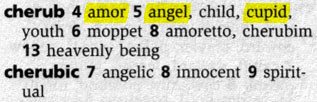
http://en.wikipedia.org/wiki/Cupid, Cupid, “Portrayal in art and literature”:
In painting and sculpture, Cupid is often portrayed as a nude (or sometimes diapered) winged boy or baby armed with a bow and a quiver of arrows. The Hindu Kama also has a very similar description. The traditional Christian depiction of a cherub is based on him.
http://www.in2greece.com/english/historymyth/mythology/names/eros.htm, Eros:
The more popular, and later, version of Eros as that of a winged baby or youth shooting arrows into people's and god's hearts, making them fall in love. This is the best known image of him, and it is often believed that it was Eros that stood model for the christian cherubs.
Handbook to Life in Ancient Rome, Adkins, 1994, p. 260, “Cupid”:
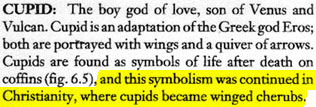
Dictionary of Roman Religion, Adkins, 1996, p. 56, “Cupid”:
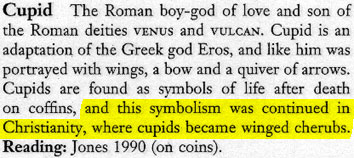
The Oxford Companion to Classical Literature, 1989, p. 126, “Cupid”:
The “mystery religions,” which Christianity was one, were known for sex orgies (see my pages on “Mysteries”).
The Donning International Encyclopedic Psychic Dictionary, Bletzer, 1986, p. 209, “Eros”:

Fundamentals of Human Sexuality, Katchadourian, 1989, p. 576, “Erotic Themes in Greek Mythology”:
http://www.mythicimages.com/printeros.htm, The Mythic Images Collection: Library Information, “Eros – God of Love”:
The changing conception of the god is reflected in art, in which Eros remains perpetually youthful, even growing steadily younger. He is represented as a youth in archaic times, as a young boy in the classical period, and becomes a baby by later Hellenistic and Roman times. He finally gets muddled up with angels and cherubs in later Christian sentimental iconography. This encroaching babyhood seems almost a sad metaphor for the infantilization of male sexuality. Yeah, but that’s why it made it through Middle Age corruption: for it to be available for “me” to use today, no other reason.
The Dictionary of World Myth, Bently, Facts On File, 1995, pp. 71-72, “Eros”:
Myth: Myth and Legends of the World Explored, McLeish, 1996, p. 181, “Eros”:
Eros: The God of Love in Legend and Art, Irene Korn, 1999, p. 3, “Introduction”:
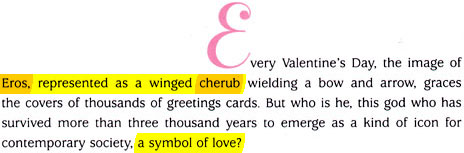
Webster’s Third New International Dictionary of the English Language (Unabridged), 1986, p. 72, “amor”:

… “amorous”:

Webster’s Third New International Dictionary of the English Language (Unabridged), 1986, p. 554, “cupid”:

The American Heritage Dictionary of the English Language, 1992, p. 456, “Cupid”:

Webster’s Third New International Dictionary of the English Language (Unabridged), 1986, p. 772:
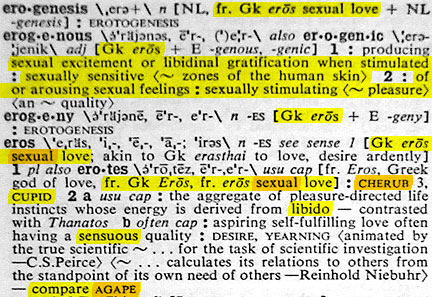
http://www.amazon.com/Cupid-Bow-Arrow-WATCHBUDDY%C2%AE-Strap-Womens/dp/B000SSVLA2/ref=sr_1_3?ie=UTF8&s=watches&qid=1209369893&sr=1-3:
Generic descriptions / examples:
Ultimate Visual Dictionary, DK Publishing, 1998, p. 472, “Architecture | Gothic 2 | … Church of St. Maclou, Rouen, France, c. 1519”:
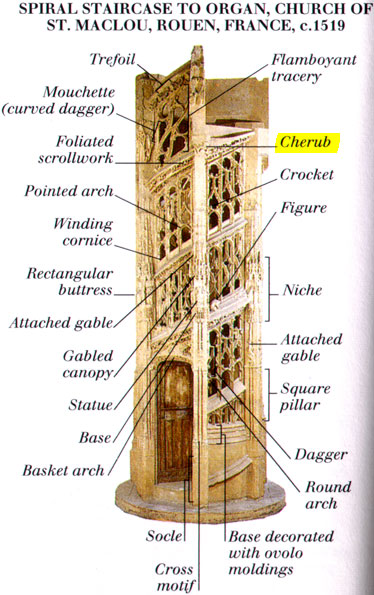
In fact, “Cherub” seems to be the only character (and the only pagan deity) there; other than maybe “Figure” or “Statue,” which are generic terms.
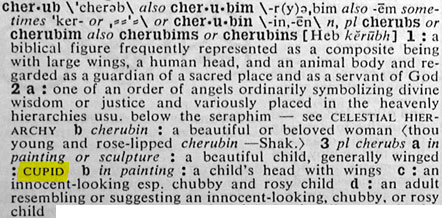
Webster’s Third New International Dictionary of the English Language (Unabridged), 1986, p. 385, “cherub”:
 :
:
Cherub – Second Order of Angels:
Random House Word Menu, 1992, p. 831, “Faith | Religion | Individuals and Titles | cherub”:

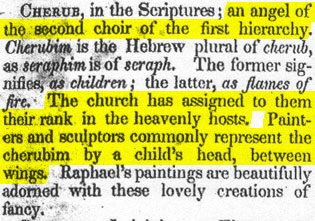
Encyclopaedia Americana, Vol. III, 1830, p. 131, “Cherub”:
http://www.cliffsnotes.com/WileyCDA/LitNote/id-140,pageNum-53.html (Cliff Notes), Milton’s Universe:
Below God and the Son are the angels. Traditional Christian thought grouped angels into nine hierarchical categories. The traditional Christian categories and hierarchies of angels were Seraphim, Cherubim, Thrones, Dominations or Dominions, Virtues, Powers, Principalities, Archangels, and Angels.
http://www.geocities.com/SouthBeach/9327/cherubim.html, Cherubim: Function and Philosophy:
The Cherubim Choir is the second of the nine accepted choirs of angels, placed second as well in the first triad of the angelic hierarchy(with the seraphim and thrones). They are some of the most powerful and awe-inspiring of all angels, standing below only the seraphim in direct closeness to God.
http://www.sarahsarchangels.com/archangels/9orders.html, The Nine Orders:
CHERUBIM (Cherub,
singular for Cherubim):
Second to only the seraphim, the Cherubim hold the knowledge of God.
So the early Christians made Eros into the Cherub to “hold” the knowledge of God.
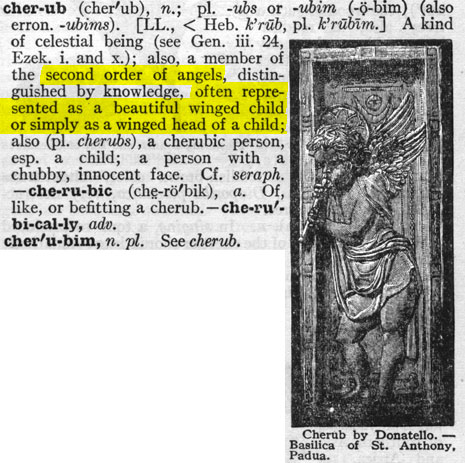
The New Century Dictionary of the English Language, Emery / Brewster, 1952, vol. 1, p. 243, “cherub”:
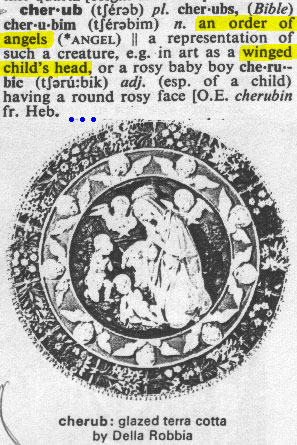
Larousse Illustrated International Encyclopedia and Dictionary, Times Mirror, 1972, p. 135, “cherub”:
Similar:
http://pro.corbis.com/; Search number: AV002528, Madonna and Child by Andrea Della Robbia, 1435-1525, Christian art, Located in: Museo Nazionale del Bargello, Italy:
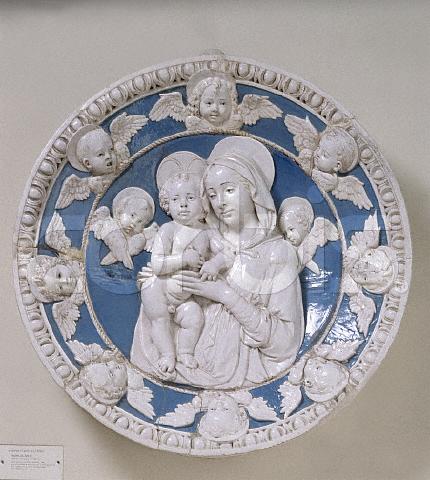
Seraphim (first order of angels):
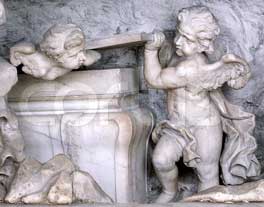
http://pro.corbis.com/, Search # DE004043, Detail of Cherub and Seraphim from The Deposition by Francesco Celebrano, Located in: Cappella di Santa Maria Della Pieta dei Sangro (Sansevero Chapel, Naples, Italy), ca. 1729-1814, Christian art:
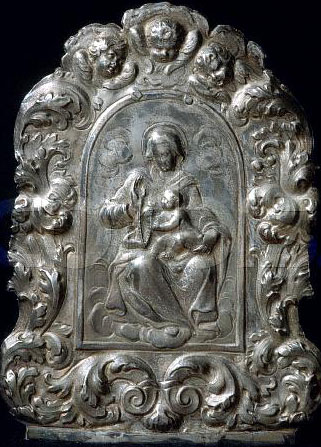
http://pro.corbis.com/, Search # EL006307, Relief Plaque Depicting Virgin and Child with Seraphim, Christian art:
http://pro.corbis.com/, Search # VU005082, Sculpture of Seraphim from the Tomb of Filippo Strozzi, in Chiesa di Santa Maria Novella by Benedetto da Maiano, 1493, Christian art:
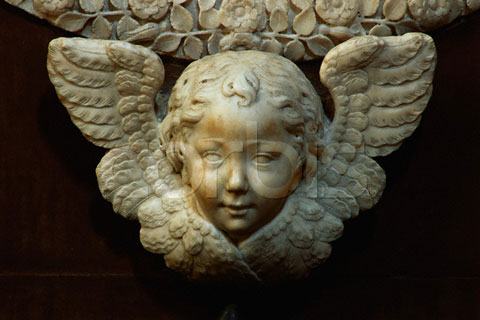
http://pro.corbis.com/, Search # MI002998, Plaque with Seraphim from Santa Caterina a Formiello, Renaissance period, Christian art:
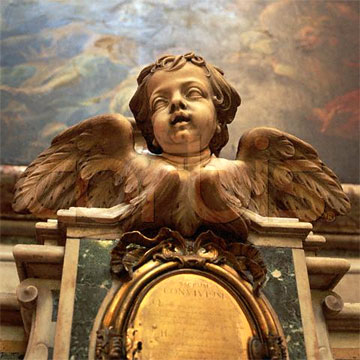
“Seraphim” which is the first in the “traditional Christian” angel hierarchical order, appears to be Eros also in “Christian” art.
http://www.answers.com/topic/seraphim-judaic-mythology, “Seraphim”:
The Hebrew plural of Seraph. Cf. Cherubim.
…
The word seraphim in the English and Latin Bible is a
transliteration from the Hebrew, and appears to be the plural of the
Hebrew noun saraph. The plural form seraphim occurs in the Bible
only in Isaiah 6:2, 6 where it designates the winged creatures positioned above
the throne of the Lord. According to Isaiah, each of the seraphim has six
wings. One pair of wings is for covering the seraph's face so that he will not
behold the Lord (the underlying assumption is that whoever does see the Lord
will die; Ex 33:20); a second pair of wings is for covering the seraph's
genitals for modesty's sake; the third pair of wings is for flying (Is 6:2). In
Isaiah's description of his vision of the Lord enthroned in the Temple, the seraphim declaim to each
other, "holy, holy, holy is the Lord of hosts; the whole earth is full of
his Glory" (Is 6:3), their voices making the doorposts of the Temple shake (Is 6:4). To Isaiah's
exclamation, "I am a man of unclean lips, and I dwell in the midst of a
people of unclean lips" (Is 6:5) one of the seraphim reacts by scorching
the prophet's lips with a hot coal from the altar and proclaiming: "Your
iniquity is taken away, and your sin purged." (Is 6:6-7).
http://www.answers.com/topic/seraph, “seraph”:
1. A celestial being having three pairs of wings.
2. seraphim Christianity. The first of the nine orders of angels in medieval angelology.
http://www.family-estore.com/catalog/32004.jpg (via http://www.family-estore.com/servlet/the-Christian-Gifts/searchpath/48426/start/67/total/84/Categories#), Christian Gifts, “Sleeping Angel in a Seashell Statue”:
Sleepy seraph snuggles in a seashell, dreaming the
sweet dreams of heaven and all its spendor!
Makes a lovely addition to any home or garden.
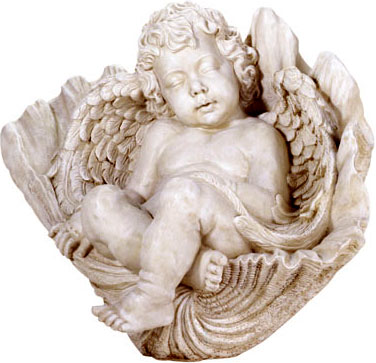
Looks like Eros to me.
http://benedettoxviforum.freeforumzone.leonardo.it/discussione.aspx?idd=8527207&p=3, Benedetto XVI Forum - Benedict XVI: NEWS AND COMMENTARY:
ST. PASCUAL
BAYLON (Spain, 1540-1592)
Franciscan tertiary and mystic
'Seraph of the Eucharist'
How about some praying to Eros.
http://pro.corbis.com/Enlargement/Enlargement.aspx?id=EL006922&ext=1, EL006922: Renaissance Reliquary with Knight Figures, Christian art, Angel, Seraph:
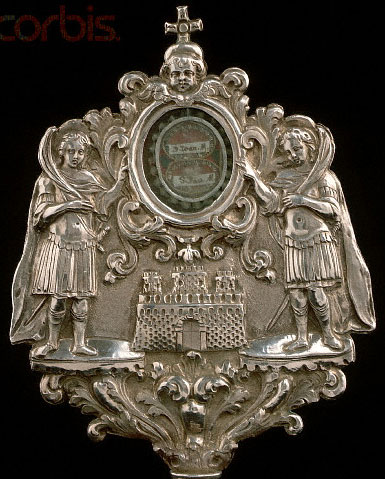
http://seventime.tripod.com/AngelsCherubs.html, Angels, Cherubim, Seraphim, and Archangels, “ANGELS”:
Many artistic portrayals more closely resemble the traditional image of Cupid than they do the biblical description of angels. The Bible tells us that they are mighty4[Psalm 103:20; 2 Thessalonians 1:7, NIV] and holy.5[Revelation 14:10, NIV] It says they are mightier than we humans are.
http://www.answers.com/topic/putto, “putto”:
Art historian Juan Carlos Martinez writes: "Originally, Cherubs and Putti had distinctly different roles, with the former being sacred, and the latter, profane. That is, Cherubs and Seraphs (Cherubim, Seraphim) are Angels, occupying the highest angelic orders in Heaven and are thus the closest to God. On the other hand, Putti, arise from Greco-Roman classical mythos (i.e., non-Christian). They are associated with Eros/Cupid as well as with the Muse, Erato; the muse of lyric and love poetry... "Putti – which comes from the Latin, putus, meaning 'little man' – are...not so much babies as they are 'not human'. They are spiritual beings and thus depicted in their typically odd fashion; as winged little people of indeterminate gender. Using babies as models for Putti (or for Cherubs, either) doesn't quite get across the true concept of 'Putti-ness' as they (babies) are too guileless, for one thing, whereas Putti are clever and purposeful. They are there to help Cupid/Eros facilitate the onset of profane love – or secular, non-religious love, as between two people, rather than the love as between a human and God.
http://www.sacred-texts.com/lcr/fsca/fsca11.htm, Cherubim and Seraphim in Heraldry:
These must not, however, be confounded with the cherub and seraph of Scripture. It was a thoroughly pagan idea, borrowed from classic mythology, and unworthy of Christian Art. It soon degenerated into "earthly loves" and "cupids," or amorini as they were termed and as we now understand them.
Cherubim in Old Testament:
HarperCollins Bible Dictionary, 1996, p. 176, “cherub”:

The Access Bible: An ecumenical learning resource for people of faith (NRSV), O’Day / Peterson, Oxford, 1999, “Glossary” p. 425, “cherubim”:
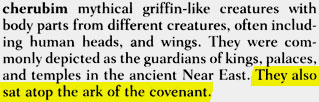
Hebrews 9:1-5:
1Then indeed, even the first covenant had ordinances of divine service and the earthly sanctuary. 2For a tabernacle was prepared: the first part, in which was the lampstand, the table, and the showbread, which is called the sanctuary; 3 and behind the second veil, the part of the tabernacle which is called the Holiest of All, 4which had the golden censer and the ark of the covenant overlaid on all sides with gold, in which were the golden pot that had the manna, Aaron’s rod that budded, and the tablets of the covenant; 5and above it were the cherubim of glory overshadowing the mercy seat. Of these things we cannot now speak in detail. – A “mystery.”
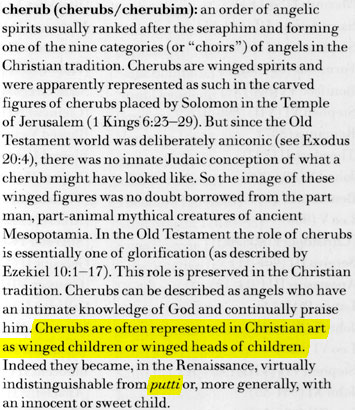
Myths and Legends of the World, Wickersham, 2000, Vol. 1, pp. 131-132, “Cherubim”:
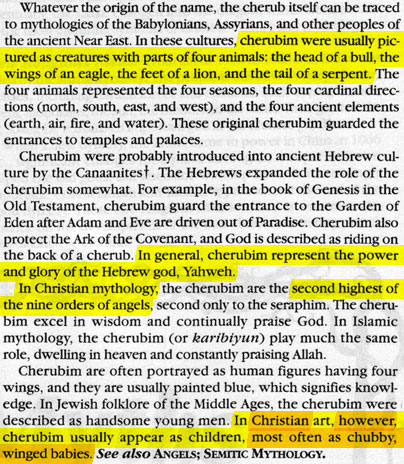
The Invisible Made Visible: Angels from the Vatican, Duston / Nesselrath, 1998, p. 310, “Glossary | cherub (cherubs / cherubim)”:
New Catholic Encyclopedia, 1967, Vol. III, p. 550, “Cherubim”:
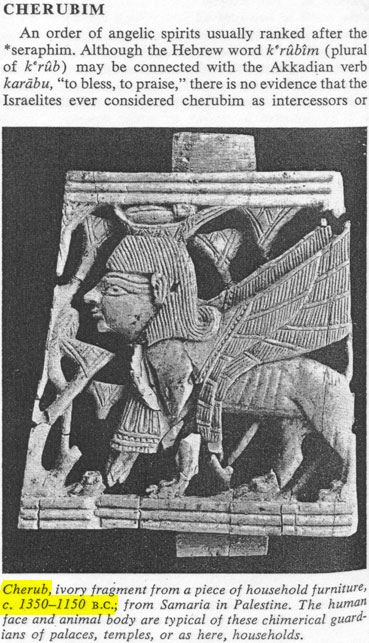
You see, that doesn’t look too much like our little feathered friend (Eros). But, somehow Eros became the Christian depiction of the cherub.
2 Kings 19:15 (NKJV):
Then Hezekiah prayed before the LORD, and said: "O LORD God of Israel, the One who dwells between the cherubim, You are God, You alone, of all the kingdoms of the earth. You have made heaven and earth.
Isaiah 37:16 (NKJV):
"O LORD of hosts, God of Israel, the One who dwells between the cherubim, You are God, You alone, of all the kingdoms of the earth. You have made heaven and earth.
http://www.bibleorigins.net/CherubimOrigins.html (Bible Origins), King Solomon’s Temple at Jerusalem:
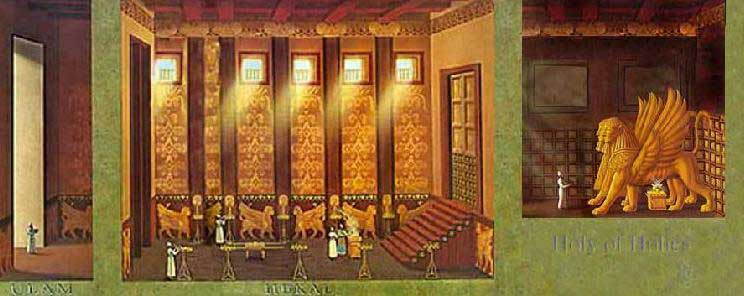
http://www.bibleorigins.net/CherubimOrigins.html (Bible Origins) , Cherubim, The Pre-Biblical Origins of:
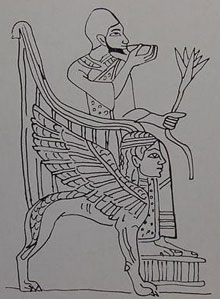
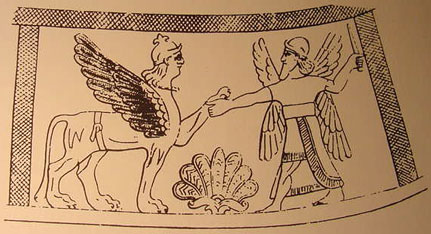
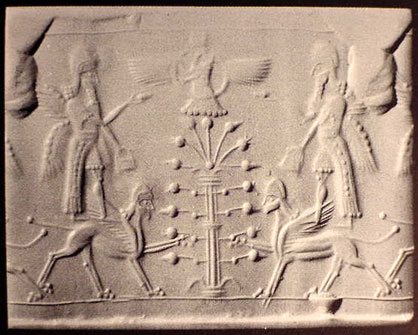
Not generally known to the public at large is that Cherubim have been determined not to be angels with human forms and wings. Nor is the public aware of the pre-biblical origins of Cherubim. This brief article attempts to address these issues. Many today envision Cherubs to be naked little children with halos and wings, frequently seen on Valentine's Day cards. These representations arose in Renaissance times, and are based on still earlier representations found in Roman art forms. … This is a most remarkable admission on Josephus' part in light of Ezekiel's very detailed description of a Cherub (Ez 1:1-25). Josephus makes mention of Ezekiel (Antiquities 10.5.1), so he should have been aware of Ezekiel's description of the Cherubim, yet he avers that no one knows their shape or form ! Ezekiel portrayed the Cherub as having a human-like body, with four arms, hands, and legs, but with some remarkable non-human features- that is, the head had four faces, a calf, an eagle, a lion and a human. It possessed two legs whose feet were cloven like a bull's. It had four wings and was accompanied by a spinning wheel capable of flight. Four Cherubim, each with its wheel were under a firmanent supporting the throne of God and evidently provided locomotion for the throne. … Archaeologists have unearthed objects in Phoenicia and Canaan from the period of the Late Bronze Age (1540-1200 BCE) showing kings and rulers seated on thrones whose side arms consist of winged four-legged beasts, possessing a lion's body and a human head. They are known in Egyptian art as Sphinxes. Today's scholars thus understand that the Mercy Seat was a winged Sphinx throne modeled after Late Bronze Age thrones found in Phoenicia and Canaan. … In the Garden of Eden story Cherubim are described as guarding or barring the way to the the Tree of Life. Two winged sphinxes appear frequently in Phoenician art forms in association with a sacred tree, flanking either side of it. They also appear in Assyrian art forms with a sacred tree- in one case a winged sphinx attacks a sword-wielding winged genii approaching the tree. A bas-relief from South Arabia, the Yemen, where some Jewish traditions place the Garden of Eden, shows two winged sphinxes flanking the sacred tree with palm-trees in the background (Palm-trees and Cherubim being portrayed in the Temple of Solomon).
http://www.bibleorigins.net/VictoryNikeCherubimAngels.html (Bible Origins), Angel Illustrations, The Evolution of Christianty's Pictorial Representation of Cherubim and Angels From Hellenistic Roman Victory and Greek Nike Exemplars:
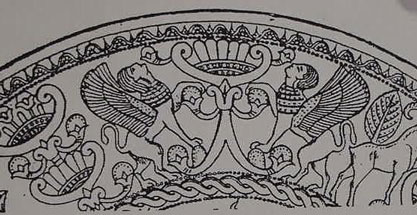
Below, from a Phoenican crafted platter of the 8th/7th century BCE are two Cherubim, winged sphinxes, smelling the fragrant aroma of a sacred tree and guarding it. This motif is understood by some scholars to lie behind Genesis' Cherubim guarding the Tree of Life in the Garden of Eden.:
Below, a Canaanite king or prince of Megiddo seated on a Cherubim throne, after an ivory found in the Late Bronze Age palace ca. the 13-12th century BCE.:
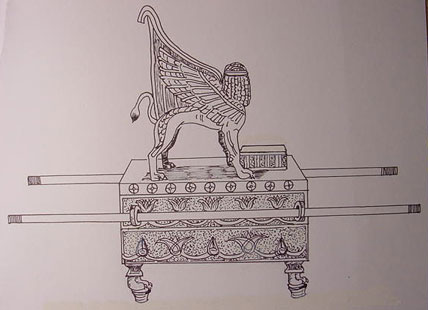
http://www.bibleorigins.net/cherubthroneside.html (Bible Origins), God's "Mercy Seat" atop the Ark of the Covenant:
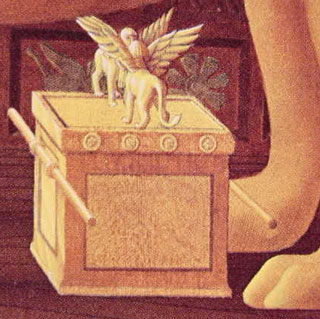
"And you shall make two cherubim of gold; of hammered work shall you make them, on the two ends of the mercy seat. Make one cherub on the one end, and one cherub on the other end; of one piece with the mercy seat shall you make the cherubim on its two ends. The cherubim shall spread out their wings above, overshadowing the mercy seat with their wings, their faces one to another; toward the mercy seat shall the faces of the cherubim be. And you shall put the mercy seat on top of the ark; and in the ark you shall put the testimony that I shall give you." (Exodus 25:18-21)
I understand that Phoenician "Winged Sphinx" thrones are the model in use for God's Mercy Seat.:
http://www.bibleorigins.net/Cherubimturnedfacemegiddo.html (Bible Origins):
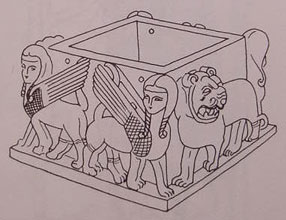
Below, an artist's rendering of an ivory box found at Late Bronze Age Megiddo, Israel. The missing heads of the Cherubim/Winged Sphinxes have been "restored" in the drawing. Note that the heads of the Lions and Cherubim "are turned" in this Phoenician late 13th century BCE creation. I have utilized the concept of the "turned face or head" to show the two Cherubim flanking the Mercy Seat atop the Ark of the Covenant "as facing each other" as described in Holy Writ.:
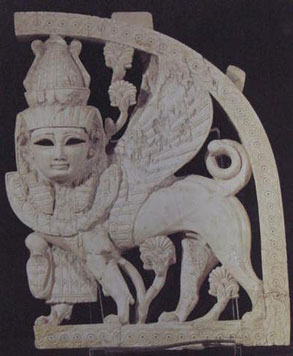
Below, another example of a Cherub or winged Sphinx, with "face/head turned," on an ivory found in Nimrud, ancient Calah of the Bible (Ge 10:11), Neo-Assyrian period. (cf. photo on p. 375. "Syrien Kunst." [Syrian Art]. Barthel Hrouda, et al. Der Alte Orient, Geschichte und Kultur des alten Vorderasien [ The Ancient East, History and Culture in the Ancient Near East].C. Bertelsmann Verlag GmbH. Gutersloh, Deutschland. ISBN 3572-00867-0. 1991):
http://www.bibleorigins.net/CherubimfacingeachotherArk.html (Bible Origins):
20th century artist's rendering of two Cherubs/Sphinxes facing each other as "the Mercy Seat" atop the Ark of the Covenant.:
http://www.bibleorigins.net/cherubvsgod.html (Bible Origins):
Cherub (Assyrian type, 9th century BCE), lion-bodied, winged, engages a winged god with sword, perhaps "protecting" the stylized "Sacred Tree" ( A Palm Tree). Perhaps this motif underlies Genesis' Tree of Life" which some Jewish traditions identified as a Palm Tree. (cf. p.62, fig. 160. Heinz Demisch. Die Sphinx, Geschichte ihrer Darstellung von den Anfangen bis zur Gegenwart. Stuttgart. Verlag Urachhaus Johannes M. Mayer. 1977. ISBN 3-87838-219-7):
http://www.bibleorigins.net/GodRidesaCherub.html (Bible Origins):
Crowned and Winged Gods or Genii riding upon two Cherubim (winged Sphinxes) minister to the Sacred Tree (German: Lebensbaum, "Tree of Life") and winged Sun disc with the features of a god (8/7th century BCE ?).:
http://www.bibleorigins.net/cherubchariot.html (Bible Origins):
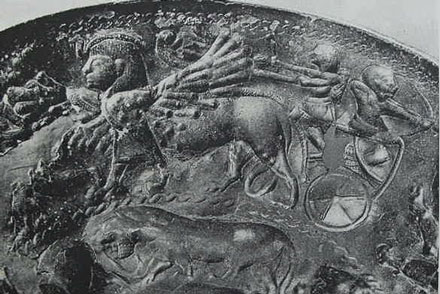
King David's Cherubim Chariot
1 Chronicles 28:18 mentions King David's plan for "the golden chariot of the Cherubim that spread their wings." … a photo of a bronze bowl dated ca. 8th century BCE found at Olmpyia, Greece, please scroll down for the photo (cf. p. 74, figure 209. Heinz Demisch. Die Sphinx, Geschichte ihrer Darstellung von den Anfangen bis zur Gegenwart. Stuttgart. Verlag Urachhaus Johannes M. Mayer. 1977 (ISBN 3-8738-219-7)
According to the Bible, Phoenician craftsmen were responsible for building the Temple of Solomon and its decorations (2 Chronicles 2:1-13):
http://www.bibleorigins.net/HiramCherubThrone.html (Bible Origins):
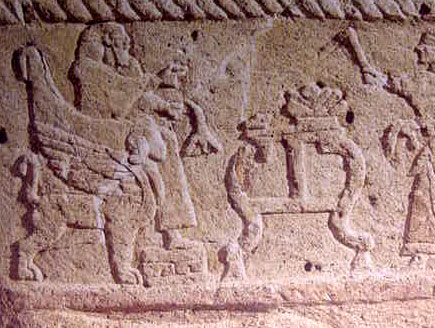
King Hiram of Byblos (our word "Bible" is derived from Byblos, ancient Gebal) in Phoenicia, seated on a "Cherub throne" … -the bas relief is from his sarcophagus- The Cherubim have been identified as Winged Sphinxes (p. 127. Sabatino Moscati. The Phoenicians. Gruppo Editoriale Fabbri Bompiani, Sonzono, Etas S.p.A. Milan. March 1988).
Please note that Moscati dates the sarchopagus to the 13th-12th century BCE :
http://www.bibleorigins.net/CherubThroneSealColor.html (Bible Origins):
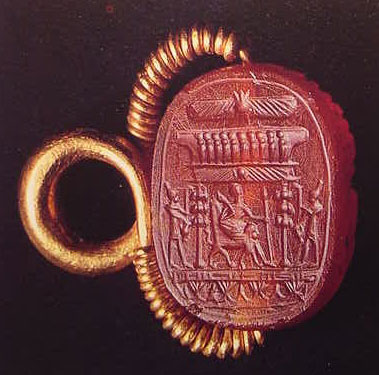
Phoenician Seal showing a god seated on a winged Cherubim Throne inside an Egyptian Aedicula. 5th century BCE from Tharros. (p.516. Sabatino Moscati. The Phoenicians. Gruppo Editoriale Fabbri Bompiani, Sonzogno, Etas S.p.A. Milan. March 1988):
http://www.bibleorigins.net/ColossalCherubim.html (Bible Origins):
Colossal Cherubim of wood, overlaid with Gold, are being brought into Solomon's Temple, their wings are removed.
(p.128 "Kingdom of Israel." The Epic of Man. Time Life Incorporated. New York. 1961):
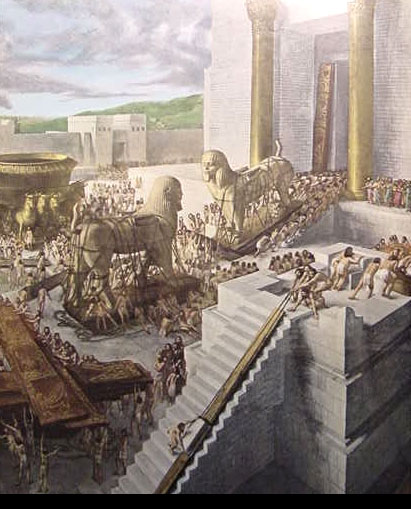
http://www.bibleorigins.net/CherubimColossalinHolyofHolies.html (Bible Origins):
20th century artist's rendering of the Colossal gold-overlaid olive-wood Cherubim within the Holy of Holies in the Temple of Solomon at Jerusalem. Between the giganitic Cherubim lies the Ark of the Covenant with Cherubim facing each other as God's Mercy Seat. (pp126-7. "The Holy-of-Holies : A Throne for God's Presence." The Sea Traders. [The Emergence of Man Series] New York. Time-Life Books. 1974.):
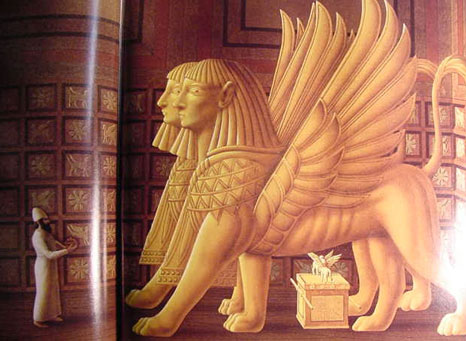
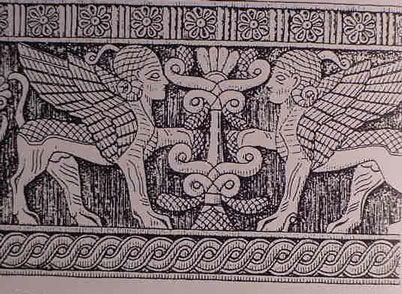
http://www.bibleorigins.net/CherubimNimrudPrixis.html (Bible Origins):
Cherubim (winged Phoenician sphinxes) flank a sacred tree (Lotus/Palmette) on an ivory Prixis found at Nimrud from ca. the 9th-8th century BCE (p. 86, Abb. 38. Wolfgang Zwickel. Der salomonische Tempel. Mainz Am Rhein. Verlag Philipp Von Zabern. 1999. ISBN 3-8053-2466-9):
http://www.bibleorigins.net/EzekielsCherubim.html (Bible Origins):
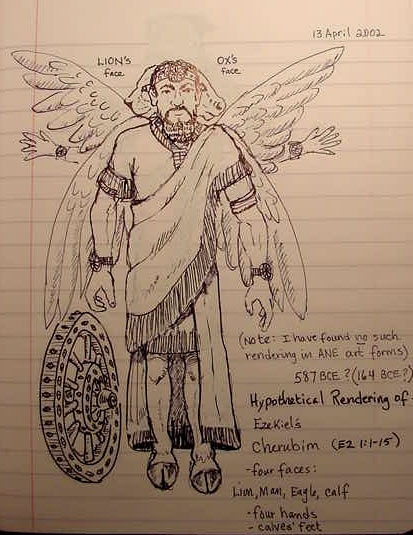
My (Bible Origins’) quick sketch, in ink, of Ezekiel's description of Cherubim (Ez 1:1-15).
Ezekiel 1:5-18 [NKJV]:
[5]… And this was their appearance: they had the likeness of a man. [6]Each one had four faces, and each one had four wings. [7]… the soles of their feet were like the soles of calves’ feet. They sparkled like the color of burnished bronze. … [10]As for the likeness of their faces, each had the face of a man, each of the four had the face of a lion on the right side, each of the four had the face of an ox on the left side, and each of the four had the face of an eagle. … [18]… their rims were full of eyes, all around the four of them.
Ezekiel 10:14-21 [NKJV]:
[14]Each one had four faces: the first face was the face of a cherub (apparently the ox, or a calf according to Rev. 4:7), the second face the face of a man, the third the face of a lion, and the fourth the face of an eagle. [15]And the cherubim were lifted up. This was the living creature I saw by the River Chebar. … [20]This is the living creature I saw under the God of Israel by the River Chebar, and I knew they were cherubim. [21]Each one had four faces and each one four wings
This doesn’t sound like or look like Eros/Cupid to me. So the Christians (not the Jews) decided to use the god of sexual love as their Cherub, for some strange reason.
However:
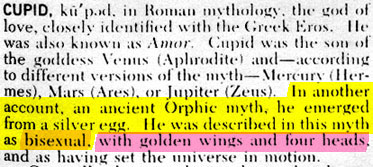
The Encyclopedia Americana International Edition, 1995, p. 327, “CUPID”:
http://insightsfromthebible.blogspot.com/2009/06/cherub-or-cupid.html (Insights From The Bible), Cherub Or Cupid?:
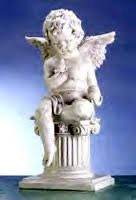
Have you ever wondered why the Catholic Church portrays ‘Cherubs’ the way that they do? It certainly is not biblical. According to the bible a Cherub has four faces, 1) a Man; 2) an Ox; 3) a Lion; and, 4) an Eagle (Ezekiel 1:10). So why do the Catholic Church portray them like small babies/children? The reason for this can be found in the ancient Roman religion that worships the false pagan god ‘Cupid.’ The Catholic Church and Roman Empire emerged together, the Catholic (universal) Church adopted Roman ideas and beliefs to try to satisfy both Romans and Christians, one such adoption was the image of Cupid that has been turned into our modern perception of a Cherub. When looking for the truth we must always consult God’s word the bible, and the bible tells us that Cherubs bear four faces (Ox, Man, Eagle and Lion) NOT the image of Cupid.
Sounds good to me.