BASILICA OF AQUILEIA, ITALY (EROS)
Earliest surviving Christian church: 313 AD
http://www.bibleorigins.net/CherubimOrigins.html (Bible Origins); CherubimOrigins, The Pre-Biblical Origins of the Cherubim:
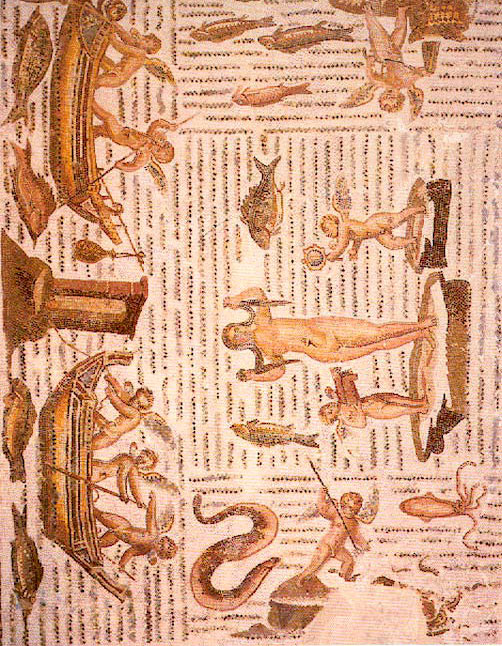
Roman "Cupids," (Greek : "Eros") naked, with wings -associated with love and sex- were borrowed by Early Christians and associated with Christian themes. They lie behind today's Cherubs appearing on Valentine's Day cards.
When you click on the site’s “Cupids” link (shown above), you get this:
http://www.bibleorigins.net/CupidCherubs.html (Bible Origins), CupidCherubs:
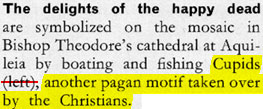
Roman Cupids, associated with Love and Sex originally, have been adapted for Christian themes in this moasic from Bishop Theodore's Cathedral at Aquileia. (p.188. Arnold Toynbee, Editor. The Crucible of Christianity- Judaism, Hellenism and the Historical Background to the Christian Faith. World Publishing Company. New York & Cleveland. 1969):
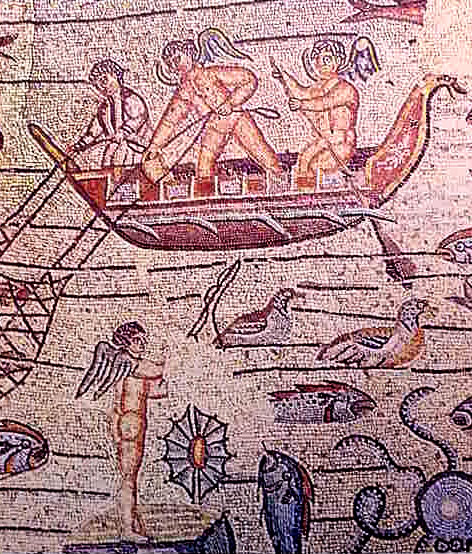
http://www.christusrex.org/www1/ofm/pilgr/bord/10Bord02Pcts.html, Early Christian Pilgrimage, to the Holy Land:
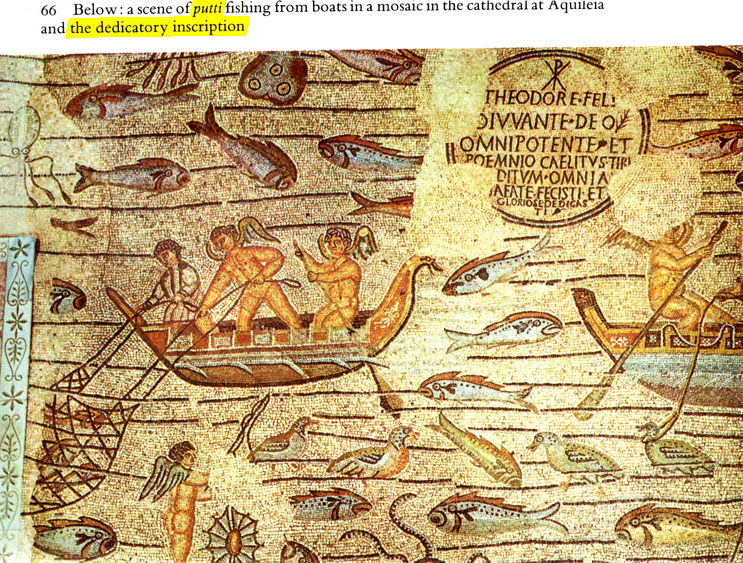
5. The Early-Christian basilica of Aquileia, with its beautiful mosaic floor, was dedicated in 313 AD The Latin inscription, set in a circular frame and preceded by the Christ monogram (XP), is addressed to the bishop: "O happy Theodore. With the help of the almighty God and of the flock which was given to you by Heaven, you did make everything happily to be gloriously consecrated.”:
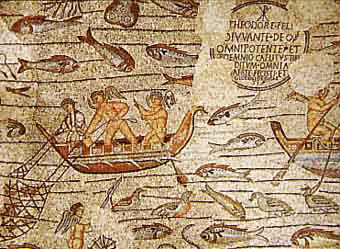
As you can see, this actual citation is right next to/with the “consecrated” (sacred) Cupids/Erotics, which are symbolized as Theodore’s “happi[ness]” – does that tell you anything? Hint: sex is generally considered a “happy” thing. In fact, to the “vast majority,” it is considered the greatest “happy” thing in life.
Early Christian & Byzantine Art, Lowden, 1997, pp. 17-18, “Art before Iconoclasm | God and Salvation | The Formation of a Christian art”:
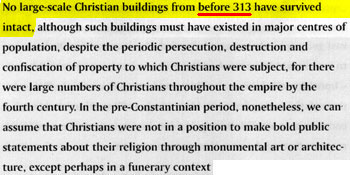
So this must be the “earliest” surviving Christian church. And, guess who’s on the cover?
http://www.cryingvoice.com/Christianity/HunAttila.html (Crying Voice in the Wilderness – Christianity); God Terrifies Attila the Hun, AD 452; “Early Christian Churches in Aquileia, Northeastern Italy, Built Before the Town Was Destroyed by Attila in AD 452”:
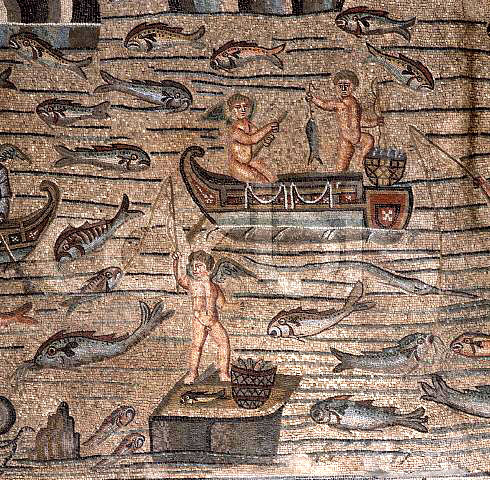
The symbolic fishing scene of the mosaic floor. The fish represent unbelievers listening to the Gospel, while the fishermen stand for the Christians who are saving lost souls.
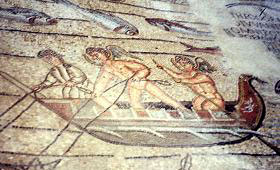
http://utenti.lycos.it/clubdellegalline/friuliveneziagiuliaenglish.htm, Friuli, “Aquileia”:
The original church on this site dates from 313, since when several stages of further building have taken place. In the 11th century, the complex was totally rebuilt under Patriarch Poppo. From 1365-81, it was rebuilt in the Gothic style. The spacious interior has three aisles separated by limestone and granite pillars, and a wonderful mosaic floor dating from the 4th century, the largest and most beautiful early-Christian mosaic in Western Europe.
http://www.slowtrav.com/tr/TripReport.asp?tripid=101&index=2, Part Three: Aquileia, Si! – Grado, Non!:
Pillars added in the Middle Ages have done some damage to the floor but the original foundations can be seen at the base of the pillars since the entire medieval floor was removed at the start of the 20th Century revealing the amazing mosaics largely i tact thanks to a protective layer of clay
Bishop Theodore (Bishop from c. 308-319) had constructed three large halls to serve the people of Aquileia
Why would a historic sacred mosaic (700-1000 years old) be covered with clay and desecrated by pillars? Well, regardless, all it did was preserve it for me to use today.
The Crucible of Christianity, Toynbee, 1969, pp. 188-189, illustration 30:
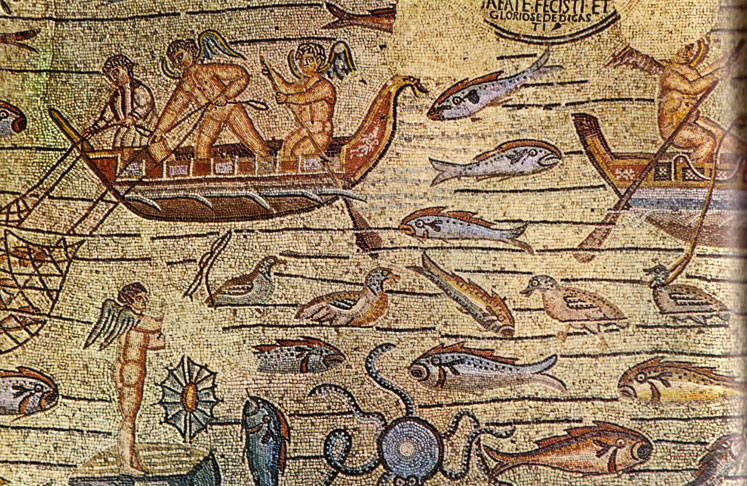
P. 360, “List and Sources of Illustrations | Away from sheer beauty”:
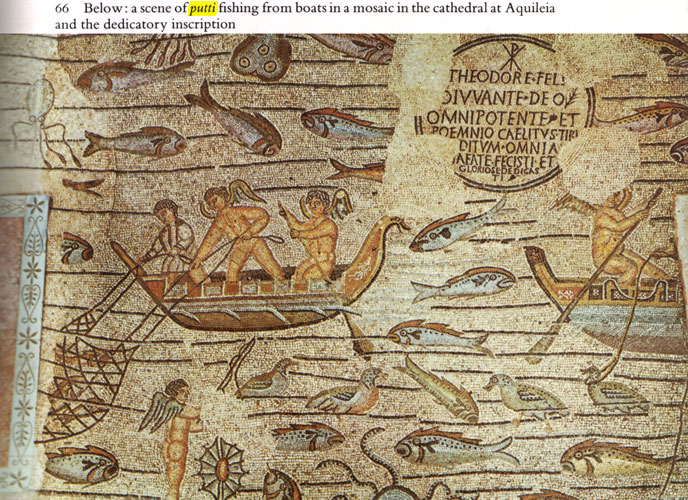
The Origins of Christian Art, Michael Gough, 1973, Ill. 66:
For all you skeptics out there, here’s an example of what Eros does not look like fishing:

More On This Subject:
http://www.tekline.co.uk/natjes2.htm, 3. The Naked Christ – Peter – the Naked Fisherman:
Peter's example of nude fishing was used in the early churches for illustratve purposes. For example, the Basilica in Aquileia, was built on the remains of an early Christian church burnt to the ground by Attila the Hun in AD 452. The famous council of AD 381 was held in that early Christian church, and the mosaic floor of the basilica is the largest known paleo-Christian mosaic floor in Western Europe, measuring about 760 square meters. Interestingly, we find a mosaic of naked fishermen in a symbolic fishing scene. The fish represent unbelievers listening to the Gospel, while the fishermen stand for the Christians who are saving lost souls. The fishermen are naked in imitation of Peter.
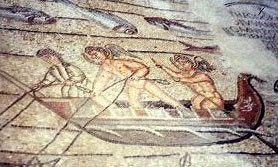
A Handbook of Roman Art, Henig, 1983, pp. 239-240:
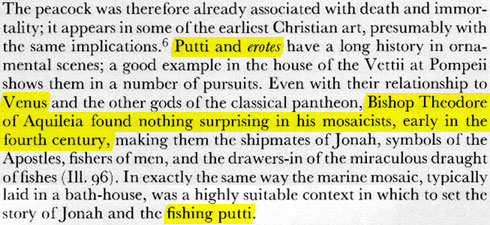
http://www.bikeabout.org/journal/notes_127.htm, BikeAbout Log: Rider Notes: May 2, 1998, “Place of the Day: Aquileia”:
The very large mosaics were
discovered here in 1904 under the basilica's raised floor and have been
dated to the 4th century AD. Entering the
church is a little disorientating as basically the entire floor of the basilica
is COVERED in mosaics. They are everywhere. It was no surprise to learn that
the floor of the basilica is the largest known Paleo-
(or early-) Christian mosaic floor in Western
Europe (it measure almost 760 square meters (over 900 sq yds)!). The
most famous part of the mosaics depict some of
the early days of Christianity with
scenes from Christ's life, lots of animals (especially fish, but also stags, lions  ,
boars, birds and sheep) and what must have been
Roman notables. Over the last 1600 years and many earthquakes
the floor has shifted and heaved so that walking around is a bit of a
challenge. You have to walk up, down, over and around bumps in the undulating
floor.
,
boars, birds and sheep) and what must have been
Roman notables. Over the last 1600 years and many earthquakes
the floor has shifted and heaved so that walking around is a bit of a
challenge. You have to walk up, down, over and around bumps in the undulating
floor.
The Origins of Christian Art, Gough, 1973, p. 75, illustration 66, “From Constantine to Justinian”:
http://pro.corbis.com/, Search # EL005889, Detail Showing Fishermen from a Floor Mosaic with Christian and Pagan Themes, Christian art:
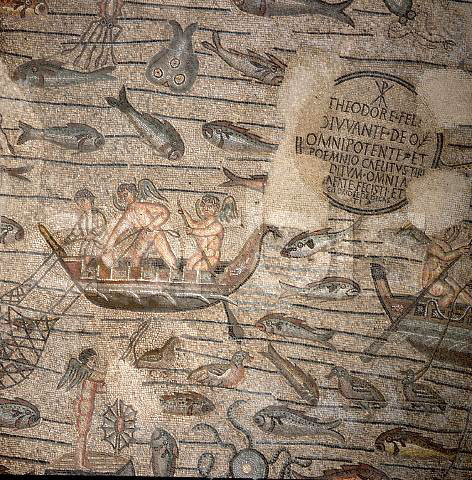
http://pro.corbis.com/, Search # EL005890, Detail Showing Descriptive Latin Text from a Floor Mosaic with Christian and Pagan Themes, Christian art:
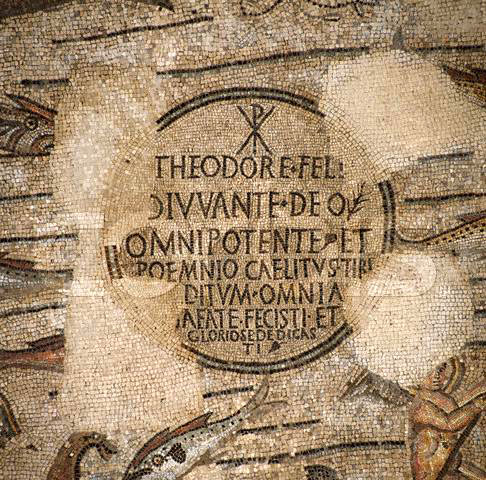
To the right of the
above Christian chi-rho (ΧΡ  ) inscription symbol, beyond the pillars
is:
) inscription symbol, beyond the pillars
is:
http://pro.corbis.com/, Search # EL005893, Detail Showing Nude Male Figure on a Raft from a Floor Mosaic with Christian and Pagan Themes, Christian art:
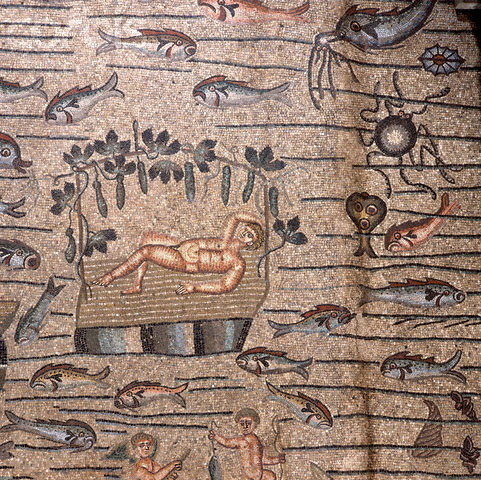
http://pro.corbis.com/, Search # EL005892, Detail Showing Winged Men Catching Fish from a Floor Mosaic with Christian and Pagan Themes, Christian art:
http://pro.corbis.com/, Search # EL005897, Detail Showing an Angel Casting for Fish from a Floor Mosaic with Christian and Pagan Themes, Christian art:
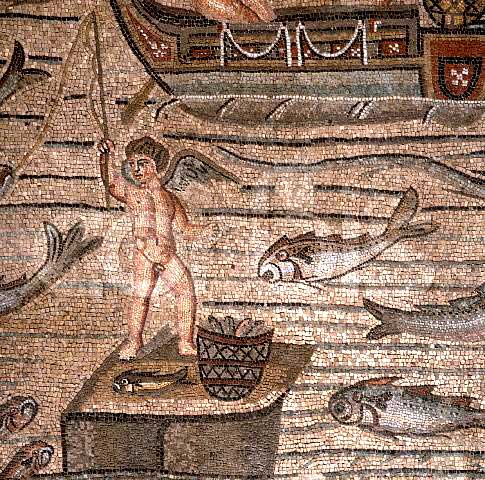
The attributes of pagan gods / goddesses was part of the language and communication of the classical (Biblical) period; therefore, is valid for definition use. However, the use of a pagan god / goddess for the translation of Biblical words / messages is not intended to indicate a devotion to that particular god / goddess, which would overrule Jesus Christ associated with the “one” God of the Bible. Again, attributes of pagan gods / goddesses are used as valid definitions (only) for Christian literature and art, without constituting support for all characteristics and/or all varieties of pagan gods / goddesses.
http://homepage.mac.com/paduan/PhotoAlbum26.html; Mosaic floor, Basilica of Aquileia:
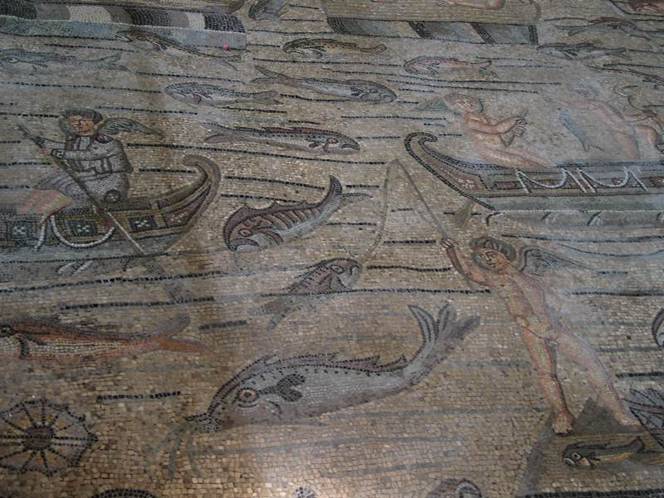
http://www.hp.uab.edu/image_archive/ulg/ulgd.html (Univ. of Alabama), Late Roman ecclesiastical synthesis:
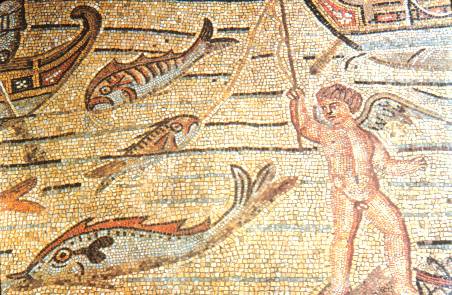
1. Mosaic pavement detail of a fisherman, ca. 314 A.D. (Aquileia Cathedral pavement).
http://www.irre.toscana.it/fields/home.htm:
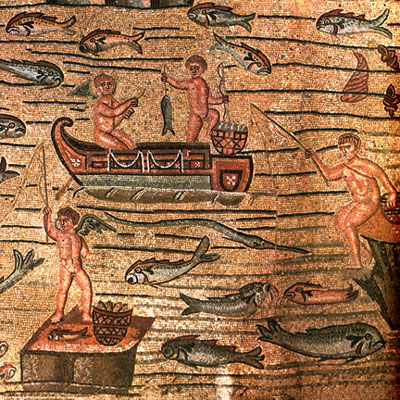
http://pro.corbis.com/, Search # EL005888, [Ciol European art and architecture]:
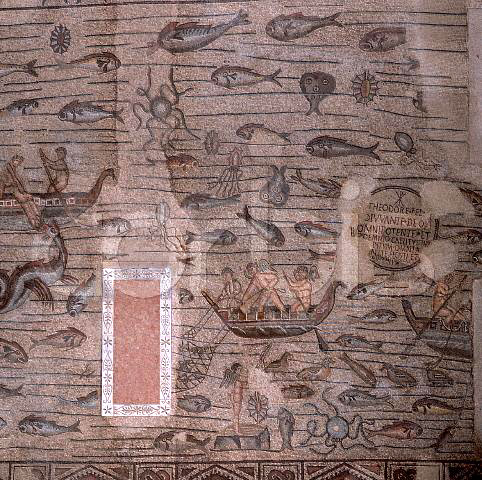
http://pro.corbis.com/, Search # EL005887, [Ciol European art and architecture]:
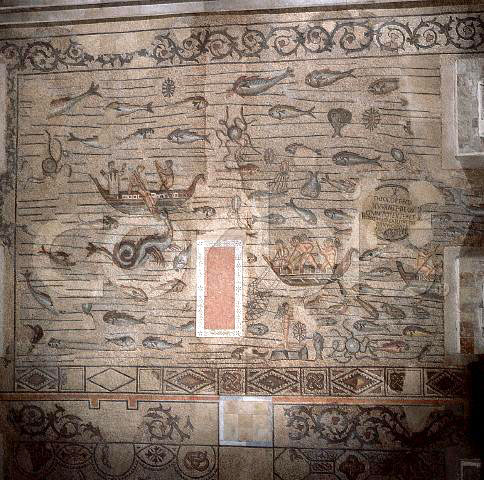
http://pro.corbis.com/, Search # EL005886, [Ciol European art and architecture]:
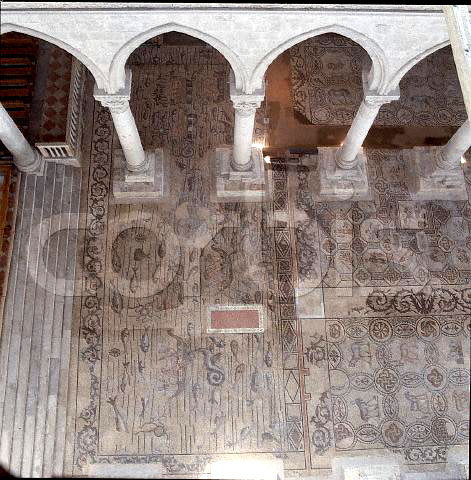
http://www.cryingvoice.com/Christianity/HunAttila.html, God Terrifies Attila the Hun, AD 452:
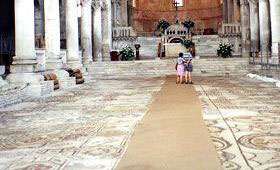
The 4th century mosaic floor of the basilica is the largest known paleo-Christian mosaic floor in Western Europe, measuring about 760 square meters.
http://www.charta.it/guidarello/english/agenzia/pavimenti_e.html (9-10-02), Aquileia: Mosaic Flooring:
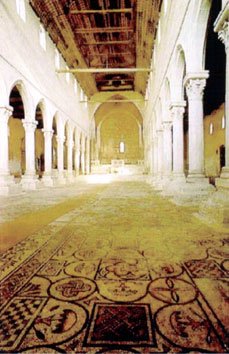
http://www.italicon.it/museo/i224-064.htm, Basilica di Poppone, Aquileia, interno, 1031:
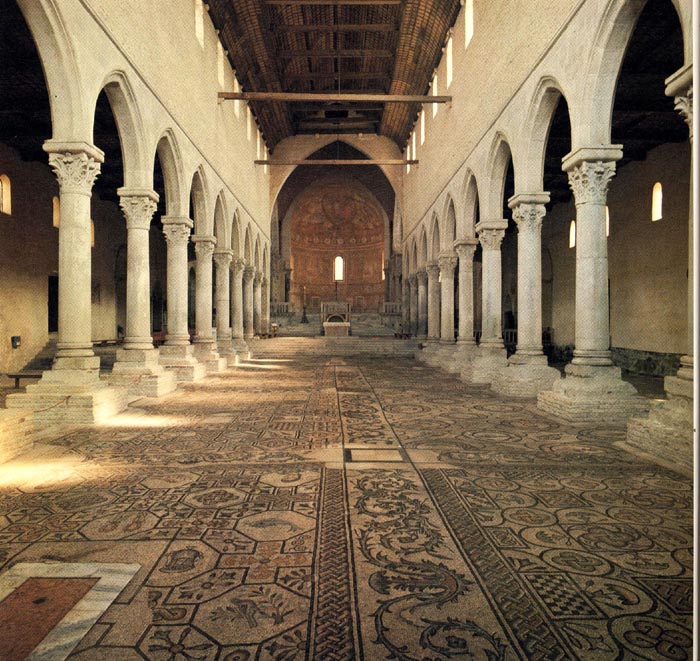
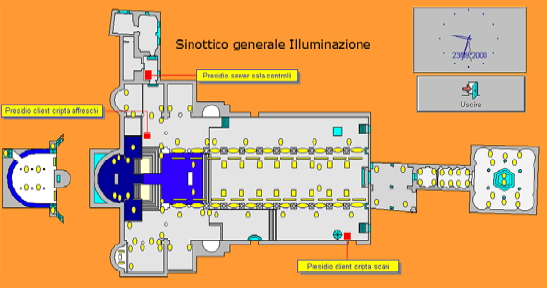
http://www.progea.it/articoli/Basilica%20di%20Aquileia.pdf:
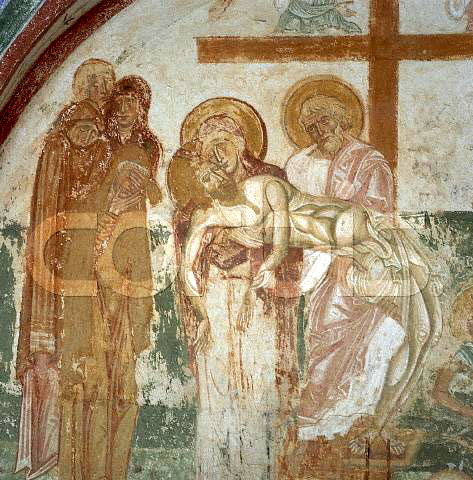
http://pro.corbis.com/, Search # EL005962, Detail Showing Christ and Mourners from Descent from the Cross and Entombment from Passion of Christ Fresco Cycle from the Crypt of the Basilica of Aquileia, Christain art, Jesus Christ:
Generic Pagan art (not at Aquileia):
http://terra.antiqua.free.fr/mosaiques/navigation%20de%20venus%20avec%20vol%20d'amours_JPG_view.htm (via http://terra.antiqua.free.fr/mosaiques2.html), “navigation de venus avec vol d’amours” (pagan art):
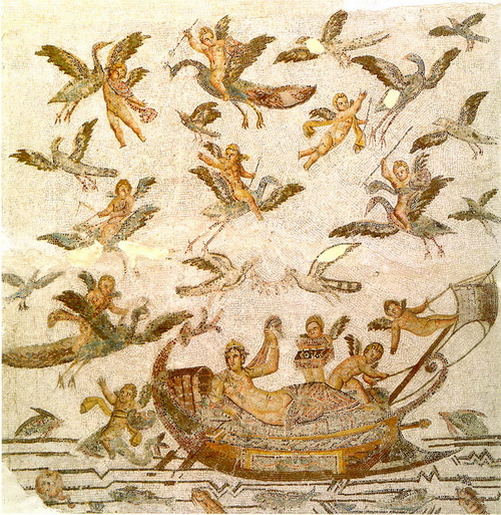
http://terra.antiqua.free.fr/mosaiques/Venus_%20mer_%20ecueils%20musee%20Lemta_jpg_view.htm (via http://terra.antiqua.free.fr/mosaiques2.html), “Venus mer ecueils musee Lemta” (pagan art):
Again, for all you skeptics out there, here’s not what Eros looks like fishing: