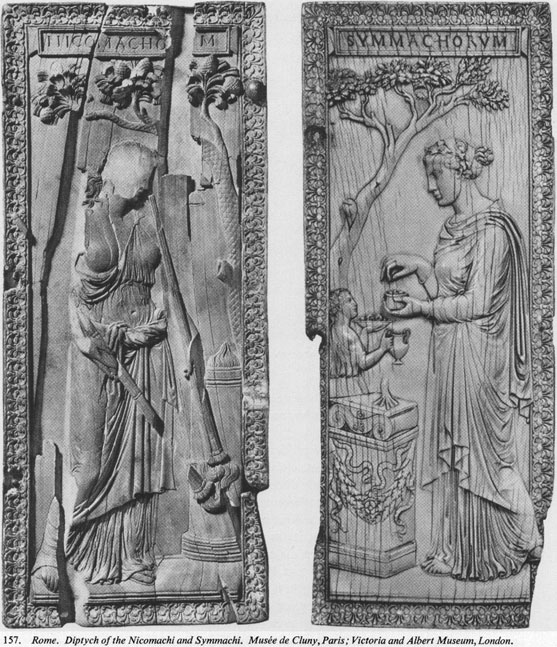
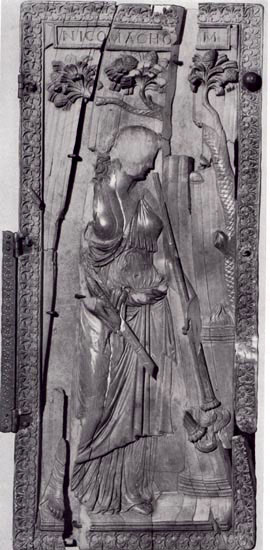
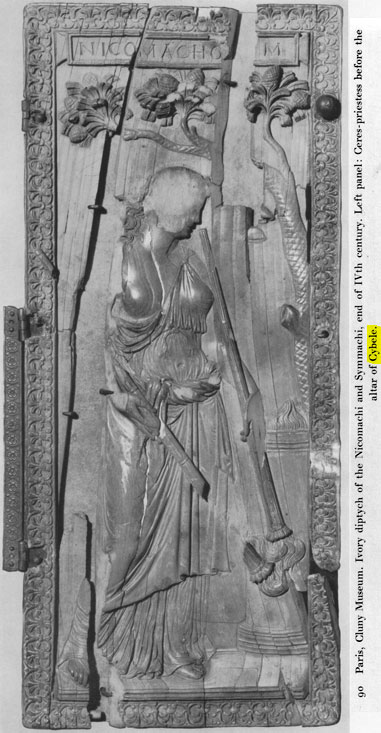
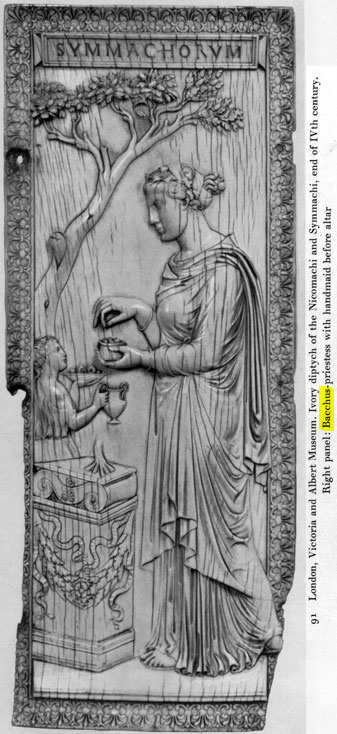
DIPTYCH: NICOMACHI AND SYMMACHI
392-401 AD
http://slides-www.ucsc.edu/subjects/dbms.acgi$detail?54492, Slide Detail:
|
Main Entry |
Early Christian |
|
Title |
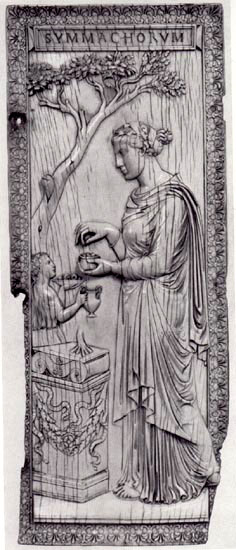
Nicomachi and Symmachi Diptych. Right panel |
|
Title Part |
Priestess of Bacchus before altar of Jupiter |
|
Date |
392 or 401 |
http://166.109.159.22/dedrickd/themes/echr8.htm, Early Christian Art, “Luxury Arts”:
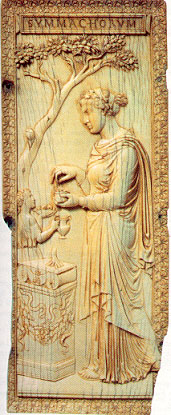
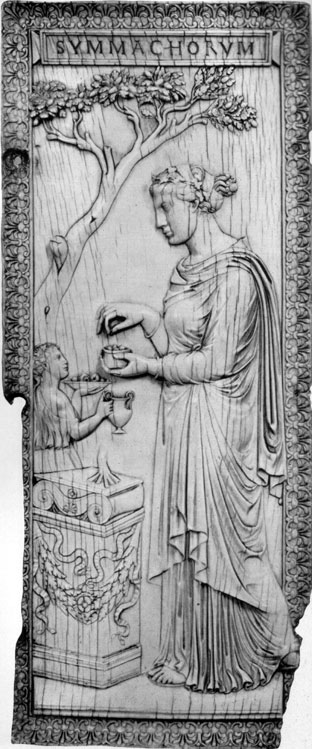
Priestess celebrating the rites of Bacchus, c.380-400. Right leaf of the Diptych of the Nicomachi and the Symmachi:
http://www.public.iastate.edu/~tart/fall2003arth280website/earlychristian.html, The History of Art Survey: Lecture 16: Early Christian Art:
22 Priestess celebrating the rites of Bacchus, right leaf of
Diptych of the Nicomachi and the Symmachi, c400, 1’
Even after Theodosius closed all non-Christian
temples and banned all non-Christian cults in 391, imagery from those
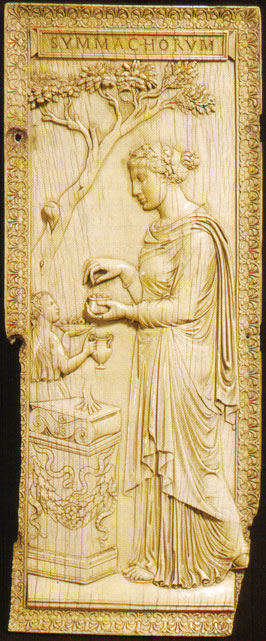
traditions continued, as Christian had before it was made legal. Here is half
of a diptych celebrating the marriage of two
wealthy, senatorial families. This is a low relief depiction of a traditional
Roman sacrifice, by a priestess at an altar of Bacchus, before a sacred oak of Jupiter.
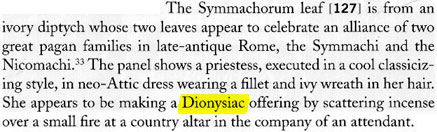
Imperial Rome and Christian Triumph, Elsner, 1998, p. 190, illustration 127, “Ivory leaf from a diptych issued in the names of the Symmachi and Nicomachi families, Rome, last or penultimate decade of the fourth century AD”:
P. 191:
The Decline of Rome, Vogt, 1967 (translated from German), p. 302, “Cultural Change Reflected in Art”:
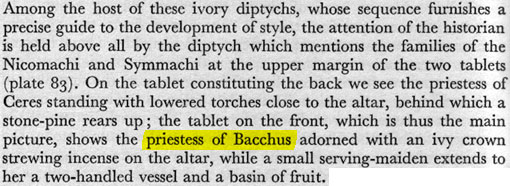
Illustration 83, “Decorative Arts in the Late Empire”:
http://www.personal.kent.edu/~rlokay/British/page10.html, Priestess of Bacchus:
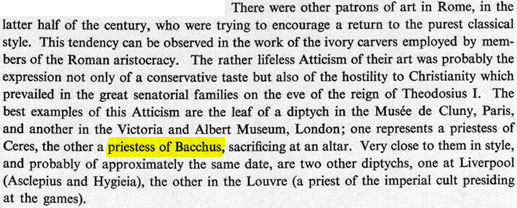
C. 390-401 A famous ivory diptych documents the realtionship of particians Quintus Aurelius Symmachus and Virius Nicomachus Flavianus and their anti-Christian ways. It is a revival piece of classic culture. It commemorates the marriage of the two families. This one is inscibed, "Symmachorum" with a elaborately dressed priest makes an offer to an elaborate altar. Extremely skilled Roman ivory carvers were commissioned by Pagans and Christians both. The folds and wrinkles with the foliage is reminiscent of earlier works.
http://www.newadvent.org/cathen/05022a.htm (Catholic Encyclopedia), Diptych:
In the fourth and fifth centuries a distinction arose between profane and ecclesiastical (liturgical) diptychs, the former being frequently given as presents by high-placed persons. … The most beautiful of the profane diptychs was carved at the time of a marriage between the Symmachi and the Nicomachi (392 to 394, or 401).
http://dannybornt.tripod.com/art_history/late_antique.html, Early Christian Art, “Early Christian A. D. 29 – 527”:
Priestess celebrating the rites of Bacchus, right leaf of the Diptych of the Nicomachi & the Symmachi, Ivory, 11 3/4” x 5 1/2” ca. 400
http://www.web.virginia.edu/artemis/artgus/showstudents.cfm?lectureid=396 (University of Virginia), Constantinople & the Eastern Empire:
IVORY:4 C:EARLY CHRISTIAN. Diptych/Nicomachi & Symmachi, R. side: Priestess/Bacchus. Ca. 390-400.
http://faculty.hope.edu/educ/specialty/fineartsgroup/syll/art109.pdf (Hope College), Art from Prehistory to Post-Medieval: a Critical History, “Early Christian and Constantinian Art”:
Priestess celebrating the Rites of Bacchus, leaf of the Nicomachi and Symmachi Diptych, c. 400