DIONYSUS – CHRISTIAN CONNECTION (overview)
http://www.belinus.co.uk/mythology/Dionysus.htm, Dionysus:
Christ was also associated with the vine, and many myths and attributes of Dionysus are used in (early) Christian iconography and mythology.
http://muse.jhu.edu/cgi-bin/access.cgi?uri=/journals/journal_of_nietzsche_studies/v029/29.1liebscher.pdf, Excerpt: The Journal of Nietzsche Studies 29 (2005) 71-74
According to Balthasar, there is no difference between the world of Dionysos and the Christian world—the Dionysian reduced to its foundations shares common ground with Christianity.
http://www.sacred-texts.com/eso/sta/sta06.htm, The Ancient Mysteries and Secret Societies: Part Three:
:In the Anacalypsis, Godfrey Higgins conclusively establishes Bacchus (Dionysos) as one of the early pagan forms of the Christos myth, "The birthplace of Bacchus, called Sabazius or Sabaoth, was claimed by several places in Greece; but on Mount Zelmisus, in Thrace, his worship seems to have been chiefly celebrated. He was born of a virgin on the 25th of December; he performed great miracles for the good of mankind; particularly one in which he changed water into wine; he rode in a triumphal procession on an ass; he was put to death by the Titans, and rose again from the dead on the 25th of March: he was always called the Saviour. In his mysteries, he was shown to the people, as an infant is by the Christians at this day, on Christmas Day morning in Rome." … The Bacchanalia, or orgies of Bacchus, are famous in literature.
http://www.hfac.uh.edu/mcl/classics/Orpheus/Orph_Theog.html, Ancient Greek and Roman Religion: The Orphic Theology (from Classical Mythology, Morford / Lenardon, 1998, p. 363):
MYSTERY RELIGIONS
Mystery religions have been a persistent theme; their spiritual ethos has been associated with Eros, Rhea, Cybele and Attis, Aphrodite and Adonis, Dionysus, Demeter, and Orpheus. … The correspondences between Christianity and the other mystery religions antiquity are perhaps more startling than the differences. Orpheus and they share attributes in the early centuries of our era, and of all the ancient deities, Dionysus has most in common with the figure of Christ.
MYSTERY RELIGIONS IN ROMAN TIMES
Indeed, the association of Christ with the vine frequently led to the use of myths and attributes of Dionysus in early Christian iconography. In the third century CE wall mosaic in the cemetery beneath St. Peter's basilica in the Vatican and the fourth century mosaics in the church of Santa Costanza in Rome, the vine Dionysus, the symbol of new life after release from the old life, is associated with the Christian resurrection and the words of Jesus in John 15:1, "I am the true vine." In the same cemetery there is a tomb containing both pagan and Christian burials, one of which is a third-century sarcophagus decorated with relief showing Dionysus finding Ariadne (see p. 457).
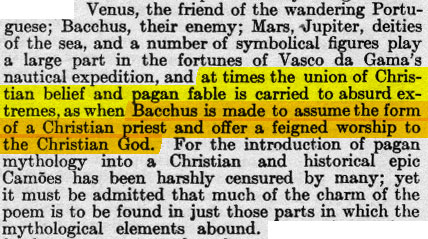
The Catholic Encyclopedia, 1908, Vol. 3, p. 219, “Camões (or Camoens)” (1524-1580):
http://bornagainpagan.multiservers.com/Glossary/DIONYSUS.html, exWitch Australia (formally ‘Born Again Pagan’): Glossary of Terminology, “Deja Vu”:
According to another tradition, associated with the Greek Orphic mystery cult, Dionysus was born of an incestuous union between the serpentine Zeus and his daughter Persephone. Persephone also was born from such a union between Zeus and Rhea. This serpentine birth of Dionysus has been recognized as important in that the serpent is an arcane symbol of earth and water, both vital to life, and the serpent can penetrate the tomb, and in sloughing its own skin represent the resurrection of the dead. Dionysus' birth has been likened to that of Christ.
http://www.answers.com/dionysus, “Dionysus”:
The god of wine and of an orgiastic religion celebrating the power and fertility of nature. Also called Bacchus. … he was one of the most important gods of the Greeks and was associated with various religious cults. …
Influence on Christianity Dionysian mythology would later find its way into Christianity. There are many parallels between the legends of Dionysus and Christ; both were said to have been born from a mortal woman but fathered by a god, to have returned from the dead, and to have transformed water into wine. (See: Further Reading below for more detailed comparison.)
Further Reading [2] (http://mcadams.posc.mu.edu/txt/ah/Livy/Livy39.html) Titus Livy, History of Rome, Book 39:13, Description of banned Bacchanalia in Rome and Italy
http://rg.ancients.info/thracetets/part1.html, Thracian tetradrachms: Imitations and Thrace:
There are other parallels between Dionysos and Jesus. One of Dionysos' miracles was the turning of water into wine. Like Jesus, Dionysos was said to have been born of a mortal mother and a divine father (in his case Semele, a daughter of the king of Thebes, and Zeus). Dionysos was considered to be the divine in human form, died and was resurrected, and was associated with the immortality of the soul.
http://www.freerepublic.com/forum/a3b3a47345f84.htm, Do Parts of the Gospels come from Pagan Mythology?:
The Greek deity Dionysus (also called Bacchus) is known by most people for his patronage of wine; he is best known, in the context of this series, as one from whom, supposedly, Jesus' Cana miracle was borrowed. … not merely a god of wine, but a god of paradox; he was the god of the civilized theater, but also the god of wild, orgiastic behavior and drunkenness. … We now begin the main portion of our essay, in which we analyze, one by one, the alleged similarities between Dionysus and Christ. These claims are taken from two sources: The Christ Conspiracy by Acharya S [111-113] and Freke and Gandy's The Jesus Mysteries. Let's see what Acharya S has to say first (with any needed supplements by Freke and Gandy).
- Dionysus was born of a virgin on December 25th and, as the Holy Child, was placed in a manger.
http://www.religioustolerance.org/chr_jcpa3.htm, Parallels between the Christian Gospels and Pagan Mythology:
Ministry: Jesus appeared as a wandering holy man who is later transfigured in the presence of some of his disciples. Dionysus was portrayed in the same manner in Euripides' play The Bacchae, written in 410 BCE. … Arrest: Both Dionysus and Jesus celebrated a Last Supper with his 12 disciples before his death. Dionysus is described in Euripides' play The Bacchae as bringing a new religion to the people, being plotted against by the leaders, being arrested and appearing before the political ruler. Dionysus said to his captors "You know not what you are doing..," almost replicating Jesus' words at the cross. He was unjustly accused and executed. All of these themes are seen in the Gospels.
http://www.wargoddess.net/essay/ivycross/info.php, Enyo’s Workshop, “The Ivy-Covered Cross, by Sannion”:
In the Bakkhai, Dionysos comes to earth in human form. He says that he has "veiled his Godhead in a mortal shape" in order to make it "manifest to mortal men." (5) This is similar to John's statement that Jesus became "the Word made flesh" (John 1:14) and Paul's statement that Jesus appeared "in the likeness of sinful flesh." (Romans 8:3) …
At one point Jesus was dressed to look like Dionysos, with a purple robe, a plaited crown, and a reed in his hand like a thyrsos. (Matthew 27:28-29)
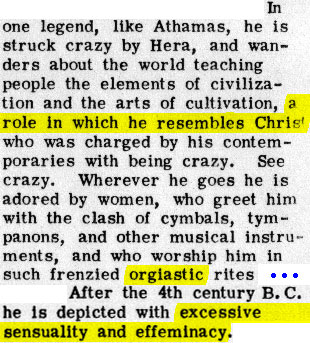
Dictionary of Mythology Folklore and Symbols, Jobes, 1961, Vol. 1, pp. 447-448, “Dionysus (Dionusos, Dionysos, Dyanysos)”:
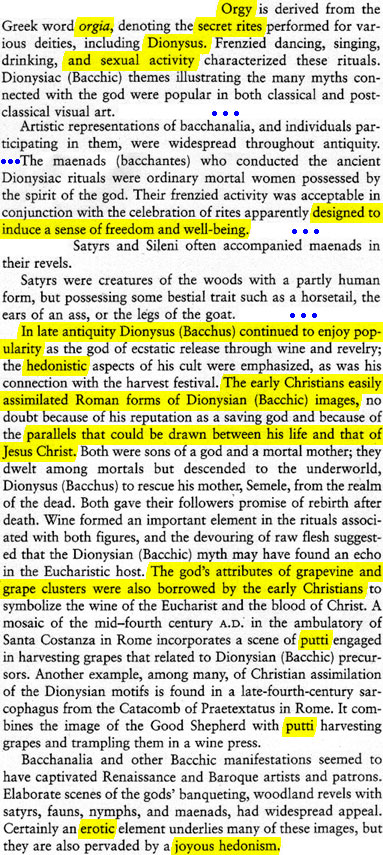
Encyclopedia of Comparative Iconography: Themes Depicted in Works of Art, Roberts, 1998, Vol. 1: A-L, pp. 97-98, “Bacchanalia / Orgy”:
But today:
http://members.tripod.com/~immortaltreasure/sex.html, SEX SEX SEX:
Not only was Europe crucified by Christian antisexuality but also much of Oceania, Africa, and the Far East. Wherever Christian missionaries went-which was everywhere-people were told their own generally healthy sexual attitudes were wrong and sinful. One missionary described Bantu harvest festivals as Bacchic feasts: "It is impossible to witness them without being ashamed. Men and women, who in ordinary circumstances are modest in behavior and speech, then abandon themselves to licentiousness."
http://www.balaams-ass.com/journal/homemake/lewsdion.htm, Further Into the Depths of Satan in C.S. Lewis’ Chronicles of Narnia: Dionysus, Bacchus, Silenus and the Maenads:
The most revolting thing, which has been evident right along, is stated plainly in the quote on p. 192. Aslan is leading! Now, if Aslan is supposedly the Lord Jesus Christ, as many assure us and as Lewis himself allowed, then what we find here is the grossest blasphemy!! This is then supposedly Jesus Christ leading a Satanic orgy of Bacchus!! This is sick beyond description!!
See, the greatest of all tangible (real) loves is what today’s Church describes as “the most revolting thing,” “the grossest blasphemy” and “sick.” Therefore, the truth on this subject should turn the world completely around (like a map made in Australia). Sex was a victimless crime, until the greedy monopolization of food and the greedy possessiveness of the attractive. But, today, with effective birth control and disease prevention, it’s victimless again. This just shows how large of a subject this really is. Kind of at an “apocalyptic” degree, wouldn’t you say? I think today’s Church supported animal slaughter (any meat eater) and condoned killing of innocent civilians in war (any soldier) is “the most revolting thing,” “the grossest blasphemy” and “sick.” So… we “disagree” – we can agree on that. I’m looking forward to my Judgment: I don’t need any artificial salvation cop-outs. But I sure do hear a lot about how they do, every time I walk into a church.
Jewish:
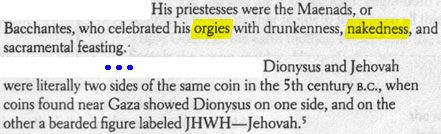
The Woman’s Encyclopedia of Myths and Secrets, Barbara G. Walker, 1983, pp. 236-237, “Dionysus”:
http://home.swbell.net/dndylion/paganreligions.html, Roots of Christianity:
Greek Pagan Religion: Dionysus is another savior-god. He was worshipped throughout much of the Middle East as well. He had a center of worship in Jerusalem in the 1st century BCE. Some ancient coins have been found in Gaza with Dionysus on one side and JHWH (Jehovah) on the other. In later years, his flesh and blood were symbolically eaten in the form of bread and wine.
http://www.theosociety.org/pasadena/etgloss/ja-jz.htm, Encyclopedic Theosophical Glossary: Ja-Jz:
Jehovah Nissi yehowah nissi (Hebrew) [from nes lofty, an elevation + i mine] Jehovah, my elevation; in the Bible the altar built by Moses (Ex 17:15); Blavatsky maintains that this aspect of Jehovah was equivalent to Dionysos or Bacchus, and that the Jews worshiped this deity (the androgyne of Nissi) as the Greeks might have worshiped Bacchus and Osiris. Tradition has it that Bacchus was reared in a cave of Nysa, which is between Phoenicia and Egypt. As the son of Zeus, he was named for his father (gen Dios) and the place: Dio-Nysos (the Zeus or Jove of Nysa). Diodorus identifies this Dionysos with Osiris.
http://books.google.com/books?vid=OCLC06612305&id=9MIPAAAAIAAJ&printsec=titlepage&#PPA149,M1, Remarks on Ecclesiastical History – Google Book Result, by John Jortin, 1751, p. 149:
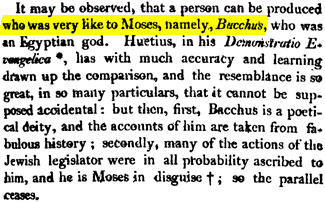
Agape:
http://www.piney.com/AgapeSummary.html, The Agape or Agapae Pagan and Biblical Background:
Agape, like Grace, spoke of perverted pagan rituals which worshipped them as goddesses. All of these depended on wine and music or other drugs to induce repulsive activity to mock all but sexual, carnal "gods and goddesses."
http://dance-of-ecstasy.net/dance/0302.html, 3.2 LUST/LOVE/ECSTASY:
I suspect, however, that agape is a substitute word for ekstasis. So, too, the pious "love feast" became the sanitized Christian version of the Dionysian orgy, which was its most likely forebear and model. Ekstasis means "standing beside or outside of oneself." This is an apt description of the ecstasy of eternal consciousness recognizing and loving itself as two individual human beings in time and space. …
As I mentioned above, agape, the charity or brotherly love of the orthodox, and the altruistic love of the philosophers, almost certainly substitutes for the word ekstasis. As Joseph Campbell points out, agape, as a form of love and eros share the nature of being indiscriminate. Both are essentially selfless and impersonal.
"The lights go out, so to say, and whatever is at hand, one loves, either in the angelic way of charity or in the orgiastic, demonic way of a Dionysian orgy; but in either case, religiously: in renunciation of ego, ego judgment, and ego choice."
The New International Dictionary of New Testament Theology, Brown, Zondervan Publishing, 1976, vol. 2, p. 539, “Love | αγαπάω”:
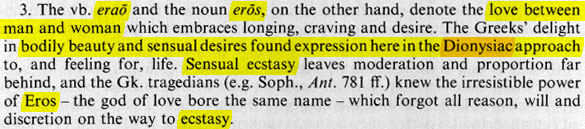
The Encyclopedia of Religion, Eliade, 1987, vol. ?, p. 36, “LOVE | Love as the Quest for Immortality in Plato”:
