BAPTISM-COTYTTO: OTHER LANGUAGE TRANSLATIONS
(Greek: βαπτ… - Κοτυ[τ]τώ / Κότυς)
French:
http://ugo.bratelli.free.fr/Dulaure/PhallusGrecs.htm, Du Culte du Phallus chez les Grecs (Worship of the Penis among Greeks): Extrait de l’ouvrage, Les divinités génératrices (1805), par Jacques-Antoine Dulaure (Extract of the work, The divinities generators [1805], by Jacques-Antoine Dulaure):
Une secte particulière et peu connue, appelée la secte des Baptes, célébrait à Athènes, à Corinthe, dans l’île de Chio, en Thrace et ailleurs, les mystères nocturnes de Cotitto, espèce de Vénus populaire. Les initiés qui se livraient à tous les excès de la débauche, y employaient les Phallus d’une manière particulière ; ils étaient de verre, et servaient de vase à boire[10]. … [10] Juvénal, parlant de la licence extrême de ces mystères, dit (Satyre 11, vers 95) : « ... Vitreo bibit ille priapo. »
Translated from French:
A sect particular and little known, called the sect of the Baptes, celebrated in Athens, in Corinth, in the island of Chios [in the Aegean Sea], in Thrace and elsewhere, the night mysteries of Cotytto, type of popular Venus. The initiates who devoted to all excesses debauchery, employed the Penis in a particular way there; they were of glass, and were used as vase to drink[10]. … [10] Juvenal, speaking about the extreme license (licentiousness) of these mysteries, known as (Satyr 11, verses 95): "... He/she/it drinks of glass that to the erect penis [Latin]."
http://www.celtiberia.net/verimg.asp?id=1222, Fresco pompeyano (Pompeiian Fresco), “Príapo" [name of Greek god] (this is just a visual aid to Latin translation above):
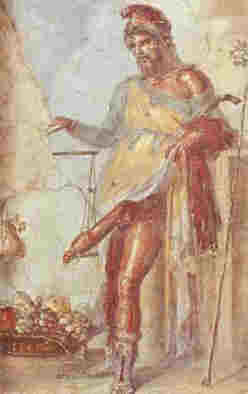
http://www.answers.com/topic/priapus, Priapus:
in Greek religion, fertility god of gardens and herds; son of Aphrodite and Dionysus. He was represented as a grotesque little man with an enormous phallus (penis).
Some context:
http://bibliolib.free.fr/article.php3?id_article=108; Laurent Tailhade: Discours civiques (Civic Speeches), P.V. Stock, Editeur (Editor), 1902; “Les Diaconales” (“The Deacons”):
Si l’ouvrage dont vous allez entendre quelque fragments appartenait au genre de ces écrits plus que libertins, composés en vue d’une clientèle spéciale, bibliophiles trop jeunes ou trop vieux, par des entrepreneurs d’immondices, publiés sous la custode, avec l’enseigne de Priape ou bien de Cottyto ; si nous apportions, ici, les œuvres de l’Arétin ou du marquis de Sade, le Portier des Chartreux ou les obscénités d’Andréa de Nercia, vous flétririez d’une juste réprobation un pareil goujatisme et votre fuite nous punirait d’un si grave manquement.
Le livre que nous allons entr’ouvrir n’a rien de commun avec ces pornographies du ruisseau. Par une singulière déviation de l’entendement, il passe même aux yeux des catholiques pour un manuel, un épitomé de la plus transcendante morale. Ce livre renferme les questions que, dans l’ombre des nefs où languit un éternel crépuscule, dans une guérite où leurs haleines se confondent, où leurs lèvres se touchent presque, le confesseur pose brutalement aux vierges impubères, aux femmes que leurs stupides époux n’ont pas le cœur d’arracher à cette ignominieuse dégradation.
Translated from French:
If the work of which you will hear some fragments belonged to the kind of these writings more than libertines(licentious / debauched / sexual libertinism), composed for special customers, book lovers too young or too old, by contractors of rubbish, published under the caretaker, with the sign of Priape(erect penis) or of Cottyto; if we bring, here, works of Aretin(Pietro Aretino, Italian writer 1492-1556 Puttana Errante[Wandering Whore][erotic]) or the Marquis le Sade(French sex writer 1740-1814), the Porter of the Carthusian monks(Roman Catholic) or the obscenities / lewdness of Andréa de Nercia, you would fade of a just disapproval a similar goujatism and your escape would punish us of a so serious failure.
The book that we go between opening does not have anything common run with these pornographies of the brook / stream. By a singular deviation of the understanding, it passes even to the eyes of the Catholics for a handbook, one epitome(book summary) of most transcendent(risen above) morals. This book contains the questions that, in the shade of the naves(central part of churches) where an eternal twilight languishes(weakens), in a workman’s hut where their breaths merge, where their lips are touched almost, the confessor poses to the prepubescent virgins brutally, with the women that their stupid husbands do not have the heart to tear off with this ignominous(shameful / disgraceful) degradation.
http://ebooksgratuits.free.fr/ebooksfrance/louys/louys_aphrodite_moeurs_antiques.pdf, Aphrodite : moeurs antiques (Aphrodite : ancient morals), Pierre Louÿs, “Livre Deuxieme, Chapitre I” (Book 2, Chapter 1):
Ce dernier monument était enveloppé de tant de mystères qu'on n'en peut donner aujourd'hui une description détaillée. Nous savons seulement qu'il était compris dans le péribole et qu'il avait la forme d'un triangle dont la base était un temple de la déesse Cottyto, au nom de qui s'accomplissaient d'effrayantes débauches inconnues. Les deux autres côtés du monument se composaient de dix−huit maisons ; trente−six courtisanes habitaient là, si recherchées des amants riches qu'elles ne se donnaient pas à moins de deux mines : c'étaient les baptes d'Alexandrie. Une fois le mois, à la pleine lune, elles se réunissaient dans l'enceinte close du temple, affolées par des boissons aphrodisiaques, et ceintes des phallos canoniques. La plus ancienne des trente−six devait prendre une dose mortelle du terrible philtre érotogène. La certitude de sa mort prompte lui faisait tenter sans effroi toutes les voluptés dangereuses devant lesquelles les vivantes reculent. Son corps, de toute part écumant, devenait le centre et le modèle de la tournoyante orgie ; au milieu des hurlements longs, des cris, des larmes et des danses, les autres femmes nues l'étreignaient, mouillaient à sa sueur leurs cheveux, se frottaient à sa peau brûlante et puisaient de nouvelles ardeurs, dans le spasme ininterrompu de cette furieuse agonie. Trois ans ces femmes vivaient ainsi, et à la fin du trente−sixième mois, telle était l'ivresse de leur fin.
Translated from French:
This last monument was wrapped of so many mysteries as one cannot give today a detailed description. We know only that it was comprised in the peribolus(external wall limiting a space closed around a temple) and that it had the shape of a triangle whose base was a temple of the goddess Cottyto, in the name of which achieved alarming unknown debaucheries. The two other sides of the monument were composed of eighteen houses; thirty-six courtesans(high dollar hookers) lived there, if required rich lovers whom they did not give each other to less than two mines: they were the baptes of Alexandria. Once a month, with the full moon, they met in the closed enclosure of the temple, thrown into a craze by drinking aphrodisiacs, and encircled canonical(canon law) phallus(penis). The oldest one of the thirty-six had to take a fatal dose of the terrible erotogene(erotic discomfort) love potion. The certainty of her prompt death made her try without fear all dangerous pleasures in front of which the alive ones move back. Her body, of all partly foaming, became the center and the model of the whirling orgy; in the middle of the long screems, cries, tears and dances, the other nude women embraced her, wetting their hair with her perspiration, rubbed themselves to her burning skin and drew renewed great warmth / passion, in the continuous spasm of this furious mortal agony. Three years these women lived thus, and at the end of the thirty-sixth month, such was the intoxication of their end.
Their destructive actions are pagan, what can I say? Jesus overruled human and animal sacrifices.
http://www.spiritcentral.com/library/phallos.htm:

Larousse du XXe Siècle (Larousse of the 20th Century), 1928, Vol. 1, p. 550, “BAPTES”:

In text:
BAPTES [bapt’] n. m. pl. (gr. baptai; de baptein, baigner) Ant. gr. Prêtres de la déesse thrace Cotytto, adorée à Athènes et à Corinthe. Le Mot vient sans doute du bain sacré précédant les mystères.
Translated from French (via Dictionary.com / Translator):
BAPTES [ bapt' ] n. m. pl. (gr. baptai; of baptein, to bathe) Ant. gr. Priests of the goddess thrace Cotytto, adored in Athens and Corinth. The Word undoubtedly comes from the sacred bath preceding the mysteries.
Larousse du XXe Siècle (Larousse of the 20th Century), 1929, Vol. 2, p. 515, “Coty…”:
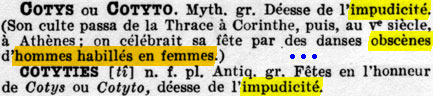
In text:
COTYS ou COTYTO. Myth. gr. Déesse de l'impudicité. (Son culte passa de la Thrace à Corinthe, puis, au ve siècle, à Athènes; on célébrait sa fête par des danses obscènes d'hommes habillés en femmes.)
COTYTIES [tî] n. f. pl. Antiq. gr. Fêtes en l'honneur de Cotys ou Cotyto, déesse de l'impudicité.
Translated from French:
COTYS or COTYTO. Myth. gr. Goddess of the impudicity / immodesty / shamelessness. (Her worship passed from Thrace to Corinth, then, in the ve century, Athens; they celebrated her festival by dances obscene / lewd of men dressed as women.)
COTYTIES [ tî ] n. f. pl. Antiq. gr. Festivals in the honor of Cotys or Cotyto, goddess of the impudicity / immodesty / shamelessness.
Grand Larousse Encyclopédique, 1960, Vol. 3, p. 555, “COTYT…”
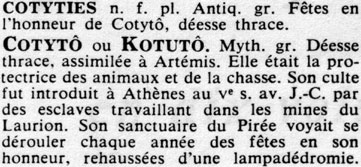
In text:
COTYTIES n. f. pl. Antiq. gr. Fêtes en l'honneur de Cotytô, déesse thrace.
COTYTÔ ou KOTUTÔ. Myth. gr. Déesse thrace, assimilée à Artémis. Elle était la protectrice des animaux et de la chasse. Son culte fut introduit à Athènes au ve s. av. J.-C. par des esclaves travaillant dans les mines du Laurion. Son sanctuaire du Pirée voyait se dérouler chaque année des fêtes en son honneur, rehaussées d'une lampadédromie.
Translated from French:
COTYTIES n. f. pl. Antiq. gr. Festivals in the honor of Cotytô, thrace goddess.
COTYTÔ or KOTUTÔ. Myth. gr. Thrace goddess, comparable with Artémis. She was protector of the animals and hunting. Her worship was introduced in Athens in ve s. av. J.-C. by slaves working in the mines of Laurion. Her sanctuary of Pirée saw being held each year of the festivals in her honor, raised / elevated of a run-with-the-torches.
Grand Dictionaire Encyclopédique Larousse, 1982, Vol. 3, p. 2681, “COTYT…”:
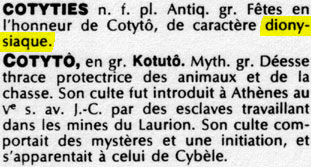
In text:
COTYTIES n. f. pl. Antiq. gr. Fêtes en l'honneur de Cotytô, de caractère dionysiaque.
COTYTÔ, en gr. Kotutô. Myth. gr. Déesse thrace protectrice des animaux et de la chasse. Son culte fut introduit à Athènes au Ve s. av. J.-C. par des esclaves travaillant dans les mines du Laurion. Son culte comportait des mystères et une initiation, et s'apparentait à celui de Cybèle.
Translated from French:
COTYTIES n. f. pl. Antiq. gr. Festivals in the honor of Cotytô, character dionysiac.
COTYTÔ, in gr. Kotutô. Myth. gr. Thrace goddess protector of the animals and hunting. Her worship was introduced in Athens in Ve s. av. J.-C. by slaves working in the mines of Laurion. Her worship comprised mysteries and an initiation, and was connected with / resembled that of Cybèle.
http://www.mediterranees.net/civilisation/religions/mysteres/mysteria.html, Religions antiques (Ancient religions), Article Mysteria - Daremberg et Saglio (1877) (Article: Mysteria - Daremberg and Saglio [1877]), C. Les Mystères des thiases (The Mysteries of the Bacchic celebrations [Greek]):
4° Bendis et Cottyto. Dans les thiases de Cotytto, les initiés avaient à peu près les mêmes rites que ceux de Sabazios ; il y avait la purification par l'eau, comme l'indique le mot baptai ; et les mêmes objets symboliques que pour Cybèle, le tambour et la toupie.
Translalted from French:
4° Bendis and Cottyto. In the Bacchic celebrations of Cotytto, the initiates had about the same rites as those of Sabazios; there was the purification by water, as the word baptai indicates it; and the same symbolic systems objects as for Cybèle, the drum and the spinning top.
Encyclopédie ou Dictionnaire Raisonné des Sciences des Arts et des Métiers (Encyclopaedia or Reasoned Dictionary of Sciences of Arts and the Trades), Vol. 2, 1751, pp. 65-66, “BAPTES”:
In text:
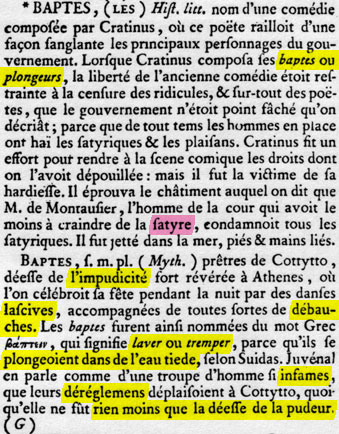
BAPTES, ( LES ) Hist. litt. nom d'une comédie composée par Cratinus, où ce poëte railloit d'une façon sanglante les principaux personnages du gouvernement. Lorsque Cratinus composa ses baptes ou plongeurs, la liberté de l'ancienne comédie étoit restrainte à la censure des ridicules, & sur-tout des poëtes, que le gouvernement n'étoit point sâché qu'on décriât; parce que de tout tems les hommes en place ont haï les satyriques & les plaisans. Cratinus fit un effort pour rendre à la scene comique les droits dont on l'avoit dépouillée: mais il fut la victime de sa hardiesse. Il éprouva le châtiment auquel on dit que M. de Montausier, l'homme de la cour qui avoit le moins à craindre de la satyre, condamnoit tous les satyriques. Il fut jetté dans la mer, piés & mains liés.
BAPTES, s. m. pl. ( Myth. ) prêtres de Cottytto, déesse de l'impudicité fort révérée à Athenes, où l'on célébroit sa fête pendant la nuit par des danses lascives, accompagnées de toutes sortes de débauches. Les baptes furent ainsi nommées du mot Grec βάπτειν, qui signifie laver ou tremper, parce qu'ils se plongeoient dans de l'eau tiede, selon Suidas. Juvénal en parle comme d'une troupe d'homme si infames, que leurs déréglemens déplaisoient à Cottytto, quoiqu'elle ne fût rien moins que la déesse de la pudeur. ( G )
Translated from French:
BAPTES, (THE) Hist. litt. name of a comedy composed by Cratinus [Athenian comedy writer / poet, c. 520-423 BC], where this poet mocks[?] in a bloody way principal characters of the government. When Cratinus composed his baptes or dippers / plungers, the freedom of the former comedy was restraint with the censure / censorship of the ridiculous / comical ones, & on all of the poets, that the government was aware of which one condemned; because of all arguments the men in place hated the satiric/sarcastic ones & jokesters. Cratinus made an effort to return to the comic scene the rights of which one stripped / deprived him: but he was the victim of his boldness. He tested the punishment to which one says that Mr. de Montausier, the court gentleman which has less to fear of the satyr / lecher, convicted all the satiric / sarcastic ones. He being thrown in the sea, feet & hands secured / in bonds.
BAPTES, s. m. pl. (Mythology) priests of Cottytto, goddess of the impudicity / immodesty / shamelessness extremely revered / worshipped in Athens, where one celebrates her party / festival during the night by lustful / lewd / lascivious (exciting sexual desire) dances, accompanied by all kinds of debauchery / vices (sexually immorality). The baptes were thus named Greek word βάπτειν, that means to wash or soak / dunk / dip, because they are plunged / dipped / immersed in lukewarm water, according to Suidas. Juvénal speaks about it as of a troop / group of men that infamous / disgraceful, that their unregulated / disruptive offensive / displeasing to Cottytto, even though born being the least not that the goddess of the decency / modesty / shame ( G )
http://www.answers.com/satyr, “satyr”:
2. A licentious man; a lecher. … An immoral or licentious man: lecher, roué. Informal dirty old man. Slang lech. See sex/asexual. … An important part of Dionysus' entourage, they were lustful … A creature in classical mythology who was part man and part goat. Satyrs were famous for being constantly drunk and for chasing nymphs. They were companions of Dionysus. … By extension, a “satyr” is a lecherous male. … man with strong sexual desires Synonym: lecher … one of a class of woodland deities; attendant on Bacchus …
http://www.answers.com/lechery, “lechery”:
1. Excessive indulgence in sexual activity; lewdness. … unrestrained indulgence in sexual activity
http://www.answers.com/lecher, “lecher”:
from Old French lecheor, from lechier, to lick, to live in debauchery … An immoral or licentious man … man with strong sexual desires
Encyclopédie ou Dictionnaire Raisonné des Sciences des Arts et des Métiers (Encyclopaedia or Reasoned Dictionary of Sciences of Arts and the Trades), Vol. 4, 1754, p. 419, “COTYTTÉES”:
In text:
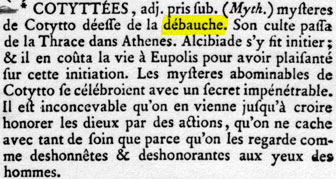
COTYTTÉES, adj. pris sub. (Myth.) mysteres de Cotytto déesse de la débauche. Son culte passa de la Thrace dans Athenes. Alcibiade s'y fit initier; & il en coûta la vie à Eupolis pour avoir plaisanté sur cette initiation. Les mysteres abominables de Cotytto se célébroient avec un secret impénétrable. Il est inconcevable qu'on en vienne jusqu'à croire honorer les dieux par des actions, qu'on ne cache avec tant de soin que parce qu'on les regarde comme deshonnêtes & deshonorantes aux yeux des hommes.
Translated from French:
COTYTTÉES, adj. taken sub. (Myth.) mysteries of Cotytto goddess of the debauchery. Its worship passed from Thrace in Athens. Alcibiades [General and Athenian politician, 450? – 404 BC] was made there initiate; & it cost the life to Eupolis to have joked on this initiation. The abominable mysteries of Cotytto are celebrated with an impenetrable secrecy. It is inconceivable that one comes from there until believing to honor the gods by actions, that one hides with such an amount of care only because one looks them like dishonesty & dishonorable with the eyes of the men.
Encyclopédie ou Dictionnaire Raisonné des Sciences des Arts et des Métiers (Encyclopaedia or Reasoned Dictionary of Sciences of Arts and the Trades), Vol. 34, 1780, p. 419, “COTYTTÉES”:

In text:
COTYTTÉES, (Mythol.) mysteres de Cotytto, déesse de la débauche. En quels lieux son culte fut établi. Alcibiade initié à ces mysteries. IV. 314. b.
Translated from French:
COTYTTÉES, (Mythology) mysteries of Cotytto, goddess of the debauchery. In which places its worship was established. Alcibiades [General and Athenian politician, 450? – 404 BC] initiated with these mysteries. IV. 314. b.
http://24.201.59.108:8080/mission/peche3.htm, Le péché et sa mère, la boue - Partie 3 (The sin and its mother, the mud - Part 3):
dans les orgies des baptes, sorte de secte mystique fondée en l'honneur de Vénus Cotyto ou Vénus populaire, dont les mystères étaient célèbres de nuit en Thrace,
Translated from French (in Google):
in the orgies of the baptes, kind of mystical sect founded in the Venus Cotyto honor or popular Venus, whose mysteries were famous of night in Thrace,
http://publipress.com/reference/Dictionnaire%20latin-fran%E7ais/Dicolat-B.html (http://www.guetali.fr/home/jeanneau/Dico-B.htm [4-4-02]), “Baptae”:
Baptae, arum, m. : les Baptes (prêtres de la déesse Cotytto).
Translated from French:
Baptae, arum, m.: the Baptes (priests of the goddess Cotytto).
Latin:
http://www.uni-mannheim.de/mateo/camenaref/hofmann/hof1/s0469b.html (Universität Mannheim [University of Mannheim, Germany]):
Lexicon Universale (Latin), Johann Jacob Hofmann (1635-1706), 1698, p. 469, “BAPT…”:
http://www.uni-mannheim.de/mateo/camenaref/hofmann/b/books/b_576.html (Universität Mannheim [University of Mannheim, Germany]), Baptae (the above scan, 1st entry):
Blue translated from Latin (with the aid of http://lysy2.archives.nd.edu/cgi-bin/words.exe?impudicitiae, http://www.quicklatin.com/ & others):
BAPTAE
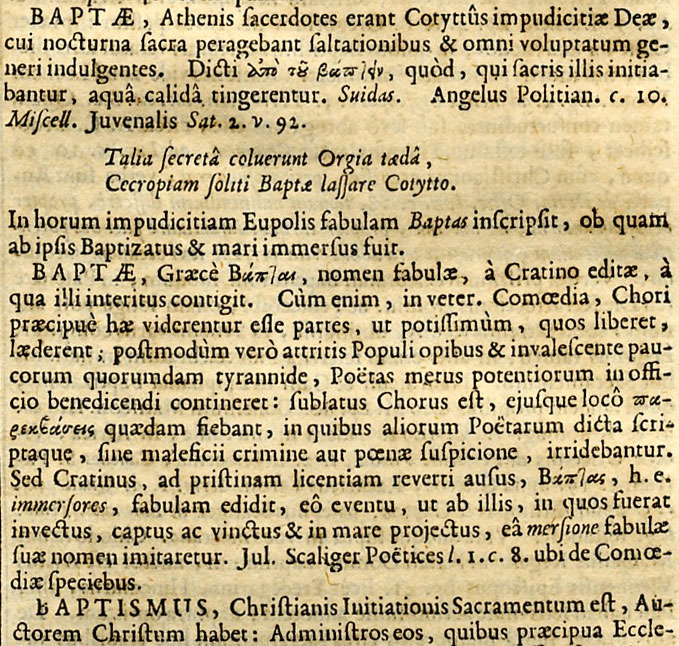
Athenis Inhabitants of Athens sacerdotes the priests erant were of Cotyttûs Cotyttûs impudicitiae the sexual impurity (often of homosexuality) / unchasteness, immodesty, lewdness Deae Goddess, cui who nocturna by night sacra sacred/holy peragebant were disturbing saltationibus dancings et and omni all persons voluptatum pleasure/delight/enjoyment generi kind/sort/variety indulgentes indulging, Dicti l)po\ tou= *baptein baptein, quod which/who, qui anyone sacris sacred/holy/consecrated illis to those initiabantur initiated into, aquâ water. calidâ warm water tingerentur wet/moisten/dip/soak; color/dye/tinge/tint, stain. Suidas [A Greek lexicographer, A.D. 970]. Angelus Politian. c. 10. Miscell. Iuvenalis Sat. 2. v. 92.
Talia Such were secretâ secret mystic rite coluerunt worship Orgia orgies taedâ pine torch, Cecropiam Cecropian/Athenian (from Cecrops: the first king of Athens) soliiti (soliti) been in the habit of Baptae Baptae lassare to tire/exhaust Cotytto Cotytto. : Such were the secret torchlight orgies with which the Baptae wearied the Athenian Cotytto.
In In horum this impudicitiam sexual impurity (often of homosexuality) / unchasteness, immodesty, lewdness Eupolis (Athenian comic poet, 430-411 BC) fabulam story Baptas Baptas inscripsit write on, ob on the account of quam anyone ab by ipsis himself Baptizatus Baptizatus et and mari sea water immersus dip/immerse fuit to be.
http://www.uni-mannheim.de/mateo/camenaref/hofmann/b/books/b_577.html (Universität Mannheim [University of Mannheim, Germany]), Baptae (the above scan, 2nd entry):
BAPTAE
Graece Greek *ba/ptai baptai, nomen name fabulae story, a by Cratino (Cratinus) (Greek dramatist 423 BC) editae put forth, a by qua which illi that interitus perished contigit come to pass. Cum With enim for/namely, in into veter old/forbidden. Comoedia The comedy, Chori Chorus praecipue particular hae this viderentur look at esse exist partes parts, ut to potissimum most prominent, quos who liberet it pleases, laederent might offend/hurt; postmodum after a while vero truly attritis rub against Populi people/society opibus influence et and invalescente strengthen paucorum small amount of people quorumdam a certain tyrannide tyranny, Poetas Poets metus fear potentiorum powerful in in officio office benedicendi mighty/strong/powerful contineret confine/restrain/contain: sublatus destroy/suffer Chorus choir est consume/devour, eiusque they loco a place parekba/s1eis2 (parekbaseis [παρεκβάσεις]) deviate from quaedam certain fiebant be made/happen, in in quibus who/which aliorum another Poetarum Poet dicta talk scriptaque write, sine set/fix malesicii (maleficii) an evil deed/crime crimine indictment/charge/accusation aut or poenae penalties suspicione suspicion, itridebantur (irridebantur) ridicule/mock. Sed But Cratinus Cratinus (Greek dramatist 423 BC), ad to be pristinam former licentiam freedom/liberty/license reverti to be turn backed ausus intended, *ba/ptas2 baptas, h. e. immersores dip/immerse, fabulam story edidit published/distributed, eô go eventu come out/happens, ut that ab by illis those, in in quos who fuerat to be invectus bring in, captus captivity ac and vinctus binded et and in in mare sea water proiectus (or projectus) thrown down, eâ they mersione earn/deserve fabulae story suae his/one's nomen name imitatetur imitate/copy. Iul. Scaliger Poetices l(L). 1. c. 8. ubi where de from Comoediae Comedies speciebus show.
http://www.uni-mannheim.de/mateo/camenaref/hofmann/hof1/s1005a.html (Universität Mannheim [University of Mannheim, Germany]):
Lexicon Universale (Latin), Johann Jacob Hofmann (1635-1706), 1698, p. 1005, “COTYTTO”:
COTYTTO
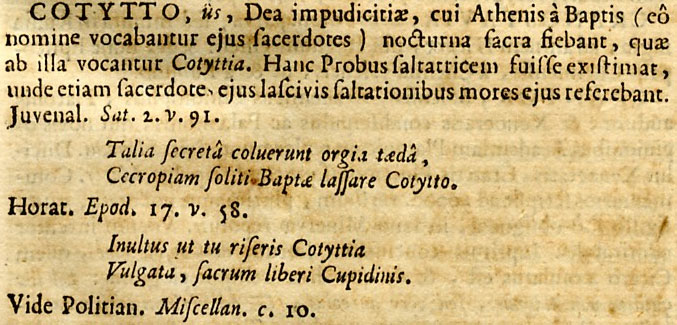
us, Dea Goddess impudicitiae sexual impurity (often of homosexuality) / unchasteness, immodesty, lewdness, cui who Athenis Athenians à Baptis Baptis (eo there nomine name vocabantur call ejus her sacerdotes priests) nocturna night sacra sacred fiebant take place/happen, quae who ab by illa that vocantur are called Cotyttia Cotyttia. Hanc This Probus good saltatticem dance fuisse to be existimat values/esteem, unde from which place etiam now too/yet sacerdote a priest ejus they/same lascivis lustful/wanton saltationibus dancing mores behavior/character ejus they referebant return/give back.
Juvenal. – (same as Baptae, 1st entry, above)
Horat. Quintus Horatius Flaccus (Horace), Roman poet, 65 BC-8 BC Epod. Epodi/Epodon Liber (The Epodes) 17. v. 58.
Inultus Unpunished ut to/in order that tu you riseris laugh at/ridicule Cotyttia Cotyttia Vulgata (Volgata) Spread around/among the multitude, sacrum sacred/holy liberi free/unimpeded/licentious Cupidinis Cupidness/Sexual Love.
Vide Politian. Miscellan. c. 10.
http://www.intratext.com/IXT/LAT0532/_PZ.HTM, Quintus Horatius Flaccus, Epodi, “17”:
inultus ut tu riseris Cotytia
volgata, sacrum liberi Cupidinis, (Same basic text
as above)
Italian:
http://www.rodoni.ch/busoni/bibliotechina/orazio/epodi.html, Quinto Orazio Flacco: Epodi (Quintus “Horace” Flaccus: Epodi) (Quintus Horatius Flaccus, poet, 8 BC), “17”:
Senza pena hai irriso e
svelato i misteri
di Cotitto, i riti del libero amore,
Translated from Italian:
Without punishment/penalty you have ridiculed(Latin irriso) and revealed the mysteries of Cotitto, the rituals/rites of the free love,
http://digilander.libero.it/freesurfer64/arte/arte/libri/nicoletti/, I giorni lunghi del Salento, di Aldo Nicoletti, recensione a cura di Giorgio Barba (The long days of the Salento, by Aldo Nicoletti, book review edited by George Beard):
Daniele, invece, rappresenta l'uomo cacciatore il cui destino è quello di diventare preda, il Sabazio, l'antica divinità traco-frigia "che amò, con la stessa intensità, la dolce Bendis e l'impudica Cotitto".
Translated from Italian:
Daniel, instead, represents the man hunter whose destiny is that of to become prey, the Sabazius, the ancient divinity Thracian-Phrygian "that he loved, with the same intensity, the sweet Bendis and the immodest Cotitto".
http://www.answers.com/immodest, “immodest”:
Offending against sexual mores in conduct or appearance; indecent: a bathing suit considered immodest by the local people.
http://www.was.it/elamilmago/games/imperorom/mitre106numi.txt (4-11-02):
NOME/SESSO NOME GRECO DIO PATRONO SFERA/NOTE …
Batte (f) [sic] Cotito Venere Impudicizia. Feste notturne in Grecia. …
Cottito (f) Cottito Ecate Lascivia. Feste orgiastiche. Etrusco: Vei.
Translated from Italian:
NAME/SEX GREEK NAME PATRON GOD SPHERE/NOTE…
Bapte (f) Cotito Venus Immodesty. Nocturnal festivities in Greece. …
Cottito (f) Cottito Ecate Lasciviousness/lewdness/lustfulness/obscenity/wantonness. Orgiastic festivities. Etruscan(W.-Cen. Italy): Vei.
http://www.underome.com/ita/sub/240.php, L'ipogeo di via Livenza:
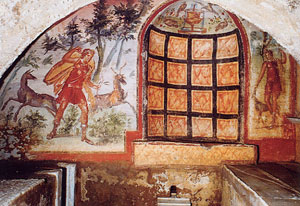
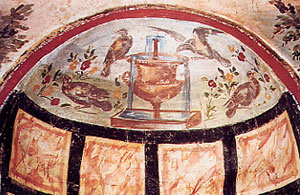
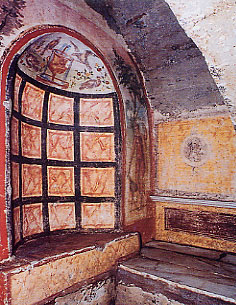
L'ubicazione, l'architettura e la ricchezza delle decorazioni ne escludono l'utilizzazione come semplice cantina o bottega cosi' come, data la profondita', non si puo' pensare ad una dimora o ad un bagno. Il Paribeni, che svolse i primi scavi sistematici dell'ipogeo, ipotizzo', evidenziando la presenza della vasca, che si potesse trattare di un santuario appartenente alla setta misterica, nata in Grecia, dei Baptai che venerava la Dea Tracia Cotys, spesso assimilata ad Artemide e praticava, durante le cerimonie sacre a carattere orgiastico, un bagno rituale in acqua fredda al fine di provocare lo shock dell'estasi. La struttura dell'edificio a pianta basilicale, l'interpretazione delle pitture ed ancora l'esistenza della vasca, contrariamente portano il Wilpert a riconoscervi un battesimo cristiano sotterraneo e piu' precisamente, con ipotesi ardita, l'antichissimo battistero ricordato dai documenti : ad nynphas Beati Petri, ubi Petrus Baptizavit ; lo studioso lesse nella scena moisacata superstite la rappresentazione del miracolo della fonte operato dal Mose'-Pietro ed interpreto' in senso simbolico le pitture: Diana rappresenterebbe il paganesimo che scaccia i fedeli contrapposta alla ninfa, raffigurante il Cristianesimo, che attira le anime alla conversione.
(Quick) translation from Italian:
The location, the architecture and the wealth of the decorations of it exclude the use like simple wine cellar or shop things’ like, given squandered it', puo' not to be believed to one dwelling or a bath. The Paribeni, that it carried out the first diggings arranged us of the ipogeo, I assume ', evidencing the presence of the bath, than it could be dealt of a sanctuary pertaining to the misterica schism, been born in Greece, of the Baptai that venerated the Goddess Thrace Cotys, often assimilated to Artemis and practiced, during the sacred ceremonies to orgiastic character, a ritual bath in cold water to the aim to provoke the shock of the ecstasy. The structure of the basilican building to plant, the interpretation of paintings and still the existence of the bath, contrarily carry the Wilpert to recognize a underground Christian baptism to you and piu', with hypothesis just dared, the ancient baptistry remembered from documents: to nynphas Made happy Petri, ubi Petrus Baptizavit ; the student read in the moisacata scene survivor the representation of the miracle of the source operated from the Mose' Peter and interpreto' in symbolic sense the paintings: Diana would represent the aganism that drives away the faithful countered to the nymph, representing the Christianity, that it attracts the spirits to the conversion.
Hey, I found a completed English translation (leaving out “orgiastic” of course):
http://www.underome.com/eng/sub/240.php (or, http://www.romanet.it/Extras/guida_turistica_ENG/rs/sub/livenza2.htm), The Hypogeum of via Livenza:
The
position, the architecture and the rich decoration lead us to exclude its use
as a cellar or workshop or even as part of a private house. Paribeni, who
started the first organised excavation of the hypogea, suggested that it might
have been used as a sanctuary by the Greek mystery
cult Baptai, who worshipped the goddess
Tracia Cotys (or Artemide [Artemis]). The hypothesis was
supported by the presence of the pool and by the fact that, in part, the Baptai ritual required a bath in cold water.
The plan of the construction, the interpretation of the paintings and
especially the presence of the pool leads Wilpert to suggest that the hypogea
was used instead to baptise Christians.
A more far-fetched hypothesis identifies the hypogea with the ancient baptistery named in the documents: "ad
nymphas Beati Petri, ubi Petrus Baptizavit".
Wilpert recognised in the remnants of the mosaic the representation of the
miracle of the spring of Mose'-Peter and read the painting in a symbolic
way. Diana [Artemis
in Roman]
represents the paganism that chases away the faithful while the nymph,
symbolising Christianity, attracts the
souls towards the conversion.
http://archiver.rootsweb.com/th/read/LATIN-WORDS/2002-06/1023171081,
Latin-Words-L Archives, “Subject: [LATIN] Church
Records Phrase "Baptizavit qui Supra"”:
Many of the baptismal and marriage records of an old German churchbook I am extracting end in the phrase "Baptizavit qui Supra" or "Copulavit qui Supra"
Spanish:
Diccionario Enciclopédico: Hispano-Americano de Literatura, Ciencias, Artes, Etc. (Encyclopedic Dictionary: Hispano-American of Literature, Sciences, Arts, etc.), no date but pretty old, Vol. 3, p. 172, “BAPTO”:

In text:
BAPTO: Mit. Sacerdote que intervenía en las fiestas nocturnas y licenciosas celebradas en Grecia en honor de Cotis.
Translated from Spanish:
BAPTO: Mit. Priest who took part in the nocturnal [nighttime] and licentious / immoral / wanton festivals celebrated in Greece in honor of Cotis [Cotys].
Diccionario Enciclopédico: Hispano-Americano de Literatura, Ciencias, Artes, Etc. (Encyclopedic Dictionary: Hispano-American of Literature, Sciences, Arts, etc.), no date but pretty old, Vol. 6, p. 1233, “COTIS”:
In text:
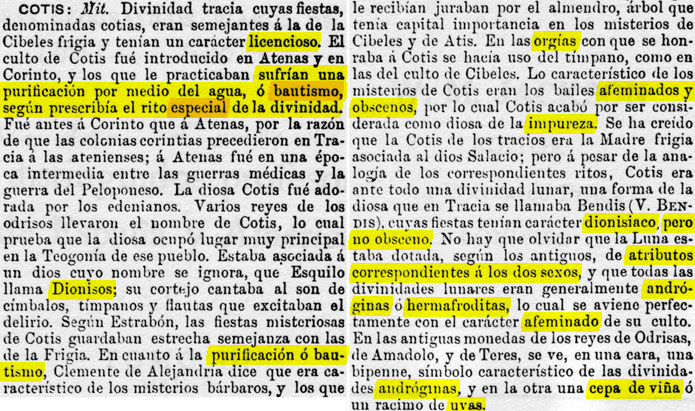
COTIS: Mit. Divinidad tracia cuyas fiestas, denominadas cotias, eran semejantes á la de la Cibeles frigia y tenían un carácter licencioso. El culto de Cotis fué introducido en Atenas y en Corinto, y los que le practicaban sufrían una purificacion por medio del agua, ó bautismo, según prescribía el rito especial de la divinidad. Fué antes á Corinto que á Atenas, por la razón de que las colonias corintias precedieron en Tracia á las atenienses; á Atenas fué en una época intermedia entre las guerras médicas y la guerra del Peloponeso. La diosa Cotis fué adorada por los edenianos. Varios reyes de los odrisos llevaron el nombre de Cotis, lo cual prueba que la diosa ocupó lugar muy principal en la Teogonía de ese pueblo. Istaba asociada á un dios cuyo nombre se ignora, que Esquilo llama Dionisos; su cortejo cantaba al son de címbalos, tímpanos y flautas que excitaban el delirio. Según Estrabón, las fiestas misteriosas de Cotis guardaban estrecha semejanza con las de la Frigia. En cuanto á la purificación ó bautismo, Clemente de Alejandría dice que era caracteristico de los misterios bárbaros, y los que le recibían juraban por el almendro, árbol que tenía capital importancia en los misterios de Cibeles y de Atis. En las orgías con que se honraba á Cotis se hacía uso del tímpano, como en las del culto de Cibeles. Lo característico de los misterios de Cotis eran los bailes afeminados y obscenos, por lo cual Cotis acabó por ser considerada como diosa de la impureza. Se ha creído que la Cotis de los tracios era la Madre frigia asociada al dios Salacio[sic]; pero á pesar de la analogía de los correspondientes ritos, Cotis era ante todo una divinidad lunar, una forma de la diosa que en Tracia se llamaba Bendis (V. BENDIS), cuyas fiestas tenían carácter dionisiaco, pero no obsceno. No hay que olvidar que la Luna estaba dotada, según los antiguos, de atributos correspondientes á los dos sexos, y que todas las divinidades lunares eran generalmente andróginas ó hermafroditas, lo cual se aviene perfectamente con el carácter afeminado de su culto. En las antiguas monedas de los reyes de Odrisas, de Amadolo, y de Teres, se ve, en una cara, una bipenne, símbolo característico de las divinidades andróginas, y en la otra una cepa de viña ó un racimo de uvas.
Translated from Spanish:
COTIS: Mit. Thracian divinity whose celebrations, denominated cotias, were similar to that of the Phrygian Cybele and had a licentious / immoral / wanton character. The worship of Cotis was introduced in Athens and Corinth, and those that practiced to her underwent a purification by means of the water, or baptism, according to prescribed the special rite of the divinity. It was before in Corinth that at Athens, for the reason that the Corinthian colonies preceded in Thrace to the Athenians; in Athens was in an intermediate time between the medical wars and the war of the Peloponeso. The Cotis goddess was worshipped / adored by the edenians / edonians [Eden pleasure]. Several kings of the Odrysians took the name of Cotis, which proves that the goddess occupied very principal / leading place in the Theology of that town. She was associated to a God whose name is ignored, that Aeschylus [playwright, 525-456 BC] calls Dionysus; her entourage / followers sang to sounds of cymbals, drums and flutes that excited the delirium / emotions. According to Estrabon [historian-geographer, 63 BC–21 AD], the mysterious festivals / celebrations of Cotis kept close resemblance with those of the Phrygians. As far as the purification or baptism, Clement of Alexandria [Christian writer, c. 150-215 AD] says that it was characteristic of the Barbarian [foreigners’] mysteries, and those that received it swore [took an oath] by the almond tree, tree that had capital importance in the mysteries of Cybele and Attis. In the orgies with which was honored to Cotis made use of the drum, as in those of the worship of Cybele. The characteristic thing of the mysteries of Cotis were the obscene / lewd and effeminate / womanish dances, by which Cotis ended up being respected like goddess of the impurity. One has thought that the Cotis of the Thracians was associated to the Mother Phrygian to the god Sabazius; but in spite of the analogy of the corresponding rites, Cotis was primarily a lunar divinity, a form of the goddess that in Thrace was called Bendis (V. BENDIS), whose celebrations had Dionysian character, but not obscene / not lewd. One must not forget that the Moon was equipped, according to the old ones, of attributes corresponding to both sexes, and that all the lunar divinities were generally androgynous [having both female and male characteristics] or hermaphrodites [same], which agrees perfectly with the made effeminate / womanish character of its cult. In the old coins of the kings of Odrisas, of Amadolo, and Teres, is seen, in a face, a bipens [round double axe looking thing?], symbol / creed characteristic of the androgynous [having both female and male characteristics] divinities, and in another stock / stump of vine or a cluster of grapes.
(“Cotis” and “cotias” above sounds like “coitus,” which means sexual intercourse.)
http://www.creatividadfeminista.org/articulos/templarios_2.htm,
LOS ARQUETIPOS FEMENINOS DE LOS TEMPLARIOS
Y LA IDEA DE IGUALDAD EN LA SOCIEDAD OCCIDENTAL (THE FEMININE
ARCHETYPES OF THE TEMPLARIOS
And The IDEA OF EQUALITY In The WESTERN SOCIETY), FRANCISCA MARTÍN-CANO
ABREU, PARTE II (PART 2), “4 - C) 1 CONCEPCIÓN VIRGINAL” (CONCEPTION VIRGINAL):
En las diferentes mitologías sagradas, en las que se basa los mitos cristianos de la virginidad de Ana y de María, las Diosas eran hermafroditas / andróginas. Leemos en la Enciclopedia Espasa, Tomo 15 (1988, 1300) de la Diosa Gran Diosa Lunar Cotito / Cotytto / Cotis / Kotytto, adorada en Tracia y en Sicilia, Diosa hermafrodita de la Impudicia:
Translated from Spanish:
In the different sacred mythologies, on which it is based the Christian myths of the virginity of Ana and Maria, the Goddesses were hermaphrodites / androgynous(having both female and male characteristics). We read in the Encyclopedia Espasa, Volume 15 (1988, 1300) of the Goddess Great Lunar Goddess Cotito / Cotytto / Cotis / Kotytto, adored in Thrace and Sicily, hermaphrodite(having both female and male characteristics) Goddess of the Impudicia(the sexual impurity [often of homosexuality] / unchasteness, immodesty, lewdness):
Enciclopedia Vniversal Ilvstrada Evropeo-Americana (Universal Encyclopedia Illustrated: European-American), 1910, Vol. 7, p. 603, “BAPTOS”:
In text:
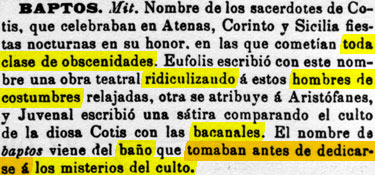
BAPTOS. Mit. Nombre de los sacerdotes de Cotis, que celebraban en Atenas, Corinto y Sicilia fiestas nocturnas en su honor. en las que cometían toda clase de obscenidades. Eufolis escribió con este nombre una obra teatral ridiculizando á estos hombres de costumbres relajadas, otra se atribuye á Aristófanes, y Juvenal escribió una sátira comparando el culto de la diosa Cotis con las bacanales. El nombre de baptos viene del baño que tomaban antes de dedicarse á los misterios del culto.
Translated from Spanish:
BAPTOS. Mit. Name of the priests of Cotys, who celebrated in Athens, Corinth and Sicily nocturnal [at night] celebrations in her honor. in that they committed all class of obscenities / lewdness. Eupolis[?] [430-411 BC] wrote with this name a theatrical work ridiculing to these relaxed customary / moral / mores men, another one attributes to Aristophanes [c. 448-380 BC], and Juvenal [c. 60-140 AD] wrote a satire comparing the cult of the goddess Cotys with the Bacchanalia. The name of baptos comes from the bath that they took before being dedicated to the mysteries of the cult / worship.
Enciclopedia Vniversal Ilvstrada Evropeo-Americana (Universal Encyclopedia Illustrated: European-American), 1913, Vol. 15, p. 1300, “COTIT…”:
In text:
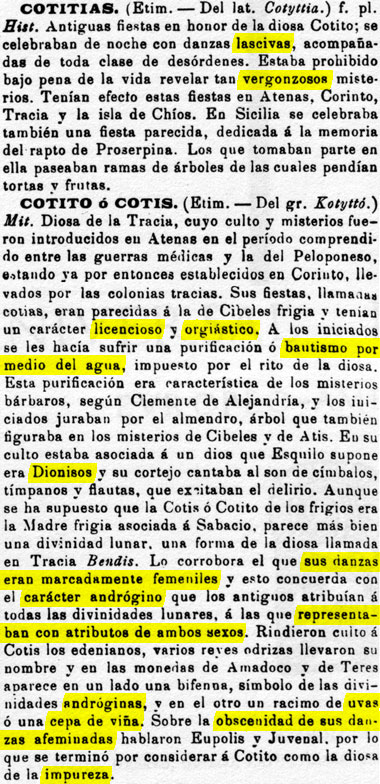
COTITIAS. (Etim. — Del lat. Cotyttia.) f. pl. Hist. Antiguas fiestas en honor de la diosa Cotito; se celebraban de noche con danzas lascivas, acompañadas de toda clase de desórdenes. Estaba prohibido bajo pena de la vida revelar tan vergonzosos misterios. Tenían efecto estas fiestas en Atenas, Corinto, Tracia y la isla de Chíos. En Sicilia se celebraba también una fiesta parecida, dedicada á la memoria del rapto de Proserpina. Los que tomaban parte en ella paseaban ramas de árboles de las cuales pendían tortas y frutas.
COTITO ó COTIS. (Etim. — Del gr. Kotyttó.) Mit. Diosa de la Tracia, cuyo culto y misterios fueron introducidos en Atenas en el período comprendido entre las guerras médicas y la del Peloponeso, estando ya por entonces establecidos en Corinto, llevados por las colonias tracias. Sus fiestas, llamadas cotias, eran parecidas á la de Cibeles frigia y tenían un carácter licencioso y orgiástco. A los iniciados se les hacía sufrir una purificación ó bautismo por medio del agua, impuesto por el rito de la diosa. Esta purificación era característica de los misterios bárbaros, según Clemente de Alejandría, y los iniciados juraban por el almendro, árbol que también figuraba en los misterios de Cibeles y de Atis. En su culto estaba asociada á un dios que Esquilo supone era Dionisos y su cortejo cantaba al son de címbalos, tímpanos y flautas, que excitaban el delirio. Aunque se ha supuesto que la Cotis ó Cotito de los frigios era la Madre frigia asociada á Sabacio, parece más bien una divinidad lunar, una forma de la diosa llamada en Tracia Bendis. Lo corrobora el que sus danzas eran marcadamente femeniles y esto concuerda con el carácter andrógino que los antiguos atribuían á todas las divinidades lunares, á las que representaban con atributos de ambos sexos. Rindieron culto á Cotis los edenianos, varios reyes odrizas llevaron su nombre y en las monedas de Amadoco y de Teres aparece en un lado una bifenna, símbolo de las divinidades andróginas, y en el otro un racimo de uvas ó una cepa de viña. Sobre la obscenidad de sus danzas afeminadas hablaron Eupolis y Juvenal, por lo que se terminó por considerar á Cotito como la diosa de la impureza.
Translated from Spanish:
COTITIAS. (Etymology — Of the Latin Cotyttia.) f. pl. Hist. Old celebrations / festivals in honor of the goddess Cotito; they were celebrated at night with lewd / lascivious / lecherous / prurient dances, accompanied by all class of disorders. It was prohibited under penalty of the life to reveal so shameful mysteries. These celebrations / festivals had effect in Athens, Corinth, Thrace and the island of Chíos. In Sicily a like celebration was also celebrated, dedicated to the memory of the kidnapping of Proserpina. The ones that took part in her walked with branches from trees of which cakes and fruits hung.
COTITO or COTIS. (Etymology — Of the Greek Kotyttó.) Mit. Goddess from Thrace, whose cult and mysteries were introduced in Athens in the period between the medical wars and the one of the Peloponeso, already at that time being established in Corinth, taken by the Thracian colonies. Their celebrations, calls cotias, were similar to the one of Phrygian Cybele and had a licentious / immoral / wanton character and orgiastic. To the initiates it was made them undergo a purification or baptism by means of the water, imposed by the rite of the goddess. This purification was characteristic of the barbarian [foreigners’] mysteries, according to Clement of Alexandria [Christian writer, c. 150-215 AD], and those initiates swore [took an oath] by the almond tree, tree that also appeared in the mysteries of Cybele and Attis. In their worship was associated to a God that Aeschylus [playwright, 525-456 BC] supposes was Dionysus and their entourage / followers sang to sounds of cymbals, drums and flutes, that excited the delirium / emotions. Although it is supposed that the Cotis or Cotito of the Phrygians was the Mother Phrygian associated to Sabazius, it seems a lunar divinity rather, a form of the goddess in Thrace called Bendis. It corroborates / confirms it that their dances were noticeably feminine and this agrees with the androgynous [having both female and male characteristics] character which the old ones attributed to all the lunar divinities, that they represented with attributes of both sexes. The edenians / edonians [Eden pleasure] yielded worship to Cotis, several Odrysian kings took her name and in the coins of Amadoco and Teres he appears in a side one bipens [round double axe looking thing?], symbol of the androgynous [having both female and male characteristics] divinities, and in the other a cluster of grapes or a stock / stump of vine. On the obscenity / lewdness / smut / nastiness of its effeminate / womanish dances spoke Eupolis [c. 430-411 BC] and Juvenal [c. 60-140 AD], reason why was conclusion to consider / regard Cotito like the goddess of the impurity.
http://www.snible.org/coins/hn/thrace.html, Ancient coinage of Thrace, “P. Thracian Kings And Dynasts.”:
Metocus, circ. B.C. 400, called Medocus by Xenophon (Anab., VII. ii. 32; iii. 16; vii. 3, 11. Hell., IV. viii. 26). See Zeit. f. Num., v. 95.
|
ΜΗΤΟΚΟ Head of bearded Dionysos. |
Double-axe. Symbol, grapes. AR 18 grs. |
The double axe is a symbol of Dionysos as well as of the great Thracian goddess Kotys or Kotytto, a divinity closely allied to the Phrygian Magna Mater (Preller, Gr. Myth., i. 549).
http://agrianika.hit.bg/TN_Trak.bronze_bipens (via http://agrianika.hit.bg/krakra_hill.htm), Krakra Hill at Pernik, “Some Photos of Finds from Krakra Hill [in Thrace, today: Bulgaria]”:
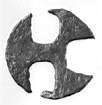
Trak.bronze bipens.jpg
Portuguese:
http://www.geocities.com/WestHollywood/Parade/3179/b.htm (4-11-02), B, “BAPTES”:
BAPTES
Sacerdotes da deusa Cotito, cujas festas eram celebradas à noite e se caracterizavam pela libertinagem.
Translated from Portuguese:
Priests of the goddess Cotito, whose parties were celebrated to the night and were characterized for the libertinism / licentiousness.
http://www.answers.com/libertine, “libertine”:
An immoral or licentious person … Marked by an absence of conventional restraint in sexual behavior; sexually unrestrained
German:
Der Kleine Pauly Lexikon der Antike (The Small Pauly Encyclopedia of the Antiquity), 1964, Vol. 1, p. 821, “Baptai”:

Der Kleine Pauly Lexikon der Antike (The Small Pauly Encyclopedia of the Antiquity), 1969, Vol. 3, p. 322, “Kotyto”:
In text:
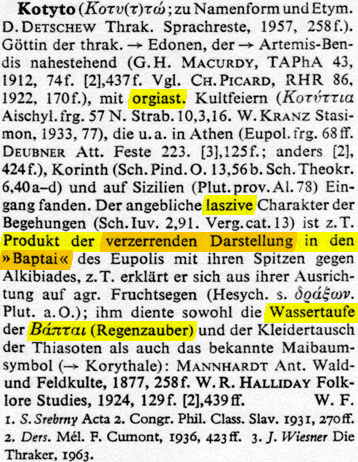
Kotyto (Κοτυ(τ)τώ; zu Namenform und Etym. D.DETSCHEW Thrak. Sprachreste, 1957, 258f.). Göttin der thrak. ® Edonen, der ® Artemis-Bendis nahestehend (G. H. MACURDY, TAPhA 43, 1912, 74f. [2],437f. Vgl. CH. PICARD, RHR 86, 1922, 170f.), mit orgiast. Kultfeiem (Κοτύττια Aischyl. frg. 57 N. Strab. 10,3,16. W. KRANZ Stasimon, 1933, 77), die u. a. in Athen (Eupol. frg. 68 ff. DEUBNER Att. Feste 223. [3],125 f.; anders [2], 424 f.), Korinth (Sch. Pind. O. 13,56 b. Sch. Theokr. 6,40a–d) und auf Sizilien (Plut. prov. A1.73) Eingang fanden. Der angebliche laszive Charakter der Begehungen (Sch. Iuv. 2,91. Verg. cat. 13) ist z. T. Produkt der verzerrenden Darstellung in den »Baptai« des Eupolis mit ihren Spitzen gegen Alkibiades, z.T. erklärt er sich aus ihrer Ausrichtung auf agr. Fruchtsegen (Hesych. s. δράξων. Plut. a.O.); ihm diente sowohl die Wassertaufe der Βάπται (Regenzauber) und der Kleidertausch der Thiasoten als auch das bekannte Maibaumsymbol (® Korythale): MANNHARDT Ant. Wald und Feldkulte, 1877, 258f. W. R. HALLIDAY Folklore Studies, 1924, 129f. [2],439 ff. W. F.
1. S. Srebrny Acta 2. Congr. Phil. Class. Slav. 1931, 270ff. 2. Ders. Mél. F. Cumont, 1936, 423 ff. 3. J. Wiesner Die Thraker, 1963.
Translated from German:
Kotyto (Κοτυ(τ)τώ; to name form and Etym. D.DETSCHEW Thrak. Language remainders, 1957, 258f.). Goddess the Thrace. ® Edonen, the ® Artemis Bendis intimate / near state (G. H. MACURDY, TAPhA 43, 1912, 74f. [2], 437f. Vgl. CH. PICARD, RHR 86, 1922, 170f.), with orgiastic. Kultfeiem (Κοτύττια Aischyl. frg. 57 N. Strab. 10,3,16. W. KRANZ Stasimon, 1933, 77), those among other things in Athens (Eupol. frg. 68 ff. DEUBNER Att. of celebrations 223. [3], 125 f.; differently [2], 424 f.), Corinth (Sch. Pind. O. 13.56 b. Sch. Theokr. 6,40a–d) and at Sicily (Plut. prov. A1.73) entrance found. The alleged lascivious character of the committing / enthusiasm (Sch. Iuv. 2,91. Verg. cat. 13) is z. T. product of the distorting representation in the "Baptai" of the Eupolis with its points against Alkibiades, partly explains itself it from its adjustment on agr. Fruit blessing (Hesych. s. δράξων. Plut. a.O.); it served both the water baptism of the Βάπται (rain charms / magic) and the dress exchange of the Thiasoten[Bacchic celebration{Greek}] and the well-known May tree symbol (® Korythale): MANNHARDT Ant. Forest and field cults, 1877, 258f. W. R. HALLIDAY folklore Studies, 1924, 129f. [ 2], 439 FF. W. F.
1. S. Srebrny Acta 2. Congr. Phil. Class. Slav. 1931, 270ff. 2. Ders. Mél. F. Cumont, 1936, 423 ff. 3. J. Wiesner The Thracer, 1963.
Polish:
http://portalwiedzy.onet.pl/21360,haslo.html, Encyklopedia: Homoseksualizm: Medycyna, Psychologia (Encyclopedia: Homosexuality: Medicine, Psychology):
Z historii kultury wynika, że oprócz orgii heteroseksualnych organizowano też homoseksualne. Przykładem są nocne orgie ku czci bogini Kotytto w Tracji, odbywające się do V w. n.e. Istniały również tajne sekty homoseksualistów, zwłaszcza w społeczeństwach o negatywnej postawie wobec homoseksualizmu i libertyńskiej obyczajowości, np. we Francji.
(Quick) translation from Polish:
From history of culture result < result >, that homosexual organize except orgy heterosexual too. Night orgies are example towards honor of (worship of) goddess in (to) Kotytto Tracji, secret sects existed for holding (proceed) a.d. also V w. homoseksualistów, especially in societies about negative posture in accordance with homosexuality and customs libertyńskiej, e.g. in france.