BAPTISM - CYBELE / ATTIS / CORYBANTES / GALLI / RHEA
Other religious deities who ritualized baptism also practiced promiscuous sex.
The main difference between Cotytto and Cybele is that Cybele used the blood of a bull for baptizing (as did also Mithras). Documentation is much greater for Cybele than for Cotytto, obviously because of Cotytto’s direct link to Christianity and John the Baptist, being her priests were called Bapt…. Plus, Cotytto’s orgies sound more (freedom) extreme against then and today’s religious sexual morals.
Overview of Cotytto-Cybele connection (including more Cotytto sources):
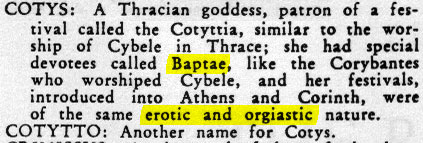
The Rapid Fact Finder: A Desk Book of Universal Knowledge, Weideman, 1958, pp. 133-134, “COTYS | COTYTTO”:
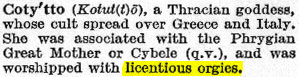
A Handbook of Classical Mythology, Howe / Harrer, 1929, p. 68, “COTYS | COTYTTO”:

The Oxford Companion to Classical Literature, 1959, p. 123, “Cotytto”:
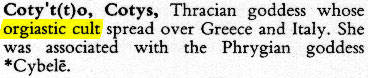
The Oxford Companion to Classical Literature, 1989, p. 158, “Cotyt(t)o, Cotys”:
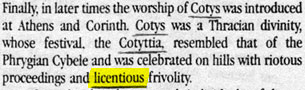
Place-Names in Classical Mythology: Greece, Bell, 1989, p. 89, “Corinth”:
http://religion.mrugala.net/Grece/Anglais/Greec%20gods.txt, “COTYS (Cotytto)”:
COTYS
(Cotytto)
Thracian goddess whose worship was marked by orgiastic rites. She was later accepted into Greece, notably at Corinth and Athens. She was represented either as a huntress goddess similar to Artemis or a mother goddess along the lines of Cybele.
http://www.fortunecity.se/kista/doman/4/mythology/c/cottyto.html, Cottyto (Cotys):
Cottyto (Cotys)
A Thracian mother and fertility goddess, who was later identified with Rhea Cybele. Her rites were orgiastic in nature, and celebrated with much licentiousness. Cotytto was also worshipped in Athens.
A Smaller Classical Dictionary, 1934, p. 169, “Cǒtys | Cǒtyttō”:

A Classical Dictionary of Greek and Roman Biography, Mythology and Geography, Smith, 1852, p. 227, “Cotys or Cotytto”:
They remove “which were originally”:
A Classical Dictionary of Greek and Roman Biography, Mythology and Geography, Smith, 1894, p. 254, “Cǒtys or Cǒtytto”:
http://www.jessworks.org/emilyasleep/ (4-10-05):
Often this was done within a temple setting, but those who were itinerant for one reason or another (particularly the baptai of Kotys and the later gallae in Greece) wandered from town to town, telling fortunes and interpreting dreams for alms. … Legally, gallae (like hetaerae [high class prostitute] and other sex workers in ancient Greece) were forbidden from inherititng property, and had few rights, but they still had to pay taxes (this sounds vaguely familiar). One contemporary writer tells that gallae and sex workers spent a lot of time together, as outcasts often do. Diodorus wrote that gallae and amazons were all considered children of Cybele. Rachel Pollack writes, “Both the Greeks and the Romans abhorred the gallae, recognizing their very existence as a threat to the rule of the phallus (penus). …
|
Kotys |
baptai |
Thrace and Phrygia, and in Greece by the seventh century BCE. Goddess of the hunt and the waning moon. In different stories, both Kotys and Cybele are credited with the invention of the cymbols and the aulos (a wind instrument). The baptai would undergo a ritual cleansing in which they were smeared with a mixture of bran and clay and then bathed. Then they would celebrate communion and chant. They played flute and drum, and in rituals they guided serpents over their bodies (snake handling?). |
Cybele:
Dictionary of Pagan Religions, Wedeck / Baskin, 1971, pp. 86-87, “CYBELE”:
An Illustrated Encyclopedia of Mysticism and the Mystery Religions, Ferguson, 1977, p. 43, “Cybele”:
Sounds like birth control to me. You see, a eunuch can still have and enjoy sex, without fear of pregnancy.
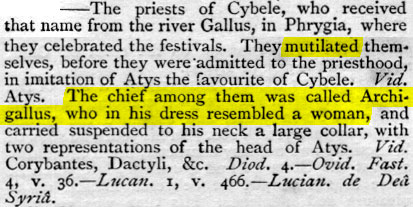
http://books.google.com/books?id=NqMOAAAAIAAJ&pg=PA23&lpg=PA23&dq=%22a+biblical+and+theological+dictionary%22+cockatrice&source=web&ots=YNX-UWI0Hd&sig=UDwN55Snb3sAK3h3RdszEATwTsU#PPA253,M1, A Biblical and Theological Dictionary: Explanatory of the Histories, Manners, and Customs of the Jews, and Neighbouring Nations, with and Account of the Most Remarkable Places and Persons Mentioned in Sacred Scripture – Google Books Result, by Richard Watson, 1856, p. 253, “COLOSSE”:
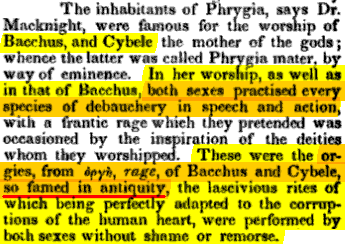
Lempriere’s Classical Dictionary, 1898, p. 182, “Cybĕle”:
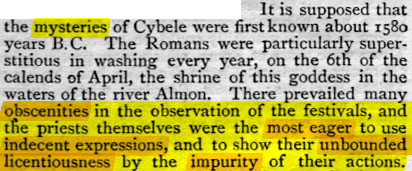
P. 245, “Galli”:
Sexualia: From Prehistory to Cyberspace, Bishop / Osthelder, 2001, p. 224, “The Classical World | Mystery Cults”:
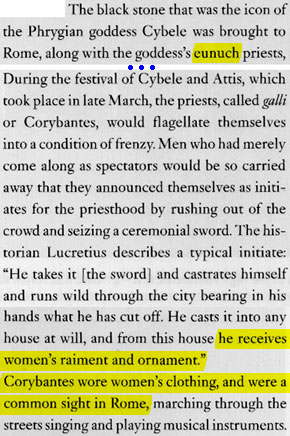
So it’s an open sex and gay theme.
http://www.aztriad.com/gallapic.html, Cybele, Attis, and the Gallae: Images of Gallae:
Castrating themselves, wearing women's clothes, and living as women these priestesses, sisters to those we call transsexual in modern times,
Cassell’s Dictionary of Classical Mythology, Jenny March, 2001, pp. 230-231, “Cybele”:
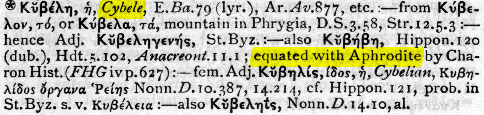
A Greek-English Lexicon (unabridged), Liddell & Scott, Oxford, 1871, pp. 892-893, “Κυβέλη”:
Dictionary of Classical Mythology: Symbols, Attributes & Associations, Bell, 1982, p. 80, “Eunuch”:
Merriam-Webster’s Encyclopedia of World Religions, 1999, p. 387, “Great Mother of the Gods, also called Cybele”:
The Ultimate Encyclopedia of Mythology, Cotterell / Storm, 1999, p. 273, “Cybele”:
P. 292, “The Korybantes”:
http://www2.una.edu/dburton/MysteryRel.htm, Ancient Mystery Religions:
III) Cybele & Attis.
-Romans & Greeks dislike & scandalized at first.
A) Cybele (= Magna Mater, Great Mother)
1) A bisexual monster mountain.
2) Dionysus - Cybele made female only.
3)Male organs of Cybele -> birth of Attis.
http://www.ancientcoins.biz/pages/gods/indexbf.php, “Cybele”:
The cult of Cybele was directed by eunuch priests called Corybantes, who led the faithful in orgiastic rites accompanied by wild cries and the frenzied music of flutes, drums, and cymbals.
http://80-www.xreferplus.com.ezproxy.jocolibrary.org/entry/773154 (subscription required), Cybele:
The Phrygian myth of Cybele, however, is as follows. When Zeus was lying on the ground asleep on Mount Dindymus in Phrygia, his seed fell on the earth. A strange being grew from the spot, with both male and female organs: the gods were alarmed at the potentialities of such a divinity and castrated the creature. It grew into the goddess Cybele. The severed male genitals, however, had fallen on the ground and grown into an almond tree, from which an almond one day fell into the lap of Nana, daughter of the river-god Sangarius. The fruit entered her womb and she conceived a son, Attis, whom she exposed on the mountain. A he-goat miraculously suckled the baby, which grew into a beautiful youth with whom Cybele fell in love. But Attis was neglectful or unaware of Cybele's passion for him, and instead made preparations to marry a daughter of the king of Pessinus. Cybele, wildly jealous, drove both Attis and his father-in-law mad, so that in their frenzy they castrated themselves. … A different story of Cybele makes her the daughter of Meion … She drove him mad, whereupon he castrated himself and died of the wound. … Yet another variant of the tale asserts that Attis received sexual approaches from a king and, being reluctant to comply, was castrated by him. As he lay dying under a pine-tree, Cybele's servants saw him and carried him into her temple, where he expired. Cybele instituted his cult, ordaining that only eunuchs might be his priests; and he was mourned every year by her worshippers.
A Dictionary of World Mythology, Cotterell, 1980, p. 27, “Attis”:
http://bluemoongallerystore.com/c-goddess.html, C-goddess:
Cybele
Great Mother of the Gods from Ida - Magna Mater Deum Idea - brought to Rome
from Phrygia in 204 B.C. Her holy image was carried to Rome by order of the Cumaean
Sybil, a personification fo the same cave-dwelling Goddess herself. As the
Great Mother of all Asia Minor, she was honored by festivals called ludi,
"games." A highlight of her worship was the Taurobolium, baptism in
the blood of a sacred bull, who represented her dying-god consort, Attis. Her temple once stood on the site of the Vatican,
where St. Peter's basilica stands today, up to the 4th century A.D. when
Christians took it over.
Does that mean it was where St. Peter was buried?
http://www.christian-thinktank.com/mostlybull.html, So, what do we know about Cybele/Attis and the taurobolium?
“She had not come alone [in 204 bc]. Her eunuchs had accompanied her. But the Senate confined them to the enclosure of the sanctuary. A priest and priestess from Phrygia took charge of the clergy, who would continue to be recruited outside Rome, in the East. No citizen had the right to castrate himself like the galli, or even to enter the annexes occupied by these eunuchs and take part in the frenzied ‘orgies’. Once a year, during the April festivals, the galli were permitted to dance through the streets of Rome to the sounds of auloi and tambourines, in their exotic ‘get up’, with their feminine garments, long hair and amulets.” [HI:TCRE:37]
… [HI:TCRE] The Cults of the Roman Empire. Robert Turcan. Blackwell:1996.
http://www.rim.org/muslim/pagannt.htm, Was the New Testament Influenced By Pagan Religions?:
The Cult of Cybele and Attis
Cybele, also known as the Great Mother, was worshiped through much of the Hellenistic world. She undoubtedly began as a goddess of nature. Her early worship included orgiastic ceremonies in which her frenzied male worshipers were led to castrate themselves, following which they became "Galli" or eunuch-priests of the goddess. Cybele eventually came to be viewed as the Mother of all gods and the mistress of all life. …
The Taurobolium
The best-known rite of the cult of the Great Mother was the taurobolium. It is important to note, however, that this ritual was not part of the cult in its earlier stages. It entered the religion sometime after the middle of the second century A.D.
During the ceremony, initiates stood or reclined in a pit as a bull was slaughtered on a platform above them.[6] The initiate would then be bathed in the warm blood of the dying animal.
http://department.monm.edu/classics/Courses/ISSI402/CourseHandouts/Cybele (Monmouth College) (4-8-02), The Mother Goddess (Cybele), “3. Rituals of worship”:
a. At the annual celebration of the death and return of Attis, processions of joyful worshipers danced through the streets and then attended ceremonies at Cybele’s temple. The rites were orgiastic, designed to increase human fertility; … The priests of Cybele, called Galli, were all eunuchs … Young men who wished to serve the goddess full-time, carried away in the frenzy of the ritual, leaped into the center of the procession, castrated themselves with the sacred swords in imitation of Attis, and dressed themselves in women’s clothes (identification with Cybele).
b. One of the major rites, prominent in other cults as well, was the TAUROBOLIUM or sacrifice of a bull*, with baptism in its blood as a ceremony of consecration or initiation. …
4. Importance of the cult
Although the orgiastic worship of Cybele was basically foreign to the Greece-Roman tradition, it spread rapidly in the Hellenistic and Roman eras
Who else could have also done this “ritual of worship”?:
Leviticus 16:14:
He [Aaron] shall take some of the blood of the bull and sprinkle it with his finger on the mercy seat on the east side; and before the mercy seat he shall sprinkle some of the blood with his finger seven times.
The New Testament: Contemporary English Version: Roman Catholic Edition, Published by Thomas Nelson, 1991, “Word List” p. 754, “Day of Atonement”:
Hebrews 10:4:
For it is not possible that the blood of bulls and goats could take away sins.
I agree, that that’s a big “10:4” good buddy.
http://etor.h1.ru/torpaper.html, Cybele, Attis, and the Mysteries of the “Suffering Gods”: A Transpersonalistic Interpretation, Evgueni A. Tortchinov, Dept. of Philosophy, St. Petersburg State University, Russia:
A parallel between taurobolia and the Christian mystery of baptizing it seems to me, lies in that in their inner, transpersonal sense, both rites are quite similar (though from the moral standpoint the bloodless baptizing is certainly more preferable): the baptizing also supposes new spiritual birth. Baptizing is a mystery rite, too, but here the blood is changed by water, i.e., orgiastic BPM 111 is changed into the oceanic serenity of BPM 1(blissfull prenatal state of foetus in the maternal womb).
http://www.newadvent.org/cathen/11388a.htm (Catholic Encyclopedia), Paganism:
… it was involved, in spite of its austerity, in a questionable alliance with the orgiastic cult of the mistress of Attis
http://www.newadvent.org/cathen/10521a.htm (Catholic Encyclopedia), Montanists:
The people of Phrygia were accustomed to the orgiastic cult of Cybele. There were doubtless many Christians there.
Benét’s Reader’s Encyclopedia, 1996, p. 243, “Cybele”:
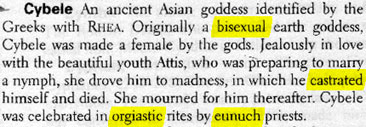
The Woman’s Encyclopedia of Myths and Secrets, Barbara G. Walker, 1983, pp. 77-79, “Attis”:
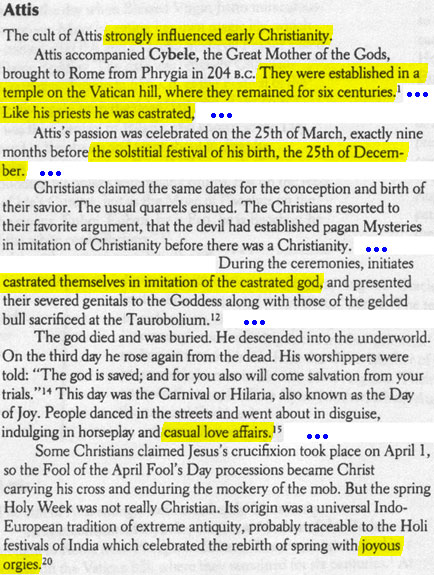
P. 202, “Cybele”:
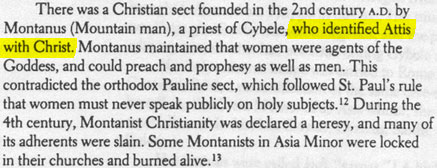
http://www.freerepublic.com/forum/a3b3a47345f84.htm, Do Parts of the Gospels Come From Pagan Mythology?, “Similarities between Pagan and Christian practices”:
According to an ancient Christian tradition, Christ died on MAR-23 and resurrected on MAR-25. These dates agree precisely with the death and resurrection of Attis. … Early Christians initiated converts in March and April by baptism. Mithraism initiated their new members at this time as well. Early Christians were naked when they were baptized. After immersion, they then put on white clothing and a crown. They carried a candle and walked in a procession to a basilica . Followers of Mithra were also baptized naked, put on white clothing and a crown, and walked in a procession to the temple. However, they carried torches. … There were many additional points of similarity between Mithraism and Christianity. 3 St. Augustine even declared that the priests of Mithraism worshiped the same God as he did
http://www.livejournal.com/community/ancient_gallae/644.html, The Cult of Cybele, “Rise and fall of the Cult”:
The early Christians were determined to destroy the cult and St Augustine condemns Her as a "demon" and a "monster" and the Gallae were "madmen" and "castrated perverts" (hardly an unbiased opinion). In the 4th century CE Valentinian II officially banned the worship of Cybele, and many of her followers perished at the hands of zealous Christians.
Justinian (c. 482–565 AD) continued the persecution of the cult and the Gallae. Under his reign, transgendered persons, and those indulging in same sex eroticism had their property confiscated, sacred texts burned, temples raised; they were tortured, forced to commit suicide, or burned alive.
By the start of the 6th century CE, the Cult and the ancient Gallae were extinct. Elements of the cult were transferred into Christianity in a manner similar to that of Isis. There is a much of Cybele and Isis in the Virgin Mary.
Encyclopedia of the Roman Empire, Bunson, Facts On File, 1994, p. 121, “Cybele”:
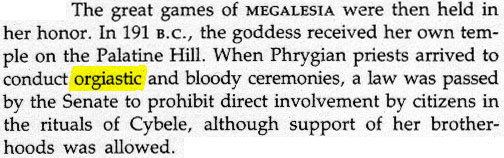
The Herder Dictionary of Symbols, 1993, p. 17, “Baptism”:

Again, I’ve never found a perfect person or culture to follow; hence, making it available for me to create. Pagan baptism was utilized by God / Jesus only for me to use to compare their most noteworthy theme: licentious orgies. It does not mean that everything these pagan religions did was Godly.
Bibliotheca Classica; or, A Classical Dictionary, containing A full Account of all the Proper Names, Lemprière, 1788, (no page numbers), “Cybele”:
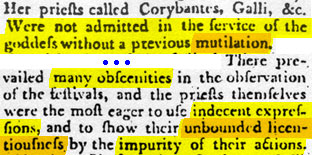
Mutilation was their castration.
http://47.1911encyclopedia.org/H/HE/HERA.htm (The 1911 Edition Encyclopedia [Britannica]), Hera:
She visits his sins upon the children born of his intrigues, and is thus the constant enemy of Heracles and Dionysus. … Hera had little to do with agriculture, and was not closely associated with such deities as Cybele, Demeter, Persephone and Dionysus, whose connection with the earth, or with its fruits, is beyond doubt.
Hera (Juno in Roman myth) was the goddess of marriage.
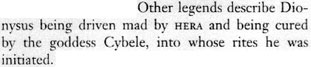
Dictionary of Roman Religion, Adkins, 1996, p. 62, “Dionysus”:
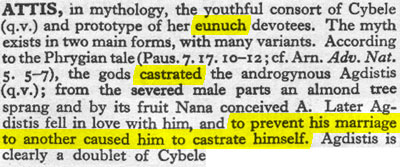
The Oxford Classical Dictionary, 1949, p. 119, “ATTIS”:
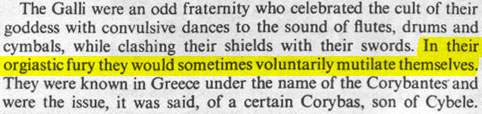
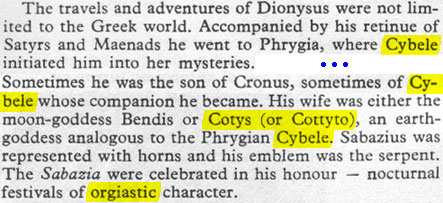
New Larousse Encyclopedia of Mythology, 1968, p. 150, “Divinities of the Earth: Gaea, Rhea and Cybele”:
Allen’s Synonyms and Antonyms, 1920, p. 304, “orgiastic”:

http://dictionary.reference.com/search?q=corybantic (Dictionary.com), “corybantic”:
A priest of the Phrygian goddess Cybele whose rites were celebrated with music and ecstatic dances.
Handbook to Life in Ancient Rome, Adkins, 1994, p. 289, “Cybele”:
Myth: Myth and Legends of the World Explored, McLeish, 1996, p. 134, “Cybele”:
Dictionary of Mythology Folklore and Symbols, Jobes, 1961, Vol. 1, p. 400, “Cybele (Cybebe, Cybelle, Kybebe, Kybele)”:
P. 445, “Dindymene (Dindymus)”:
P. 530, “Eunuch”:

Funk & Wagnalls Standard Dictionary of Folklore, Mythology and Legend, 1972, p. 271, “Cybele”:
Dictionary of Roman Religion, Adkins, 1996, p. 53, “Corybantes”:
http://www.amica2.it/tecno/cibele.htm, Cibele, “Cenni mitologici (Mythological signs)”:
I sacerdoti di Cibele erano detti "Galli" e "Coribanti" ed in suo nome officiavano dei culti orgiastici.
Translated from Italian:
The clergymen of Cibele were called "Galliums" and "Coribanti" and in their name officiated of the orgiastic cults.
http://www.newadvent.org/cathen/11388a.htm (Catholic Encyclopedia), Paganism:
in a questionable alliance with the orgiastic cult of the mistress of Attis
Who’s Who in Greek and Roman Mythology, Kravitz, 1976, p. 67, “Corybantes”:
The New Century Cyclopedia of Names, Barnhart, 1954, Vol. 1, p. 1160, “Cybele”:
Crowell’s Handbook of Classical Drama, Hathorn, 1967, p. 103, “Cybele or Cybebe”:

Crowell’s Handbook of Classical Mythology, Tripp, 1970, p. 180, “Cybele or Cybebe”:

http://www.everything2.com/index.pl?node_id=213574, “Corybant”:
Their rites tended toward wild, usually orgiastic, celebrations wherein they would dance wildly to flute and drum music, two instruments sacred to Cybele. These rituals, rumored to have the ability to cure insanity in those participating, appear reminiscent to those of Bacchus (aka Dionysus in Greek), albeit with less alcohol and more sex. Both Aristophanes and Euripides provide literary supports for the similarity in rites, comparing the Corybants as insane hedonists to the Bacchanale's/Maenids' drunkenness.
Larousse Encyclopedia of Mythology, 1959, pp. 180-181, “Dionysus”:
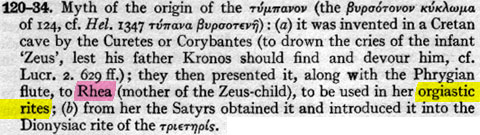
Euripides Bacchae, E. R. Dodds, Oxford University Press, 1944, p. 80, “Commentary”:
http://www.ccg.org/english/s/p235.html (Christian Churches of God), The Origins of Christmas and Easter, “The Christmas Tree”:
Pine nuts were used to produce a wine used in the orgiastic rites of Cybele which were in effect counterparts of the Dionysian orgies and Strabo compared them (Strabo, x, 3. 12 ff).
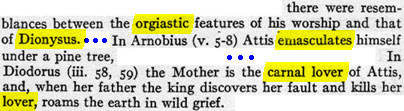
The Encyclopaedia Britannica, 1910, Vol. 2, p. 866, “Attis”:
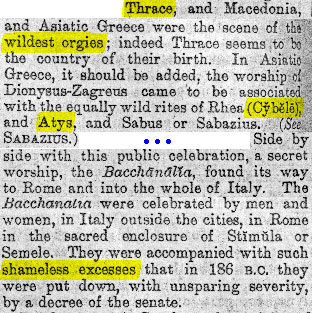
Dictionary of Classical Antiquities, Seyffert, 1956, pp. 192-194, “Dionysus”:
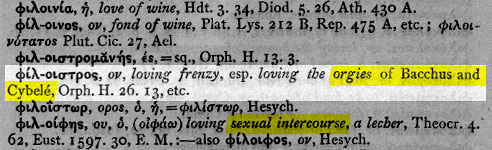
A Greek-English Lexicon (unabridged), Liddell & Scott, Oxford, 1871, p. 1759:
http://dictionary.laborlawtalk.com/Cybele, Cybele:
Cybele's most ecstatic followers were castrated males called Galli by the romans, who led the people in orgiastic ceremonies with wild music, drumming and dancing and drink. She was associated with the mystery religion concerning her son, Attis, who was castrated and resurrected. The dactyls were part of her retinue. Other followers of Cybele, Phrygian kurbantes or Corybantes expressed her ecstatic and orgiastic cult in music especially drumming, clashing of shields and spears, dancing, singing, shouts, all at night. …
Cult history: Overview: Anatolia, Greece and Rome
Cybele's cult in Greece was closely associated with, and apparently resembled, the cult of Dionysus
http://www.worldbookonline.com/wb/Article?id=ar380000&st=Cybele:
Mysteries, in religion, are secret ceremonies. … Those who are initiated promise never to reveal the group's secret ceremonies and doctrines. … Other mysteries practiced in ancient times were connected with the worship of the god Dionysus in Greece or the goddesses Cybele and Isis in Rome. Mysteries also became part of religious worship in early Christianity. Christians received the Eucharist in secret rituals. However, after Christianity became the official religion of the Roman Empire in the early 300's, the sacraments became more public.
http://www.in2greece.com/english/historymyth/mythology/names/cybele.htm, Cybele:
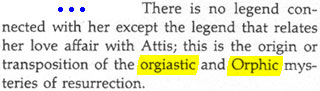
She was also considered to be the mother of the mystic Dionysos Sabazius, that the Orphic mystery cult principally worshipped.
Larousse Greek and Roman Mythology, English translation 1980, p. 74, “Cybele”:
A Greek-English Lexicon with a Revised Supplement (unabridged), Liddell & Scott, Oxford, 1996 (first edition 1843), p. 1004, “Κυβέλη”:
http://pintday.org/ebooks/suetonius/caesars-augustus.shtml, The Lives of the Twelve Caesars:
A small drum, beat by the finger or thumb, was used by the priests of Cybele in their lascivious rites and in other orgies of a similar description, These drums were made of inflated skin, circular in shape, so that they had some resemblance to the orb which, in the statues of the emperor, he is represented as holding in his hand. The populace, with the coarse humour which was permitted to vent itself freely at the spectacles, did not hesitate to apply what was said in the play of the lewd priest of Cybele, to Augustus, in reference to the scandals attached to his private character. The word cinaedus, translated “wanton,” might have been rendered by a word in vulgar use, the coarsest in the English language, and there is probably still more in the allusion too indelicate to be dwelt upon.
http://www.ourladyswarriors.org/dissent/defpagan.htm, Definition of Paganism:
Mithraism (q.v.) is usually regarded as a rival to nascent Christianity; but Nature Worship ruined its hopes of perpetuity. "Mithra remained", says S. Dill, "inextricably linked with the nature-worship of the past." This connexion cleft between it and purer faiths "an impassable gulf" which meant its "inevitable defeat" ("Roman Soc. from Nero to Aurel.", London, 1904, pp. 622 sqq.), and, "in place of a divine life instinct with human sympathy, it had only to offer the cold symbolism of a cosmic legend" (ibid.). Its very adaptability, M. Cumont reminds us, "prevented it from shaking itself free from the gross or ridiculous superstitions which complicated its ritual and theology; it was involved, in spite of its austerity, in a questionable alliance with the orgiastic cult of the mistress of Attis
http://www.sacredsource.com/prodinfo.asp?number=DDP, Sacred Source: Ancient Images, Ancient Wisdom, “Dionysus Satyr maenad Plaque 10””:
DIONYSUS
-- God of Ecstatic Devotion
Bacchus, or Greek Dionysus, came to Europe from Crete and is thought to be the indigenous vegetation
God and consort of the Mother Goddess later displaced by patriarchal Jupiter. His mystery school was closely linked with that of
Goddess Cybele, brought to Rome from Asia Minor. Both enjoyed flamboyant oriental priestesses
and priests, clashing cymbals and blowing twisted reeds as they danced barefoot
with ecstatic abandon.
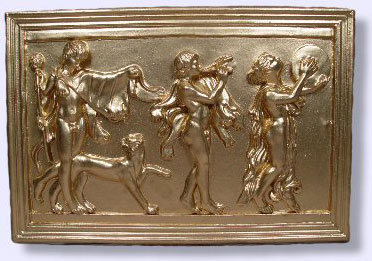
This plaque shows Dionysus in procession with an aulos-playing Satyr and
drumming Maenad, and is the inspiration for our frame drum design. The Maenad women drummers, filled with erotic longing
for union with Dionysus, developed a
reputation for unbridled licentiousness
and the ability to invoke trance with rhythm. Our word orgy comes from the annual Roman celebration of Bacchanalia corresponding with the fermenting of wine.
Stands and hangs. [Roman Relief 100 C.E.]
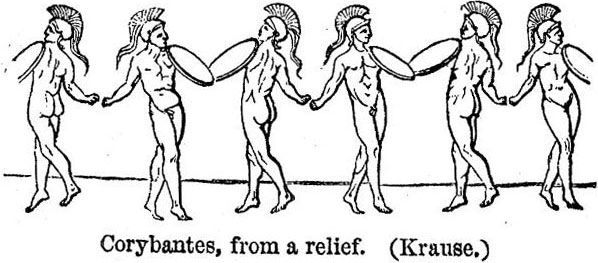
http://www.perseus.tufts.edu/cgi-bin/image?lookup=1999.04.0063.fig20593, “Corybantes, from a relief. (Krause.) Image from A Dictionary of Greek and Roman Antiquities (1890) (eds. William Smith, LLD, William Wayte, G. E. Marindin)”:
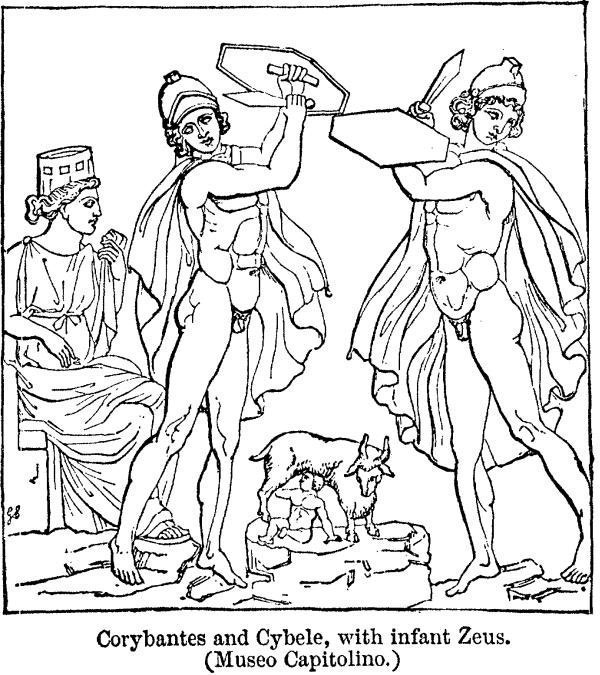
http://www.perseus.tufts.edu/cgi-bin/image?lookup=1999.04.0063.fig10553, “Corybantes and Cybele, with infant Zeus. (Museo Capitolino.)”:
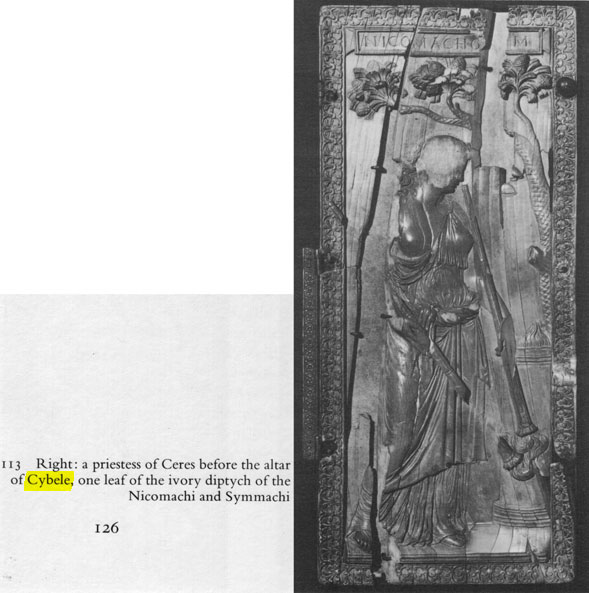
The Origins of Christian Art, Gough, 1973, p. 126, illustration 113, “From Constantine to Justinian”:
P. 209, “List of Illustrations”:
Divine Mirrors: The Virgin Mary in the Visual Arts, Katz, Oxford, 2001, p. 134, “Mary and the Ancient Goddesses”:
Early Christian Art, W. F. Volbach, 1961, p. 28 (for 107 only):
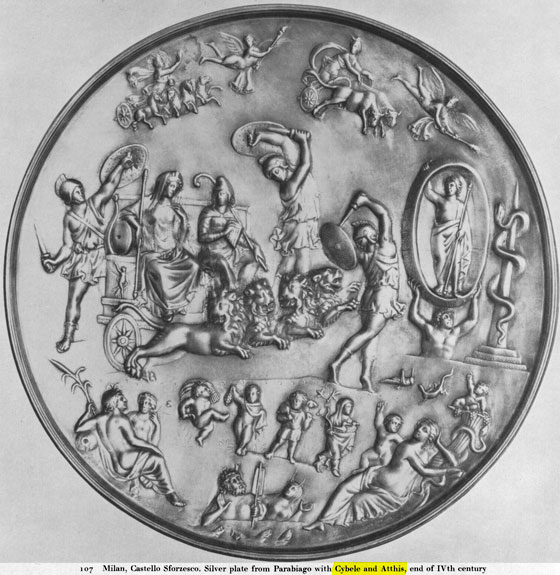
Early Christian Art, W. F. Volbach, 1961, plate 107, “Milan, Castello Sforzesco. Silver plate from Parabiago with Cybele and Atthis, end of IVth century”:
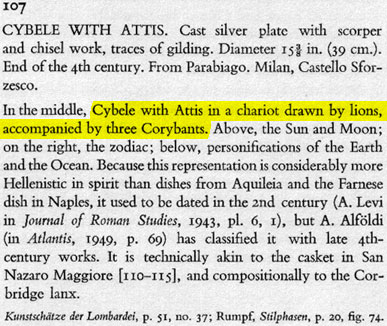
Early Christian Art, W. F. Volbach, 1961, p. 331, “Notes to the Plates”:
The Oxford History of Classical Art, Boardman, 1993, p. 366, illustration 379, “Cybele”:
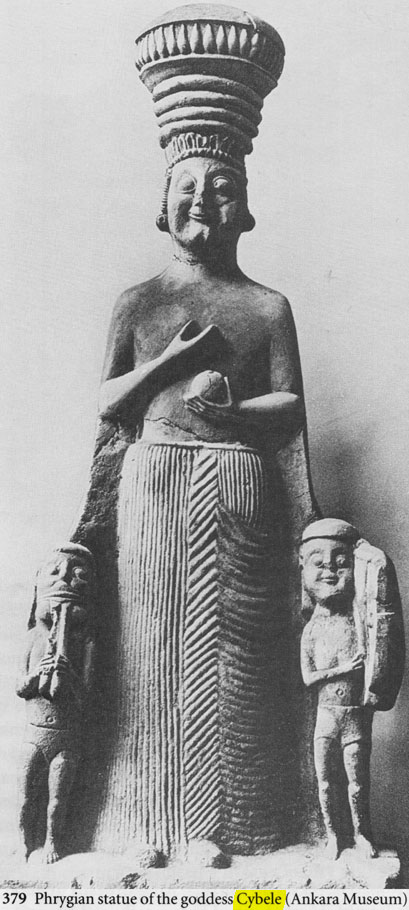
Fine lookin’ woman.
http://www.xenohistorian.faithweb.com/church/xr01.html, A History of Christianity: Chapter 1: THE DEVELOPMENT OF THE EARLY CHURCH: 1 to 300 A.D., “Competitors to Christianity”:
The cult of Asia Minor's hundred-breasted fertility goddess, Cybele ("Diana of the Ephesians" in the book of Acts), was introduced to the Romans just before 200 B.C. She was permitted to stay because some thought she had driven away Hannibal, but many had misgivings about her. Cybele was worshiped in orgies where dancers went crazy and cut themselves with swords and knives. Her temple in Ephesus figured prominently in Paul's third missionary journey, and his subsequent letter to the Ephesians talked about spiritual warfare because he was writing to believers living in a city dominated by the occult.
Cybele was never as popular as her Egyptian counterpart, Isis, a more gracious and gentle deity.
http://xenohistorian.faithweb.com/neareast/ne08.html, A General History of the Middle East: Chapter 8: ZOROASTRIANS, PAGANS, AND CHRISTIANS, “Competitors to Christianity”:
The cult of Asia Minor's fertility goddess, Cybele ("Diana of the Ephesians" in the book of Acts), was first brought to Rome during the Second Punic War. The Romans let her stay because some thought she had driven away Hannibal, but many had misgivings about her. Cybele's worshipers took part in orgies where dancers went crazy and cut themselves with swords and knives; soon participation in them was forbidden to Roman citizens.
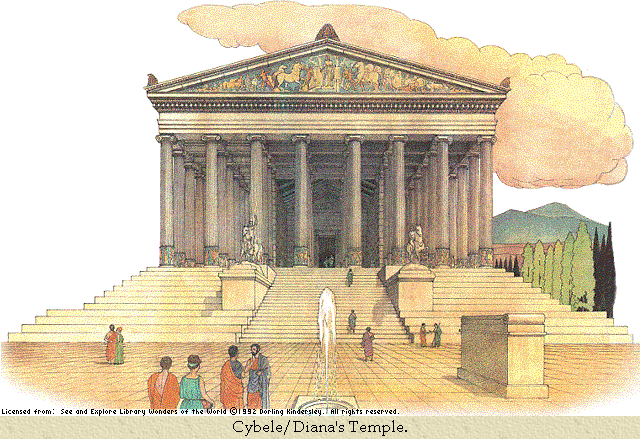
Later on, the laws were relaxed and Cybele gained a new following, but she was never as popular as her Egyptian counterpart, Isis, a more gracious and gentle deity. Romans, especially Roman women, were drawn to the 10-day initiation ceremonies of Isis, where the main event was a play that acted out the story of the death & rebirth of her husband, Osiris. This miraculous resurrection, supposedly achieved by the grief and faithfulness of Isis herself, was what made her cult appealing; her followers believed that their participation in the rites gained them immortality as well.