LUCIANUS
THE TRUE HISTORY, Book 2:25/122; and ZEUS TRAGOEDUS 2
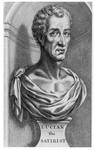
Lucianus (a.k.a. Lucian of Samosata / Lucianus Samosatensis), c. AD 120-190, was a secular Greek author.
Agape in context with erotica, c. 160 AD
Agape (Greek: αγαπ… or ηγαπ…)
Eros (Greek Ερως or ερως; ερωτικός [erotic])
THE TRUE HISTORY, Book 2:25/122
His story is about Cinyras, king of Paphos, in Cyprus, who was one of the suitors of Helen (of Troy), of the Trojan War era:
http://www.sacred-texts.com/cla/luc/true/tru02.htm, A True Story, by Lucian of Samosata; parallel English/Greek: Book II (translated by A.M. Harmon, 1913):
Six months had passed and it was about the middle of the seventh when sedition arose. Cinyras, the son of Scintharus, a tall and handsome lad, had long been in love with Helen, and it was no secret that she herself was madly enamoured (agape) of the boy. For instance, they often winked to one another at table, drank to each other and got up together and wandered about the wood. Well, one fine day through love (erotica) and despair Cinyras determined to rape Helen--she agreed to it--and go to one of the islands in the offing, either Cork or Cheesie. As accomplices they had long ago taken on three of the most reckless of my comrades; but Cinyras did not inform his father, for he knew that he would not let him do it. When they had come to. a decision, they carried out their stratagem. It was at nightfall, and I was not on hand, as I chanced to be taking a nap under the table. Without the knowledge of the rest they carried Helen off and put to sea in haste.
http://www.sacred-texts.com/cla/luc/wl2/wl213.htm, Works of Lucian, Vol. II: The True History: Book II (translated by Fowler, Oxford, 1905):
We were in the middle of our seventh month, when an incident happened. Scintharus's son, Cinyras, a fine figure of a man, had fallen in love with Helen some time before, and it was obvious that she was very much taken (agape) with the young fellow; there used to be nods and becks and takings of wine between them at table, and they would go off by themselves for strolls in the wood. At last love (erotica) and despair inspired Cinyras with the idea of an elopement. Helen consented, and they were to fly to one of the neighbouring islands, Cork or Cheese Island. They had taken three of the boldest of my crew into their confidence; Cinyras said not a word to his father, knowing that he would put a stop to it. The plan was carried out; under cover of night, and in my absence--I had fallen asleep at table--, they got Helen away unobserved and rowed off as hard as they could.
In French:
http://www.mediterranees.net/mythes/lucien/histoire2.html, Lucien de Samosate, “Histoire véritable II (True History II)”:
25. Déjà six mois s'étaient écoulés, et nous étions au milieu du septième, lorsqu'il survint un événement imprévu. Cinyre, fils de Scintharus, garçon bien fait et de jolie figure, était devenu depuis longtemps amoureux d'Hélène, qui, de son côté, laissait entrevoir la passion (agape) la plus vive pour ce jeune homme. Souvent ils se faisaient des signes pendant le repas, buvaient à la santé l'un de l'autre, et se levaient de la table pour aller s'égarer tête à tête dans la forêt. Vaincu par la violence de son amour (erotica) et par la difficulté de le satisfaire, Cinyre forma le projet d'enlever Hélène et de s'enfuir avec elle. Elle y consentit, et ils résolurent de se réfugier dans quelqu'une des îles voisines, soit à Phello, soit à Tyroessa. Ils avaient mis depuis longtemps dans le secret trois de mes compagnons les plus déterminés. Mais Cinyre n'en avait rien dit à son père : il se doutait bien que celui-ci mettrait obstacle à ses desseins. Comme ils l'avaient conçu, ils exécutent leur projet. La nuit venue, au moment où j'étais absent et endormi dans la salle du festin, ils arrivent à l'insu de tous, emmènent Hélène avec aux et se hâtent de gagner le large.
Translated from French:
25. Already six months had been passed, and we were in the middle of the seventh, when it occurred an unforeseen event. Cinyras, son of Scintharus, boy well done and of pretty face, had become since a long time lover of Helen, who, on her side, let foresee the sharpest passion (agape) for this young man. Often they were making signs during the meal, drank to health of each one other, and rose table to go to be mislaid head with head in the forest. Overcome by the violence of its love (erotica) and the difficulty of satisfying it, Cinyras formed the project to remove Helen and to flee with her. She agreed to it, and they solved to take refuge in some one of the close islands, either in Phello, or in Tyroessa. They had put for a long time in the secrecy three of my most determined companions. But Cinyras had not said anything of it to his father: he suspected well that this one would put obstacle to his intentions. As they had conceived it, they carry out their project. The come night, the moment I was absent and gone to sleep in the room of the feast, they arrive without the knowledge of all, take along Helen with to and hasten to gain the broad one.
The Original Greek Text (in clear depiction):
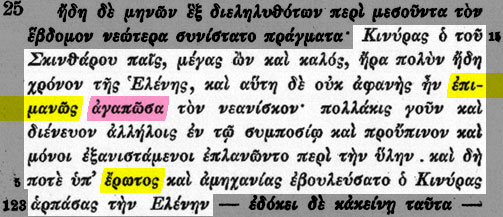
Lucianus, Edidit (published by) Nils Nilén, In Aedibus (in the houses of) B. G. Teubneri, Lipsiae, 1513; Vol. 1, Fasc. 1, 1906, pp. 186-187, “ΑΛΗΘΩΝ ΔΙΗΓΗΜΑΤΩΝ Β (TRUE SHORT STORIES / NARRATIONS B)” (Latin cover: “VERAE NARRATIONES II”), Book II: 25 / 122:
In text:
Κινύρας ό του Σκινθάρου παις, μέγας ων και καλός, ηρα πολυν ηδη χρόνον της 'Ελένης, και αυτη δε ούκ αφανης ην έπιμανως άγαπωσα τον νεανίσκον πολλάκις γουν και διένευον άλλήλοις έν τω συμποσίω και προυπινον και μόνοι έξανιστάμενοι έπλανωντο περι την υλην. και δη ποτε ύπ' ερωτος και άμηχανίας εβουλεύσατο ό Κινύρας άρπάσας την Ελένην
My translation from Greek:
|
Κινύρας |
Cinyras (or Kinyras) (a ruler of Cypress) |
|
ό |
that, which |
|
του |
of the |
|
Σκινθάρου |
Scintharus’s |
|
παις, |
son, descendant; a child, a boy (masc) |
|
μέγας |
large |
|
ων |
being, existing |
|
και |
and, also, too, even |
|
καλός, |
beautiful fair, (masc) |
|
ηρα |
raised, elevated, rendered prominent |
|
πολυν |
greatly, much |
|
ηδη |
by this time; before this time, already been; already from this time: before the |
|
χρόνον |
time, duration, period, term |
|
της |
of |
|
‘Ελένης, |
Helen, |
|
και |
and, also, too, even |
|
αυτη |
she |
|
δε |
but |
|
ούκ |
not |
|
αφανης |
obscure, unapparent, inconspicuous |
|
ην |
to be |
|
έπιμανως (adverb) (form of έπιμαινομαι / έπιμαινω) |
mad after a thing, raving, mad, to be madly in love with, lascivious, to be mad after, dote upon, madly desirous (best source: Liddell-Scott, 1871) |
|
άγαπωσα |
agape love |
|
τον |
the, that |
|
νεανίσκον. (form of νεανίας) |
young man., youth, lad, adolescent, mere young |
|
πολλάκις |
Often, many times |
|
γουν |
at least, at any rate, of course, for instance, yet, any way |
|
και |
and, also, too, even |
|
διένευον (?) |
flirted and toasted (?: I couldn’t find Greek word – entry is based on English translations above) |
|
άλλήλοις |
one another, each other |
|
έν |
in, at |
|
τω |
thereupon, in this cause, accordingly |
|
συμποσίω (form of συμπόσιον) |
symposium, a drinking party |
|
και |
and, also, too, even |
|
προυπινον |
beforehand, exist before, previous, pre-existence |
|
και |
and, also, too, even |
|
μόνοι |
alone |
|
έξανιστάμενοι |
I revolt, I rise against, emit in an upward direction, to make one rise from his seat |
|
έπλανωντο (form of πλαναω) |
for the error which they erred, of the abominations that they have committed, lead astray, mislead; leading astray, cheating; deceive, wander in mind; lead away from the right path |
|
περι |
all round about; about, around |
|
την |
the, that |
|
υλην. (form of υλη) |
the forest, woods. |
|
και |
And, also, too, even |
|
δη |
indeed, of course, already (with a sense of urgency) |
|
ποτε |
at one time, once, at some unknown point in time, in the past, in time past |
|
ύπ’ (same as ύπό) |
by, from, under, in the course of, during, with, among |
|
ερωτος |
erotica (sexual intercourse) |
|
και |
and, also, too, even |
|
άμηχανίας |
embarrassed, at a loss, puzzled, unmanageable, difficult to deal with |
|
εβουλεύσατο (form of βουλεύω) |
took counsel, deliberated, concerted measures, planned, devised, determined or resolved on, pondered, decided, determined with oneself, plotted to, be minded |
|
ό |
that, which, the |
|
Κινύρας |
Cinyras |
|
άρπάσας (form of άρπάζω) |
carry away (unlawfully), snatch up or away, carry off, to captivate, to seize unlawfully (which does not belong to oneself) |
|
την |
the |
|
Ελένην – |
Helen |
To explain in detailed English: They had the hots for each other (sexually).
Greek text can also be found at:
http://el.wikisource.org/wiki/%CE%91%CE%BB%CE%B7%CE%B8%CE%AE%CF%82_%CE%99%CF%83%CF%84%CE%BF%CF%81%CE%AF%CE%B1
You know, when they find an ancient human fossil (e.g., Ida “The Link”), it is exhausting analyzed in every possible way to tell its indisputable relation to other primate characteristics, so much so that religious leaders have to acknowledge its validity. But, the actual words of Christ don’t receive the same dignity. So, why does the evolution issue – that’s really irrelevant to how we should act today – have so much precedence over the instructions of Jesus Himself? Accordingly, there is a “Christian” museum in Eureka Springs, AR that acknowledges that dinosaurs once existed; but, super spin the time factor into saying they lived and died out within the last six thousand years. I’m sure they’ll do something with my findings once they are unable to just ignore the issue; but, hopefully I’ll be alive then to properly refute the spin. If I’m not, then they will simply win, as everyone “just trusts” them and our ancestors so much.
LUCIANUS: ZEUS TRAGOEDUS (aka: ZEUS THE TRAGEDIAN; JUPPITER TRAGOEDUS), 2:
C. 160 A.D. In sexual love context, “agape” is supposed to be in the original text:
http://www.sacred-texts.com/cla/luc/wl3/wl307.htm, ZEUS TRAGOEDUS, “2”:
2:
Hera. A truce to your passion, Zeus. We have not these good people's gift for farce or recitation; we have not swallowed Euripides whole, and cannot play up to you. Do you suppose we do not know how to account for your annoyance?
Zeus. Thou knowst not; else thy waitings had been loud.
Hera. Don't tell me; it's a love affair; that's what's the matter with you. However, you won't have any 'wailings' from me; I am too much hardened to neglect. I suppose you have discovered some new Danae or Semele or Europa whose charms are troubling you; and so you are meditating a transformation into a bull or satyr, or a descent through the roof into your beloved's bosom as a shower of gold; all the symptoms--your groans and your tears and your white face--point to love and nothing else.
Zeus. Happy ignorance, that sees not what perils now forbid love and such toys!
Hera. Is your name Zeus, or not? and, if so, what else can possibly annoy you but love?
(Research for original text someday.)